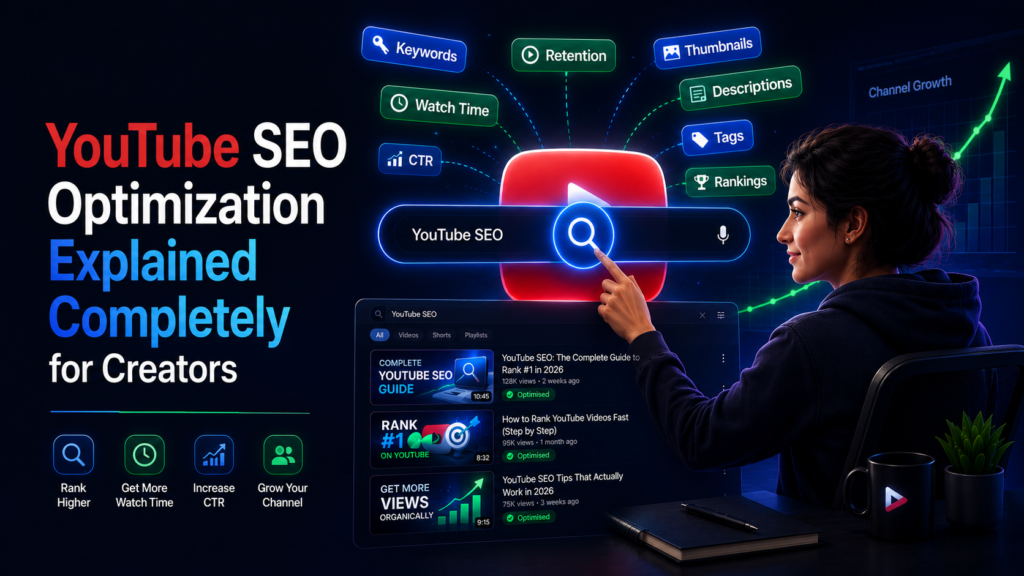
YouTube SEO Optimization Explained Completely for Creators Who Want to Rank in 2026
Posted on July 10, 2026 by Derek Harmon
I’ve spent a lot of time studying why some videos get thousands of views on day one while others — often better produced, better scripted, better everything — sit at 47 views a week after upload. The difference, more often than not, comes down to one thing: YouTube SEO optimization. Not thumbnails alone, not the algorithm, not luck. A consistent, structured approach to making videos findable.
YouTube processes over 3 billion searches every single month. Nearly 70% of total watch time on the platform comes from algorithm-driven recommendations rather than direct searches. That means you’re not just optimising for a search box — you’re optimising for a system that actively decides whether your content deserves to be pushed to new audiences it never would have reached otherwise.
This guide covers the whole thing. Not just titles and tags — those are table stakes. We’re going to go through keyword research, on-page optimisation, thumbnails, watch time, retention, channel-level SEO, and the signals most creators ignore completely. By the end, you’ll have a clear picture of what YouTube SEO actually requires in 2026 — not a surface-level list, but a working understanding you can apply to every video you publish from here.
What YouTube SEO Optimization Actually Means in 2026
Let me be clear about something first: YouTube SEO is not what it was in 2016, when stuffing keywords into tags and writing a long description was enough to rank. The platform has fundamentally changed how it evaluates content.
YouTube’s algorithm in 2026 operates less like a traditional search engine and more like a prediction engine. Its primary goal is to predict what a user is most likely to watch next — and for how long. It uses that prediction to decide which videos to show in search results, the home feed, suggested videos, and Shorts. Every signal it collects feeds that prediction.
This means YouTube SEO optimization in 2026 sits at the intersection of two things working simultaneously:
Search optimisation — helping your video appear when someone types a query into YouTube’s search bar. This is metadata-driven: keywords in your title, description, tags, and captions that match what people are actually searching for.
Recommendation optimisation — convincing the algorithm that your video satisfies viewers enough to push it to new audiences who didn’t search for it at all. This is behaviour-driven: watch time, audience retention, click-through rate, engagement.
Here’s the critical insight that most SEO guides miss: these two paths are not separate strategies. They feed each other. A video that ranks in search generates real views. Real views generate real watch time and engagement data. That data tells the recommendation algorithm this content satisfies viewers. The recommendation algorithm then pushes it further. The compound effect of search optimisation triggering recommendation distribution is what separates videos that plateau from videos that keep growing months after they’re published.
Understanding how the YouTube algorithm actually works before touching any other optimisation element is the most efficient starting point — because every other decision you make should be building toward the signals the algorithm uses.
The YouTube SEO Ranking Factors That Actually Matter
After going through everything the research says and watching what actually works on channels across different niches, here are the ranking factors that genuinely move the needle in 2026 — ranked by real-world impact:
- Click-Through Rate (CTR)
CTR is your video’s first impression — the percentage of people who click your video when they see it as an impression in search or suggested feeds. YouTube uses CTR as one of its earliest and strongest signals about whether a video deserves more distribution. A video with a 7% CTR gets dramatically more impressions than an identical video with a 2% CTR, because the algorithm interprets high CTR as evidence that viewers find the content relevant and interesting.
Average CTR across YouTube sits between 2% and 10%, with well-optimised videos in competitive niches targeting 5–8% or higher. Your thumbnail and title together determine almost your entire CTR — and we’ll cover both in depth below.
- Watch Time and Average View Duration
Watch time is the total minutes viewers spend watching your video. Average view duration is the average time each viewer spends watching, expressed in minutes or as a percentage of the video’s total length.
Both matter, but they work differently. Total watch time contributes to your channel’s overall authority with the algorithm. Average view duration as a percentage tells YouTube whether your specific video satisfied the viewers who clicked it. A video with 80% average view duration is almost always ranked and recommended more aggressively than an identical video with 20% duration — regardless of which one has more total views.
- Audience Retention
Audience retention is the second-by-second breakdown of how many viewers are still watching at each point in your video. It’s visualised as a curve in YouTube Studio’s analytics — and that curve is one of the most information-dense pieces of data YouTube has about your content.
A sudden drop at the 45-second mark tells YouTube’s algorithm that your hook failed. A gradual decline suggests pacing issues. A flat, consistently high retention curve signals genuinely valuable content that keeps viewers engaged. The algorithm pays particular attention to the first 30 seconds of every video — sharp early drop-offs are penalised significantly in distribution decisions.
Understanding what audience retention means and why it matters is fundamental to making informed decisions about how your videos are structured.
- Keyword Relevance in Metadata
Title, description, tags, captions, and spoken audio all contribute to how YouTube understands the topic of your video. In 2026, YouTube’s Natural Language Processing (NLP) has improved significantly — it reads transcripts and captions to understand context, not just isolated keywords in metadata. This is a significant shift from earlier years.
What this means in practice: keyword placement in your title and description still matters enormously, but verbatim keyword stuffing now works against you. YouTube’s AI is better at identifying forced, unnatural keyword placement, and it interprets that pattern as lower-quality content signals.
- Engagement Signals
Likes, comments, shares, saves, and subscribes that happen during or immediately after watching your video all contribute to the algorithm’s assessment of viewer satisfaction. Comments in particular carry meaningful weight — they indicate that a viewer engaged deeply enough with the content to write a response, which is a strong satisfaction signal.
A creator who responds to comments within the first 24–48 hours of upload generates additional comment activity and keeps the engagement loop active — which extends the period during which the algorithm actively tests the video with new audiences.
- Session Duration
YouTube cares not just about whether viewers watched your video, but about whether watching your video led them to keep watching more YouTube content. A video that initiates a long viewing session — where the viewer continues watching other videos, videos in your playlist, or even videos from other channels — contributes to what’s called “session watch time.”
Session watch time is one of the more underappreciated signals in YouTube SEO. A video that generates high session watch time earns more algorithmic favour than one where viewers watch and immediately close the app — even if both have similar individual retention metrics.
- Channel Authority and Topical Consistency
YouTube evaluates individual videos within the context of the channel they come from. A channel that has established consistent topical authority — uploading regularly within a specific niche and building a history of strong engagement signals in that area — earns what’s sometimes called “channel authority” or “niche credibility” with the algorithm.
This means a new video published by a channel with strong topical authority gets a distribution head-start compared to the same video published by a newer or broader channel. The algorithm borrows historical performance data from the channel’s existing content before the new upload has generated its own.
YouTube Keyword Research: How to Find What People Are Actually Searching For
Most creators pick topics based on what they want to talk about. The creators who grow systematically pick topics based on what their target audience is actively searching for — and then make videos they want to talk about within that demand space.
Here’s the keyword research process that works in 2026:
Start With YouTube Autocomplete
Type your core topic into YouTube’s search bar and don’t press enter. The dropdown suggestions are real search queries real people are typing right now. These autocomplete phrases are goldmines — they’re not invented by an algorithm, they’re populated by actual user behavior.
Start broad, then narrow. Type “YouTube promotion” and note what autocompletes. Then type “YouTube promotion for” and note the next level of suggestions. Each layer gets more specific, which usually means less competition and more qualified viewer intent.
Use TubeBuddy and VidIQ for Data
Tools like TubeBuddy and VidIQ layer search volume and competition scores directly onto YouTube’s interface. When you search any term, they show you an estimated monthly search volume and a competition rating — both of which are essential for knowing whether a keyword is worth targeting.
For newer channels (under 10,000 subscribers), targeting keywords with a competition score below 35–40 on a 100-point scale is realistic. Going after high-competition terms with under 1,000 subscribers means competing directly with established channels that have years of audience trust and algorithmic authority — a fight that’s very hard to win purely on SEO.
Study the Top Results for Your Target Keyword
Search your primary keyword and study the top 5–10 videos that rank for it. Pay attention to:
- The exact phrasing of their titles and how the keyword appears
- The length of their videos — this tells you what YouTube considers authoritative for this topic
- Their thumbnail approach — what visual patterns are working in this space
- Their view count and channel size — if all top results are from channels with 500K+ subscribers, that keyword is likely out of reach for a smaller channel right now
This competitor analysis tells you what “winning” looks like for that keyword, and helps you assess whether you can realistically compete or whether you should find a more specific angle.
Target Long-Tail Keywords Over Broad Terms
“How to grow on YouTube” is searched millions of times. It’s also dominated by enormous channels. “How to grow a YouTube gaming channel from zero in 2026” has less search volume — but the viewers searching it are more specifically matched to that content, which typically produces stronger retention and engagement when they find your video.
Long-tail keywords — three to five word phrases that are more specific than broad terms — almost always produce better quality engagement signals than high-volume broad terms, which means better algorithmic performance over time even if the raw view ceiling is lower.
For how to find trending keyword opportunities before they become competitive, see our guide on how to spot trending topics and keywords on YouTube.
Optimising Your Video Title for Search and Clicks
Your title serves two purposes at once: signalling relevance to YouTube’s search algorithm and compelling a human viewer to click. Both are required. A title that ranks but doesn’t get clicked delivers no traffic. A title that gets clicked by the wrong audience produces terrible retention data.
Here’s what works in 2026:
Put your primary keyword in the first half of the title. YouTube gives more weight to keywords that appear early in the title. “YouTube SEO Optimization: Complete Guide for Creators” is better than “The Complete Creator Guide to YouTube SEO Optimization” — the keyword leads.
Stay under 60 characters where possible. YouTube truncates titles in search results at around 60 characters. If your most important keyword phrase appears after the truncation point, most search viewers never see it. Mobile users — who account for over 70% of YouTube viewing — see even less.
Include the year for evergreen strategy content. Adding “2026” to tutorial and strategy videos significantly improves CTR because it signals freshness. A viewer comparing two identical videos — one with “2026” in the title and one without — will click the dated one more often in most niches.
Avoid clickbait. Titles that overpromise drive high initial CTR and terrible retention. YouTube’s algorithm sees through this pattern quickly — a video that gets clicked but not watched signals to the algorithm that the title was misleading, which suppresses future distribution. The short-term CTR gain is not worth the long-term algorithmic penalty.
The research behind what makes titles click is more detailed than most creators realise. What 10,000 YouTube videos reveal about titles that actually get clicked covers the data patterns that separate high-CTR titles from the ones that get scrolled past.
Writing a YouTube Description That Works
YouTube gives you 5,000 characters for your video description. Most creators use about 50, often something like “Subscribe for more!” This is one of the most consistently underused ranking opportunities on the platform.
Here’s how to approach it properly:
The first 150 characters are the most important. This is what appears in YouTube’s search result snippet — the preview text under your title before someone clicks. Write these 150 characters as if they were a meta description for a Google result: include your primary keyword, summarise the video’s value, and give viewers a reason to click.
Example: “This YouTube SEO optimization guide covers every ranking factor — from keyword research and title formulas to watch time strategy and thumbnail A/B testing — updated for 2026.”
That’s 168 characters — slightly over, but the priority content is front-loaded. Compare it to “In this video I’ll show you some SEO tips” — the keyword doesn’t appear, there’s no value proposition, and there’s no reason to click over the next result.
Use the full description body for keyword context, not keyword stuffing. The 5,000 characters following that opening are your opportunity to include secondary keywords, related terms, and semantic context that helps YouTube understand your video’s full topic scope. Write naturally — explain what the video covers, include timestamps, add links to related resources. YouTube’s NLP reads this content and uses it to match your video with a broader range of related searches beyond your single primary keyword.
Add timestamps for every major section. Chapters improve viewer experience significantly — viewers can navigate to the specific section they need, which reduces early drop-offs from people looking for one specific piece of information. YouTube also displays chapter timestamps in Google search results, giving your video additional SERP real estate beyond just the video listing itself.
Include relevant links. Links to related videos on your channel, your channel page, and your website (if applicable) extend the viewer’s journey within your content ecosystem. This improves session watch time and provides additional context signals to the algorithm.
Thumbnail Optimisation: The Most Important Visual Decision You Make
I’ve gone through a lot of testing and research on thumbnails, and the most honest summary I can give is this: your thumbnail determines whether your video gets clicked when shown to someone who has never heard of you. Everything else follows from that click. If the click doesn’t happen, no amount of quality content underneath it matters.
Custom thumbnails outperform auto-generated screenshots by a factor of 8–15x in CTR, consistently, across every niche. This isn’t a marginal difference. It’s the difference between a video getting seen and a video sitting invisible in a feed.
The elements of a high-CTR thumbnail in 2026:
A single clear focal point. Cluttered thumbnails fail at small sizes — and most YouTube viewers see your thumbnail at a size equivalent to about the size of your thumbnail on a mobile screen viewed from arm’s length. A single, clear focal point that works at that size is far more effective than a thumbnail packed with detail.
High contrast against YouTube’s interface. YouTube’s default colour palette is predominantly white, red, and grey. Thumbnails that use contrasting colours — electric blue, vivid orange, bright green — naturally stand out. This is not an accident among successful creators. It’s intentional visual design.
A maximum of three to four words of readable text. If a viewer has to read more than a few words to understand your thumbnail’s message, it’s already lost the battle with attention. Short, high-contrast text that reinforces the title’s value proposition is the target.
An expressive face when appropriate. Faces drive clicks in most content niches, because human attention is hard-wired to respond to faces faster than almost any other visual stimulus. The expression matters — neutral faces underperform compared to faces showing genuine emotion, surprise, or intensity.
A/B test your thumbnails. YouTube’s built-in Test & Compare feature serves two different thumbnails to equal portions of your impression audience and measures which generates better CTR over 10–14 days. This removes guesswork and gives you actual data on what works for your specific audience.
If you’re generating strong impressions but low clicks, the problem is almost always the thumbnail or title — or both working against each other. Why impressions are high but clicks are low covers exactly how to diagnose and fix this specific problem.
Tags, Hashtags, and Categories: What Still Matters and What Doesn’t
Tags used to be the primary SEO lever on YouTube. That was 2012. In 2026, their direct ranking impact has diminished significantly — YouTube’s NLP now reads your title, description, transcript, and spoken audio to understand content topic, and relies far less on tag hints than it once did.
That said, tags still provide value in two specific ways:
Alternative phrasings and spelling variants. Tags help YouTube understand that “YouTube SEO” and “YT SEO” and “YouTube search optimisation” refer to the same topic, which can extend your video’s reach to searches using slightly different phrasing.
The first tag carries the most weight. Put your exact primary keyword as your first tag. YouTube gives it more weight than subsequent tags, and it reinforces the core topic signal your title and description have already established.
Keep your tag list relevant and focused — 5 to 15 tags is enough. Don’t pad it with loosely related terms hoping for accidental traffic. Irrelevant tags confuse the algorithm rather than helping it.
Hashtags in the description are a separate signal. Three to five relevant hashtags in your video description are indexed and can help your video appear in hashtag browse pages — a low-effort additional discovery pathway. Don’t use more than five; excessive hashtags YouTube will actually disable hashtag display on your video.
Video categories should be set accurately based on your content. YouTube uses category data as an additional context signal. Miscategorising content (for example, categorising a cooking video under “Education” to access a different viewer pool) is the kind of manipulation the algorithm has become very good at detecting and deprioritising.
Watch Time Optimisation: Keeping Viewers Watching
Getting a click is step one. Keeping the viewer watching is step two — and it’s the step that determines whether the algorithm considers that click a successful match or a failed one.
The structure of your video matters as much as the content of it. Here’s what the retention data consistently shows:
The first 30 seconds are your highest-leverage real estate. Drop-off in the first 30 seconds is penalised more severely by the algorithm than drop-off later in the video. Your hook — the opening sequence that gives viewers a reason to stay — is the most important part of your video, even if it’s only 20 seconds long.
The hook formula that works across most niches: identify the core problem your video addresses, hint at the resolution without giving it away, and give viewers one specific reason why staying until a certain point will reward them. “Stay until the end because I’m going to show you the one mistake that tanks 90% of channels” keeps far more people watching than “welcome to my channel, in this video we’re going to talk about SEO.”
Pattern interrupts maintain attention. Every 60 to 90 seconds, something needs to change — a new visual element, a shift in framing, a transition, a graphic, a change in pacing. The human attention system is wired to disengage with predictable, repetitive stimuli. Pattern interrupts reset that attention cycle.
Remove all filler ruthlessly. Every second a viewer sits through content that isn’t delivering value is a second closer to them clicking away. Long-winded introductions, repeated explanations, excessive “umm”s and filler phrases — all of these erode retention and signal to the algorithm that the content isn’t dense enough with value. The fastest-growing channels in 2026 are almost always the most tightly edited.
For YouTube Shorts specifically, the retention mechanics are completely different. Shorts are ranked primarily on completion rate and loop count — whether viewers watch to the end and whether they watch it multiple times. How to fix low audience retention on YouTube Shorts covers the specific Shorts retention strategies, which require a different approach from long-form.
The Reason Some Videos Rank in Search But Never Get Recommended
One of the most common frustrations I hear from creators is: “My video ranks on page one for my keyword, but it stopped getting views after the first week.” This is the search-to-recommendation gap, and it’s more common than most guides acknowledge.
The explanation is straightforward: search optimisation and recommendation optimisation are not the same process. A video can be perfectly optimised for search discovery while still generating engagement signals that are too weak for the recommendation algorithm to push it to new audiences.
This usually happens when:
- The video title is keyword-optimised but attracts search viewers who aren’t genuinely interested in the full content (leading to high CTR but poor retention)
- The video answers a narrow, specific search query but doesn’t have broad appeal beyond that specific query
- The channel lacks the topical authority history that would allow the recommendation algorithm to confidently push the video to new audiences
The solution requires optimising for both pathways simultaneously — not choosing between them. Strong keyword relevance in metadata to trigger search visibility, paired with compelling hook structure and dense value delivery to generate the engagement signals that trigger recommendation distribution.
Why your video ranks in search but doesn’t get recommended covers this specific scenario in detail — including exactly how to diagnose which factor is limiting your distribution and what to do about it.
Channel-Level SEO: What Most Creators Completely Overlook
Individual video optimisation is necessary. Channel-level optimisation is what compounds it.
YouTube evaluates your channel as a whole unit when deciding how much organic reach to extend to new uploads. A channel with a clear, consistent topical identity, strong historical engagement signals, and well-structured playlists starts every new video with an algorithmic head start — the algorithm borrows from the channel’s track record before the new video has generated its own data.
Here’s what channel-level SEO covers:
Channel description and keywords. Your channel description and the keywords set in your channel settings contribute to how YouTube categorises your channel in its topic taxonomy. Include your primary niche keyword naturally in the first couple of sentences of your channel description. Set 3–5 relevant channel keywords in YouTube Studio → Customisation → Basic Info.
Playlist architecture. Playlists are one of the highest-leverage, lowest-effort SEO tools available — and most channels use them poorly or not at all. A well-structured playlist does three things: it organises your content for viewer navigation, it generates session watch time when viewers auto-queue through multiple videos, and it provides YouTube with additional topical context about your channel’s content clusters.
Name playlists with keyword-rich, descriptive titles rather than vague ones. “YouTube Growth Guide for Beginners” outperforms “My YouTube Videos” in terms of both viewer clarity and algorithmic context. Channels with five or more organised playlists consistently generate more session watch time than channels without them.
Consistent upload frequency. The algorithm models your channel’s upload pattern and learns to expect new content on a certain cadence. Channels that maintain a consistent, predictable schedule get crawled and indexed faster than channels with irregular publishing patterns. Consistency doesn’t mean daily — it means reliable. Once a week, consistently, outperforms three videos this week and nothing for six weeks.
Channel trailer and page optimisation. A well-set-up channel page converts new visitors to subscribers at meaningfully higher rates than a sparse or confusing one. For a full audit of everything that should be optimised at the channel level, how to optimise your YouTube channel in 2026 covers every element with a clear checklist.
Captions, Transcripts, and Spoken Keywords
Here’s something that’s become significantly more important in 2026 and most creators still haven’t adjusted for it: YouTube’s AI indexes your video’s spoken audio.
This means the keywords and phrases you say out loud in your video contribute to how YouTube categorises and surfaces it, not just the keywords in your written metadata. A video that mentions its target keyword naturally in the spoken content within the first 60 seconds of the video reinforces the topic signal the title and description have already established — and that reinforcement matters.
Auto-generated captions are YouTube’s default and they’re reasonably accurate for clear audio. But manually uploaded transcripts or reviewed auto-captions perform better for SEO purposes because they’re more accurate, particularly for technical terminology, proper nouns, and non-standard phrasing that auto-captions frequently misinterpret.
The practical implication: say your primary keyword naturally in your introduction. Don’t script it awkwardly — find a way to use it in your opening that flows naturally. “In this guide I’m going to walk you through YouTube SEO optimisation from the ground up” accomplishes this without sounding like a robot reading a keyword brief.
For Shorts, captions displayed on-screen are now nearly universal — both because viewers often watch without audio and because on-screen captions have been demonstrated to improve completion rate, which is one of Shorts’ primary ranking signals.
YouTube SEO and Google: The Cross-Platform Connection
Something that’s easy to overlook: YouTube is owned by Google. Well-optimised YouTube videos can rank in Google search results, appear in Google’s “Videos” tab, and get cited in Google AI Overviews for relevant queries. This cross-platform visibility is a significant source of additional views for videos that earn it.
The videos that rank on Google tend to share several characteristics: they have clear, keyword-aligned titles and descriptions, strong engagement signals on YouTube itself, and timestamps that Google can display as chapter markers in search results. Videos embedded on external websites also generate a Google indexing signal — each embed is a signal to both Google and YouTube that the content has third-party relevance.
VideoObject schema markup — a structured data element that provides explicit metadata about your video to Google’s indexing systems — is increasingly important for Google placement. Most YouTube SEO guides ignore this entirely. If your channel has a website presence, adding VideoObject schema to any page where you embed your videos significantly improves Google’s ability to index and rank those videos in web search.
The Complete YouTube SEO Optimisation Checklist
Before every upload, run through this checklist. It covers every element we’ve discussed above and takes about 15 minutes when you’re used to it:
Before Filming:
- [ ] Keyword research completed — primary keyword identified with realistic search volume and competition
- [ ] Title drafted with primary keyword in first half, under 60 characters, compelling for human CTR
- [ ] Competitor analysis done — top results reviewed for topic angle, length, and thumbnail style
During Production:
- [ ] Primary keyword spoken naturally within the first 60 seconds
- [ ] Hook structure planned — problem, tease, reason to stay — in the first 30 seconds
- [ ] Pattern interrupts planned every 60–90 seconds
- [ ] CTA placed at a moment of high viewer satisfaction, not at the start
At Upload:
- [ ] Custom thumbnail uploaded (not auto-generated frame)
- [ ] Title: primary keyword front-loaded, under 60 characters, no clickbait
- [ ] Description: keyword in first 150 characters, semantic context in full body, timestamps added, links included
- [ ] Tags: primary keyword as first tag, 5–15 relevant tags total
- [ ] 3–5 relevant hashtags added to description
- [ ] Correct video category selected
- [ ] End screen set to recommended next video or playlist
- [ ] Cards added at contextually relevant moments
- [ ] Captions reviewed or manual transcript uploaded
- [ ] Video added to relevant playlist immediately
After Upload (First 48 Hours):
- [ ] Share in relevant communities where the content genuinely helps
- [ ] Reply to every comment in the first 24 hours
- [ ] Check YouTube Studio at 24 hours: CTR, average view duration, traffic sources
- [ ] Submit URL to Google Search Console if you have a web presence
- [ ] Pin a comment that extends the conversation or adds value
Weekly:
- [ ] Review analytics for last 7 days: CTR trend, retention trend, traffic source breakdown
- [ ] Identify one underperforming older video to update title or thumbnail
- [ ] Note what’s working and carry it forward to the next upload
How Promotion Fits Into an SEO Strategy
Here’s something that’s worth being honest about: YouTube SEO optimisation creates the conditions for growth, but it doesn’t guarantee it. A perfectly optimised video still needs an initial audience to generate the engagement data the algorithm needs before it starts distributing broadly.
This is the core challenge for newer channels — the algorithm needs performance data before it will take a chance on a video, but getting that performance data requires distribution, which requires an existing audience. It’s a loop that organic optimisation can break over time, but slowly.
Targeted paid promotion — specifically Google Ads-based promotion that reaches real YouTube viewers who match your content’s audience profile — can accelerate this by generating genuine engagement data faster than organic growth alone. The key word there is “genuine.” Fake views from bot services generate no real watch time, no meaningful engagement, and no useful data for the algorithm — they actively damage the SEO work you’ve done by creating a false signal history that suppresses future distribution.
Real promotion through properly configured campaigns generates the same data that organic views would — real watch time, real retention curves, real engagement signals — just faster and more targeted than waiting for the algorithm to discover the video on its own. That’s a legitimate use of paid promotion as part of an SEO strategy, not a replacement for it.
Frequently Asked Questions About YouTube SEO Optimization
What is YouTube SEO optimization and why does it matter?
YouTube SEO optimization is the practice of structuring your video’s metadata, content, and engagement signals to rank higher in YouTube search results and get recommended by the algorithm to new audiences. It matters because YouTube processes over 3 billion searches monthly and nearly 70% of watch time comes from algorithm-driven recommendations — without optimization, even high-quality content often goes undiscovered.
What are the most important YouTube SEO ranking factors in 2026?
The most important ranking factors are click-through rate (driven by thumbnails and titles), watch time and average view duration, audience retention rate, keyword relevance in metadata and spoken content, engagement signals (likes, comments, shares), session duration, and channel authority within a specific niche. CTR and audience retention are consistently the two highest-impact factors.
How do I do keyword research for YouTube?
Start with YouTube’s autocomplete suggestions — type your topic and study the dropdown without pressing enter. Use TubeBuddy or VidIQ to check search volume and competition scores. Study the top-ranking videos for your target keyword to assess competition and content expectations. Prioritise long-tail keywords (three to five word phrases) over broad terms, especially for newer channels. Target keywords where the top results come from channels of similar or smaller size to yours.
How long should my YouTube video description be?
As long as it needs to be to include your primary keyword in the first 150 characters, naturally incorporate secondary keywords and timestamps throughout, and provide genuine value to viewers who read it. There’s no fixed minimum, but descriptions under 200 words are almost always leaving SEO opportunity on the table. YouTube gives you 5,000 characters — use them.
Do YouTube tags still matter for SEO in 2026?
Tags carry significantly less direct ranking weight than they did before 2020. YouTube’s NLP now understands video topics from titles, descriptions, and transcripts without relying on tag hints. That said, tags still contribute to search matching for spelling variants and alternative phrasings, and the first tag still receives the most algorithmic weight. Use 5–15 relevant tags with your primary keyword as the first.
How do I improve my YouTube click-through rate?
CTR is driven almost entirely by your thumbnail and title working together. Improve thumbnails with high contrast, a single clear focal point, readable text under four words, and an expressive face where appropriate. Improve titles with front-loaded primary keywords, clear value proposition, and compelling phrasing that doesn’t overpromise. A/B test thumbnails using YouTube Studio’s built-in Test & Compare feature.
Why does my video rank on YouTube but not get recommended?
This is the search-to-recommendation gap. Your metadata may be well-optimised for search visibility, but your video’s engagement signals — retention, watch time, post-watch actions — may not be strong enough for the recommendation algorithm to confidently push it to new audiences. The fix involves improving your hook structure to reduce early drop-offs, delivering higher-density value throughout the video, and ensuring your target audience is watching (not just any audience finding it through broad keyword searches).
How does channel SEO affect individual video performance?
YouTube evaluates individual videos within the context of the channel’s history. A channel with established topical authority, consistent engagement signals, and strong playlist architecture extends an algorithmic head start to each new upload. This means channel-level optimisation — niche consistency, playlist structure, upload schedule, channel description — compounds the performance of every video you publish.
Can I do YouTube SEO without paid tools?
Yes. YouTube’s autocomplete is free. YouTube Studio analytics are free. Google Trends is free. The free tiers of VidIQ and TubeBuddy cover basic keyword research and competitor analysis for most use cases. Paid tools become worthwhile when you’re ready for advanced competitor tracking, bulk optimisation, and A/B thumbnail testing at scale — but the core SEO process is fully executable without them.
How long does YouTube SEO take to show results?
Search traffic from well-optimised videos can begin accumulating within days of upload. Recommendation distribution — the algorithmic push to new audiences — typically requires three to four weeks of consistent, strong engagement signals before the algorithm begins distributing more broadly. Channel-level SEO compounds over months, not days. The creators who see the strongest long-term results from YouTube SEO are the ones who apply it consistently across every upload, not the ones who optimise one video and wait.

I’m Derek Harmon, passionate about exploring creator trends, audience behavior, and practical ideas that help turn great videos into lasting communities.
Categories: YouTube, YouTube Growth Tips, YouTube SEO