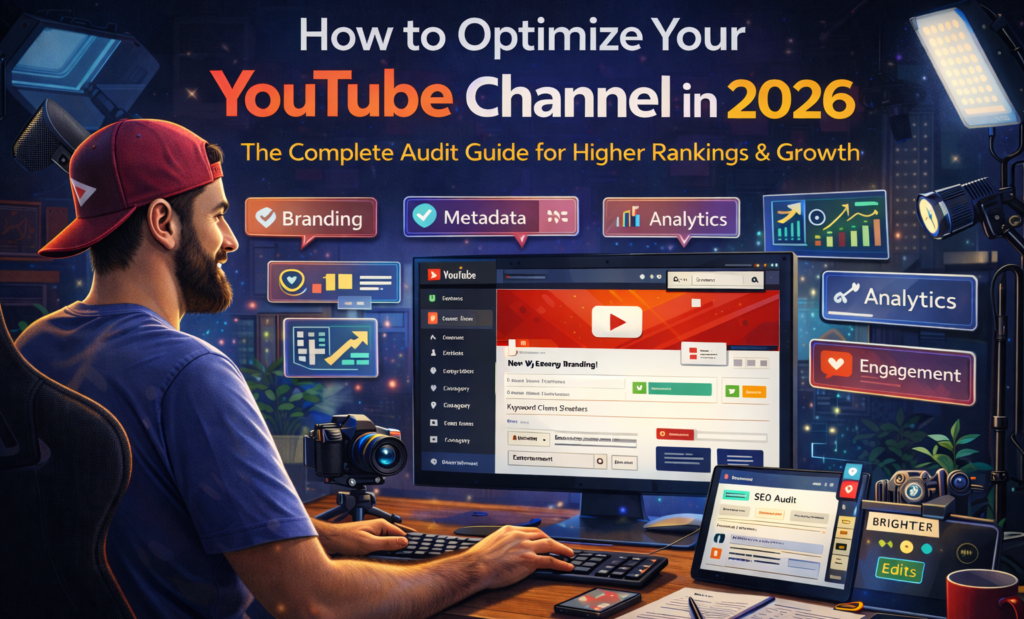
How to Optimize Your YouTube Channel in 2026: The Complete Audit Guide for Higher Rankings & Growth
Posted on December 20, 2025 by Jason Caldwell
YouTube has changed drastically over the last few years. With millions of creators publishing daily, every niche—whether you’re running a music channel, a travel vlog, or a gaming channel—now faces stronger competition than ever. Uploading consistently is no longer enough. In 2026, real growth comes from how well your entire channel is optimized, not just your videos.
A fully optimized YouTube channel ranks higher, attracts the right audience, improves watch time, and helps every video perform better across search, suggested, and home feed. Proper optimization also makes your content more effective when using any legit YouTube promotion service, because the algorithm responds faster when your channel has a strong foundation.
This SEO-driven audit guide shows you how to optimize your branding, metadata, playlists, navigation, engagement, analytics, and more. Whether you want to promote YouTube videos organically, grow through search, or tap into new audiences, the steps below will help you build channel authority.
We’ll also include one natural internal link to strengthen your topic cluster: how to promote YouTube channel.
1. Understand How YouTube Channel Optimization Works in 2026
YouTube no longer evaluates videos alone. The algorithm looks at your overall channel identity, viewer behavior, watch history patterns, and how consistently your audience returns. This means channel structure, branding, categories, playlists, and content clarity directly impact how well each new upload performs.
YouTube considers:
- Content clarity: Can viewers instantly tell your niche (music, travel, gaming)?
- Brand consistency: Do thumbnails, titles, and visuals follow a recognizable style?
- Audience alignment: Are your topics cohesive?
- Search visibility: Can YouTube categorize your content correctly?
- Engagement depth: Do viewers binge your videos?
- Retention strength: How long viewers stay across the channel.
This is why channel optimization often produces faster ranking improvements than uploading more frequently. When YouTube “understands” your channel clearly, it distributes your videos more confidently.
2. Audit & Upgrade Your Channel Branding
Your branding is your first impression. If a viewer visits your channel page and can’t understand your value in 3 seconds, they leave. Strong branding increases trust, subscriber conversions, and viewer retention.
2.1 Channel Banner
Your banner must instantly communicate your niche and value. Tailor it to your category:
- Music: Show your instrument, studio setup, or genre identity.
- Travel: Display destinations, landscapes, or your travel style.
- Gaming: Feature your character style, game genre, or platform.
Include:
- A short tagline describing your videos
- Consistent colors and fonts
- Optional: upload schedule
A strong banner increases credibility and can improve subscriber conversions by 20–40% according to YouTube Creator Insider.
2.2 Profile Picture
Use a clean, high-contrast image. For music, you might show your face or a recognizable logo; for travel, a simple portrait; for gaming, a stylized avatar. Avoid clutter and dark backgrounds — profile pictures display extremely small on mobile.
2.3 Channel Trailer & Featured Video
Create two videos for two kinds of visitors:
- Channel Trailer: For new viewers. Introduce who you are and what your videos offer. Keep it 45–60 seconds.
- Featured Video: For returning subscribers. Highlight your best-performing or most recent upload.
Example trailer concepts:
- Music: “What My Channel Is About + My Sound in 30 Seconds”
- Travel: “My Travel Style + Where I’m Taking You Next”
- Gaming: “My Gameplay Style + What Games I Cover”
3. Optimize the “About” Section for SEO & Trust
Your About section helps YouTube understand your niche and who your videos are for. It also influences how your channel ranks in YouTube Search and Google Search.
Include:
- Your niche (music / travel / gaming)
- Your main value promise
- Your primary keyword: legit YouTube promotion service
- Your secondary keyword: promote YouTube videos
- Your target regions (USA, UK, Canada, Australia)
- Optional: Links to website/socials
Example About Section (You Can Use This)
“I create practical content for creators in the music, travel, and gaming space. Whether you’re trying to promote YouTube videos, improve your SEO, upgrade your production, or understand the algorithm, you’ll find simple and actionable content here. I also break down how to use any legit YouTube promotion service safely to reach real audiences in the USA, UK, Canada, and Australia.”
This description includes keywords, niches, and location targeting—Google loves this structure.
4. Perform a Full Channel Keyword Audit
YouTube prefers channels with strong topical focus. A keyword audit helps you understand whether YouTube sees your channel as music, travel, or gaming—or if your topics are scattered. Alignment increases authority, which increases ranking.
4.1 Identify Your Core Channel Topic
Ask:
- What type of videos do I upload the most?
- What content performs best?
- What do I want viewers to associate with me?
Examples:
- Music: tutorials, covers, original songs, behind-the-scenes studio videos
- Travel: vlogs, itineraries, packing guides, budget travel tips
- Gaming: gameplay, game reviews, beginner guides, challenge videos
4.2 Build a Keyword Cluster for Your Channel
Choose 10–15 keywords that describe your niche. Example clusters:
Music Channel Example Keywords
- music production tips
- how to promote a music video
- beginner guitar tutorials
- home studio setup
- how to promote YouTube videos
Travel Channel Example Keywords
- travel vlog tips
- best places to visit 2026
- budget travel guide
- solo travel tips
- travel camera setup
Gaming Channel Example Keywords
- gameplay tips
- best beginner-friendly games
- gaming setup guide
- streaming settings for beginners
- gaming commentary tips
4.3 Insert These Keywords in the Right Places
- Your About section
- Your playlist titles
- Your playlist descriptions
- Your video titles + descriptions
- Your channel trailer script
Consistency helps YouTube categorize you correctly—boosting your rankings and visibility.
5. Optimize Your Playlists for SEO & Higher Session Time
Playlists are one of the most underrated YouTube optimization tools. In 2026, playlists directly influence channel authority and viewer session time. When viewers watch multiple videos in a row—especially within the same niche—YouTube sees your channel as more valuable.
5.1 Why Playlists Matter for Ranking
A well-designed playlist acts like a curated “content path.” The algorithm uses playlists to:
- Understand your niche more clearly (music / travel / gaming)
- Recommend your videos to each other
- Increase total session time
- Help viewers binge-watch your content
5.2 How to Build SEO-Optimized Playlists
Create playlists based on specific topics—not random video collections. Examples:
Music Playlist Ideas
- Beginner Guitar Tutorials
- How to Promote a Music Video in 2026
- Behind-the-Scenes: Studio & Recording
- Songwriting Tips for Beginners
Travel Playlist Ideas
- Travel Vlogs: Country by Country
- Budget Travel Tips & Hacks
- Solo Travel Guides for 2026
- Travel Gear & Packing Essentials
Gaming Playlist Ideas
- Beginner-Friendly Game Tutorials
- Gameplay Walkthroughs
- Gaming Challenges & Highlights
- Best Games to Play in 2026
Use your secondary keyword (“promote YouTube videos”) naturally where relevant—especially for music promotion playlists.
5.3 Write Playlist Descriptions
YouTube uses playlist descriptions for SEO. Add a short, keyword-rich paragraph.
Example playlist description (Travel):
“This playlist includes step-by-step travel guides, destination tips, and real-world vlogs to help you plan trips smarter. Perfect for anyone wanting to promote YouTube videos in the travel niche and build audience trust.”
6. Improve Video Metadata with a Strong SEO Structure
Your metadata (titles, descriptions, tags) tells YouTube exactly what each video is about. Strong metadata improves your ranking in search results and suggested videos.
6.1 Optimize Video Titles
Good titles follow a clear pattern:
Keyword + What It’s About + Benefit
Examples (Music / Travel / Gaming):
- Music: “How to Record Vocals at Home (Beginner Tutorial)”
- Travel: “Japan in 5 Days: Complete Travel Plan for 2026”
- Gaming: “Best Beginner FPS Settings for Smooth Gameplay”
6.2 Write Long, Helpful Descriptions
Your description should include:
- Your target keyword within the first 1–2 sentences
- A clear explanation of the video
- Secondary keywords like “promote YouTube videos”
- Links to related content such as how to promote YouTube channel
- Timestamps
- A clear call-to-action
Descriptions help videos rank on Google as well, especially for travel guides, music tutorials, and gaming settings.
6.3 Use Tags Correctly
Tags are not as powerful as before, but they still help YouTube understand context.
Examples by niche:
Music Tags
- music production tutorial
- how to promote a music video
- home recording setup
- legit YouTube promotion service
Travel Tags
- travel vlog 2026
- solo travel tips
- best travel destinations
- how to plan a trip
Gaming Tags
- gaming guide 2026
- fps gameplay tips
- beginner gamer setup
- game review 2026
7. Optimize Your Long-Form Videos for Retention
Retention is the strongest ranking signal in 2026. If viewers stay, YouTube pushes your content further.
7.1 Improve the First 15 Seconds
Use niche-specific hook examples:
- Music: “Here’s the exact mic setup I used to fix muddy vocals.”
- Travel: “This mistake cost me $200 on my last trip—don’t do this.”
- Gaming: “Most beginners mess this up in FPS games—fix it fast.”
7.2 Avoid Slow Introductions
Your intro should show value immediately. Avoid long storytelling unless it directly supports the topic.
7.3 Use Visual Movement
Examples by niche:
- Music: Switching between studio shots, sound wave graphics, gear close-ups.
- Travel: Scene changes, maps, budget breakdown overlays.
- Gaming: Gameplay transitions, POV angles, pop-up guides.
7.4 Add Open Loops
Tease upcoming tips relevant to your niche:
- Music: “I’ll show the exact preset later.”
- Travel: “Don’t miss the hidden cost I discovered at the end.”
- Gaming: “Stay until the end for the best sensitivity settings.”
7.5 Use Data from YouTube Analytics
Your retention graph will show exactly where viewers leave. Fix those patterns in your next music, travel, or gaming upload to maintain stronger watch time.
8. Optimize Your Shorts (Massive Reach Booster in 2026)
Shorts continue to explode channels in every niche—especially music, travel, and gaming. Shorts help you reach entirely new audiences who might never find your long-form videos otherwise.
8.1 Use a Clear Hook
Examples:
- Music: “What this $20 mic sounds like vs. a $200 mic.”
- Travel: “3 things I wish I knew before visiting Thailand.”
- Gaming: “This setting instantly boosts your FPS.”
8.2 Keep Shorts Under 28 Seconds
This increases replay loops—one of the strongest Shorts ranking factors.
8.3 Use On-Screen Captions
YouTube reads on-screen text for SEO. Naturally include niche phrases like:
- Music: “mixing tutorial,” “vocal chain,” “music video tips”
- Travel: “budget travel,” “packing tips,” “solo trip guide”
- Gaming: “fps settings,” “gaming tips,” “beginner guide”
8.4 Link Shorts to Long-Form Videos
Use pinned comments or descriptions to lead viewers to deeper videos.
Example:
“Watch my full guide on how to promote YouTube channel — complete breakdown.”
8.5 Support Your Keyword Cluster
Create Shorts that strengthen your niche identity. Examples:
- Music: Quick vocal tips, studio hacks, gear setups
- Travel: Packing hacks, food guides, destination highlights
- Gaming: Short challenges, settings tutorials, game glitches
9. Improve Channel Navigation & Viewer Experience
A well-organized channel keeps viewers watching longer and improves overall session time — one of the strongest signals for channel authority.
9.1 Organize Channel Sections
Create niche-specific sections:
Music Sections
- Studio Tutorials
- Cover Songs
- Music Video Tips
Travel Sections
- Latest Travel Vlogs
- Budget Travel Guides
- Travel Tips for 2026
Gaming Sections
- Gameplay Tutorials
- Beginner Settings Guides
- Latest Game Reviews
9.2 Use High-Quality Thumbnails
Examples:
- Music: Close-ups of instruments, gear, or studio scenes
- Travel: Bright landscapes, faces, landmarks
- Gaming: Character poses, weapon screenshots, game UI highlights
9.3 Use a Strong Channel Tagline
Examples:
- Music: “Simple music tips for beginners & home creators.”
- Travel: “Practical travel guides for real-world travelers.”
- Gaming: “Beginner-friendly gaming guides + reviews.”
10. External Promotion Done the Right Way
External promotion boosts initial traffic and helps YouTube understand your audience. But it must be targeted—not spammy.
10.1 Use Social Platforms Strategically
Where each niche works best:
- Music: Instagram Reels, TikTok, Facebook (music groups)
- Travel: Instagram Reels, Pinterest, travel forums
- Gaming: Reddit (game-specific subreddits), Discord servers
10.2 Use YouTube’s Built-In Tools
- Community posts
- YouTube Stories
- Playlists
- Shorts redirecting to long-form content
10.3 When to Use Paid Promotion
If you choose paid promotion, always use YouTube Ads or a legit YouTube promotion service. These methods use real Google Ads traffic, which is safe and compliant. Avoid any service offering “cheap fast views”—they damage retention and long-term ranking.

Hi, I am Jason, a digital content strategist with 8 years of experience helping YouTube creators and brands grow their channels through data-driven content decisions. I have worked with creators across niches including tech, education, and lifestyle, and specialise in translating YouTube Analytics data into actionable growth strategies.
Categories: Uncategorized