Effective YouTube Promotion Service to Grow Your Channel: What Actually Works in 2026
Posted on July 17, 2026 by Jason Caldwell
Finding a legit YouTube promotion service to grow your channel is harder than it sounds. The market is full of services promising overnight subscriber spikes, views delivered in hours, and viral growth for the price of a coffee. Most of them will take your money and leave your channel in a measurably worse position than it was before you spent it.
This guide cuts through that noise. What follows is a clear-eyed breakdown of how legitimate YouTube promotion actually works in 2026, what the real difference is between promotion that builds a channel and promotion that quietly destroys one, how to evaluate any service before committing a budget, and what verifiable results actually look like inside YouTube Studio. If you’re a creator, musician, gamer, or business owner trying to understand the promotion landscape before making a decision, this is the article that earns that decision.
Why YouTube Channel Growth Has Become Harder — And Why That Matters for Promotion
The platform has changed significantly. In 2026, YouTube’s recommendation algorithm evaluates videos across a much wider range of signals than it did three or four years ago. Watch time percentage, audience retention curves, click-through rate, session continuation, subscriber conversion per view, and return viewer rates all feed into the system that decides whether a video gets pushed to new audiences or stays invisible.
What this means for creators is that growth is no longer primarily a function of how often you upload or even how good your content is in isolation. The algorithm needs evidence — in the form of real engagement data from real viewers — before it will expand a video’s distribution. Without that evidence, even genuinely strong content can sit at a few hundred views for months.
This is the problem a legit YouTube promotion service is designed to solve: not to manufacture metrics, but to generate the real engagement evidence the algorithm needs to start doing its job.
The distinction between services that solve this problem and services that make it worse is the entire substance of what follows.
What Makes a YouTube Promotion Service Actually Legitimate
The word “legitimate” does specific work in the context of YouTube promotion, and it is worth being precise about what it means.
Traffic Source Is the Only Thing That Matters
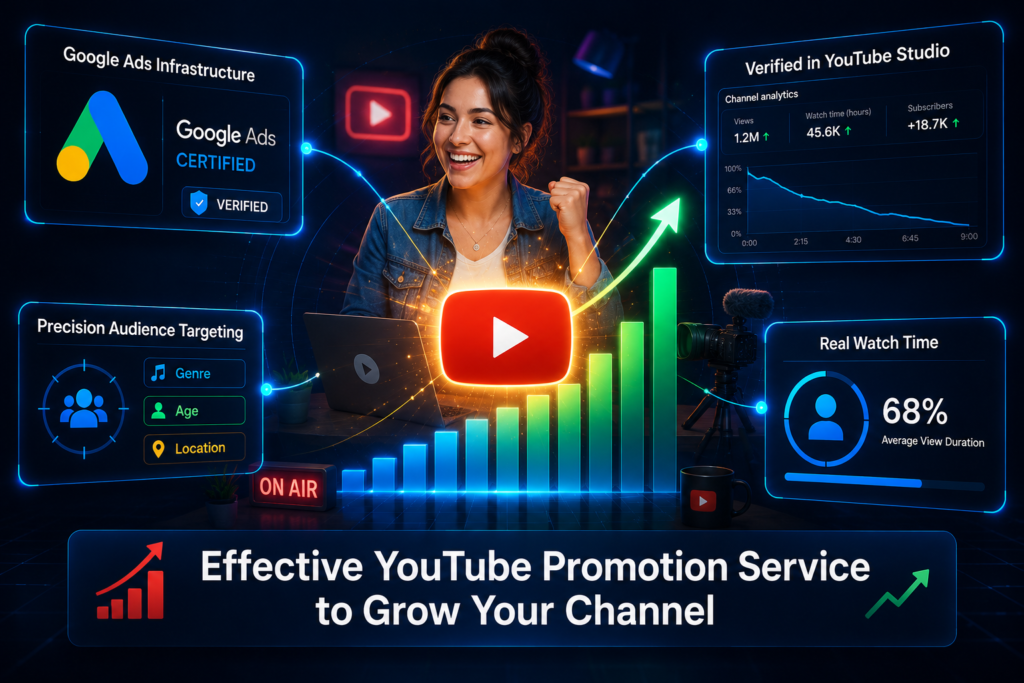
A service is legitimate when its views come from real YouTube users who are genuinely browsing the platform and choose to watch after seeing an ad. This happens through Google Ads — YouTube’s own official advertising infrastructure, the same system used by every major brand, media company, and agency to run paid video campaigns.
When a video is promoted through Google Ads, it appears as a skippable in-stream ad or an in-feed discovery ad to real users matching the targeting parameters set for the campaign. The viewer sees the video as a natural part of their YouTube experience. If they watch, their engagement — watch time, location, device, retention behaviour — is recorded exactly as organic viewing data would be, because it is organic from YouTube’s perspective.
This is what separates a legitimate promotion service from every other kind. The traffic source isn’t a bot network. It isn’t a click farm warehouse. It isn’t an incentivised viewer panel paid cents to watch and immediately close. It is YouTube’s own advertising system delivering real human attention.
Verification in YouTube Studio Is Non-Negotiable
A legitimate service produces results that a creator can verify themselves, in their own YouTube Studio dashboard, without trusting any third-party reporting. After a genuine Google Ads-based campaign runs, the creator can open YouTube Studio, navigate to Analytics, and see:
The Traffic Sources report showing “YouTube advertising” as a distinct traffic source — separate from organic search, suggested videos, and direct traffic.
An audience retention curve that follows a natural human viewing pattern — a characteristic decline from the opening rather than a flat line at near-zero watch time, which is the signature of bot traffic.
Geographic and demographic breakdown that reflects the targeting parameters set for the campaign. If the campaign targeted UK-based pop music fans aged 18 to 34, the geographic data should reflect that.
If any of these checks fail — if views don’t appear in Studio, if retention is flat at zero, if the geography doesn’t reflect targeting — the traffic was not genuine. This is a test any creator can run, and it is the most reliable indicator of whether a service is actually delivering what it claims.
How Fake Views Damage Channels — The Mechanism Creators Underestimate
Understanding why fake views are harmful requires understanding how YouTube’s algorithm actually evaluates a video’s performance — and it goes considerably deeper than most creators realise.
The Watch Time Signal Problem
When a bot or click-farm “view” registers on a video, it typically produces between three and eight seconds of watch time before the session closes. A real human who chooses to watch a genuinely relevant video typically watches several minutes. The algorithmic difference between these two scenarios is significant.
YouTube calculates average view duration as a percentage of total video length. A video that is five minutes long, watched by 10,000 bots for an average of five seconds, generates an audience retention figure of approximately 1.7%. A video with 500 real, interested viewers who watch for an average of two and a half minutes generates a retention figure of 50%.
The algorithm interprets the first result as a signal that viewers found the content unsatisfying and left. It reduces recommendation distribution accordingly. The second result triggers expanded distribution, because the algorithm infers that viewers who stayed that long were genuinely served by the content.
The Suppression That Outlasts the Campaign
What makes fake view damage particularly difficult to recover from is that the algorithmic model built during the fake view period can persist after YouTube removes the invalid traffic — and YouTube does remove it, typically within days to weeks, often wiping the entire artificial view count. The channel is left with a suppressed distribution model built from fraudulent data, and a view count that drops back to where it started.
Creators who have used fake view services and then run legitimate campaigns afterward often report that the legitimate views underperform compared to what they would have expected — because the channel’s algorithmic profile was degraded by the false engagement history. Recovery is possible, but it takes time and genuine engagement to rebuild the data picture the algorithm is working from.
Real Results From Real Campaigns: What Legitimate Promotion Delivers
The clearest way to illustrate what a legit YouTube promotion service to grow your channel actually produces is through specific campaign outcomes — not projections, not guarantees, but documented results from real campaigns.
Hip-Hop Artist Channel
A hip-hop artist channel at 1,200 views ran a targeted campaign to Music Lovers, Rap and Hip Hop Fans, and Urban Music audiences with geographic targeting focused on the United States. Over ten days, the channel moved from 1,200 views on the promoted video to 52,000 views. The audience retention curve showed a natural decline from a strong opening, average view duration settled above two minutes on a four-minute track, and the channel gained genuine subscribers from listeners who found the content through the promoted ad and returned to explore the back catalogue.
Gaming Channel
A gaming channel at 2,100 views promoted a Let’s Play video to FPS Gamers, Hardcore Gamers, and Console Gaming audiences with mixed geographic targeting across the US and UK. Over twelve days, views moved from 2,100 to 78,000. YouTube Studio showed advertising as the traffic source with real retention data, and comment activity increased from the organic gaming audience that found the channel through the campaign.
Health and Wellness Channel
A health-focused channel at 800 views targeted Health and Fitness audiences and Wellness Enthusiasts with demographic filtering toward viewers aged 25 to 44. Over seven days, the video moved from 800 views to 30,000 views, with watch time data that contributed meaningfully toward the channel’s progress toward YouTube Partner Program watch hour thresholds.
R&B Artist Channel
An R&B artist channel at 950 views promoted a new single to R&B and Soul Music fans, Love Songs audiences, and Music Lovers with geographic emphasis on urban US markets. Over nine days, views reached 41,000, with the audience retention curve on the music video showing strong performance through the first chorus — typically the most predictive retention point for music content on YouTube.
What each of these campaigns shares: the results are visible in YouTube Studio with full analytics data, the watch time is genuine, the engagement signals fed the algorithm with real information about the content’s audience, and the channel’s organic performance improved in the weeks following the campaign as a result of the stronger algorithmic profile.
Affordable YouTube Promotion Services: What Budget Actually Gets You
One of the most persistent misconceptions in the creator space is that effective YouTube promotion requires a large marketing budget. The economics of Google Ads-based promotion are considerably more accessible than most creators assume.
How CPV Pricing Works
Google Ads-based YouTube promotion uses a cost-per-view pricing model. A view is counted when a real viewer watches at least 30 seconds of a skippable ad, or watches the full ad if it is under 30 seconds, or clicks on the ad. In 2026, CPV rates for YouTube in-stream ads typically range from $0.01 to $0.05 depending on the niche, geographic targeting, and competition level for the target audience.
This means a $9 campaign delivers approximately 180 to 900 genuine views depending on targeting parameters. A $35 campaign delivers between 700 and 3,500 views, with services like Vedzzy adding 40% additional views on top of that spend as an incentive for creators who are ready to move beyond testing-level budgets.
What Small Budgets Accomplish Algorithmically
The value of a small, well-targeted campaign is not the view count itself. It is the engagement signal quality those views generate. A $9 campaign targeting the exact right audience for a piece of content can generate more algorithmic momentum than a $200 campaign delivering low-quality, untargeted traffic — because the algorithm weights engagement quality over volume.
What the data consistently shows is that small, precise campaigns that reach genuinely interested viewers generate retention rates that register as positive signals in YouTube’s distribution system. Those signals, compounding with the content’s existing organic performance, improve the video’s chance of appearing in suggested feeds for the days and weeks after the campaign runs.
For creators evaluating affordable YouTube promotion services, the question is not just what the campaign costs — it is what the cost per genuinely interested viewer is. A $9 service that delivers 900 bot views costs less than a $9 campaign delivering 300 genuine views. But the genuine views are worth more to the channel’s long-term growth than the bots by a factor that is difficult to overstate.
You can explore what different budget levels realistically deliver in our detailed breakdown of Affordable YouTube Promotion Packages.
The Five Questions to Ask Before Using Any Promotion Service
Evaluating a service before spending money is considerably more reliable than evaluating it afterward. These five questions, asked directly and specifically, separate services worth considering from services worth avoiding.
Question 1: Where Do the Views Come From?
The only acceptable answer is Google Ads, YouTube’s official advertising infrastructure, or an equivalent description of real paid advertising on YouTube’s platform. Any answer involving “our network,” “organic traffic,” “real users” without further specifics, or “proprietary methods” is insufficient. If a service cannot name its traffic source clearly, it is concealing something material about how the views are generated.
Question 2: Will the Views Show Up in YouTube Studio Analytics?
This is a binary question with a binary answer. Legitimate views from Google Ads appear in YouTube Studio under Traffic Sources as “YouTube advertising.” Ask the service to confirm this specifically. If they cannot, or if they redirect to their own reporting dashboard as the primary source of truth, that is a meaningful signal.
Question 3: Is the Pricing Consistent With Real Google Ads Costs?
As established above, real Google Ads-based YouTube promotion costs between one and five cents per view. A service offering 10,000 views for $5 is offering views at $0.0005 each — a price that is physically impossible through Google Ads. When pricing is dramatically below the range that legitimate advertising infrastructure requires, the traffic source is definitionally not Google Ads.
Question 4: What Targeting Options Are Available?
Real Google Ads campaigns offer targeting by interest, geographic location, age, gender, device, and keyword. A service with no targeting options, or targeting options that are limited to a dropdown of vague categories, is not running real ad campaigns. Genuine targeting capability is one of the clearest markers of a service using actual advertising infrastructure.
Question 5: Can They Explain What Happens When YouTube Investigates?
A service running Google Ads has nothing to hide from YouTube — it is using YouTube’s own system. A service using bot traffic or click farms will typically deflect, become vague, or claim that their methods are “undetectable.” The confidence with which a service answers this question tells you a great deal about what it is actually doing.
Targeting Precision: Why Audience Matching Determines Everything
One of the most underappreciated variables in paid YouTube promotion is the specificity of audience targeting, and this is where the gap between adequate promotion and genuinely effective promotion is most pronounced.
Genre-Level Targeting for Music Channels
A music video promoted to a broad “Music” audience will reach listeners across every genre — many of whom have no interest in the specific style of music being promoted. A hip-hop video reaching country music fans generates poor retention because the content is not relevant to those viewers. The algorithmic signal that results is weak, even though the views are technically genuine.
The same video promoted specifically to Rap and Hip Hop Fans, Urban Music listeners, and R&B and Soul audiences generates significantly stronger retention and engagement — because the viewers finding the ad are predisposed to engage with that style of content. The resulting algorithmic signal is qualitatively different, and the organic distribution that follows reflects that quality difference.
Sub-Niche Targeting for Gaming and Creator Channels
Gaming channels face particularly high competition in YouTube’s recommendation system. Broad “Gamers” targeting reaches players across every genre and platform — most of whom have no interest in the specific game or format being promoted. FPS Gamers, RPG Fans, and Console Gaming audiences are meaningfully different segments, each with distinct viewing habits and engagement patterns.
A gaming video promoted to the wrong gaming sub-audience generates exactly the engagement signal pattern that suppresses distribution: views from real people who are not interested in the specific content. The retention curve tells the algorithm that these viewers found the content irrelevant. For gaming channels specifically, this outcome is often worse than running no paid campaign at all.
If you want to understand what a properly configured manual targeting campaign looks like inside a real dashboard, our guide to Are YouTube Promotion Services Safe explains the verification process in detail.
How Geographic Targeting Affects Both Results and Revenue
The country of origin of a view affects YouTube promotion results in two distinct ways that compound over time, and both are worth understanding before configuring any paid campaign.
The CPM and RPM Connection
YouTube’s advertising rate system pays dramatically different amounts for views depending on the viewer’s country. US, UK, Canadian, and Australian viewers generate CPM rates that are anywhere from three to ten times higher than the same view from markets with lower advertiser spend. For channels monetised through the YouTube Partner Program, the geographic composition of the promoted audience directly affects ad revenue.
A music channel promoted to US urban audiences will generate meaningfully higher RPM on the views delivered than the same channel promoted to a less premium market — which means the paid campaign generates both the engagement signal benefit and higher per-view revenue simultaneously.
The Algorithmic Routing Effect
Beyond revenue, the geographic data from a paid campaign influences which organic audiences YouTube routes the video to next. If a campaign establishes that a video performs well with US-based listeners in a specific age and interest cluster, YouTube’s algorithm incorporates that data into its recommendation model for the video going forward. The organic views that follow the campaign tend to come from audiences similar to the ones the campaign reached — which means smart geographic targeting during a paid campaign shapes the organic audience the video attracts afterward.
When Promotion Works — And When It Doesn’t
A legit YouTube promotion service to grow your channel is a distribution tool, not a content repair service. Understanding this distinction prevents the most common disappointment creators experience after their first paid campaign.
What Promotion Can Accomplish
Promotion generates real engagement data faster than organic growth alone would. It puts a video in front of audiences who are genuinely likely to engage with it, producing the watch time, retention, and interaction signals the algorithm needs to expand distribution. It can accelerate progress toward YouTube Partner Program thresholds — particularly the 3,000 and 4,000 watch hour requirements — by generating substantial genuine watch time in a compressed timeframe.
Promotion can also establish a channel’s presence in specific geographic markets that organic growth wouldn’t reach naturally — useful for artists or businesses targeting particular markets regardless of where their existing audience is concentrated.
What Promotion Cannot Fix
A video with a weak hook — one that loses most viewers in the first thirty seconds — will generate poor retention data from even the most precisely targeted campaign. Promotion amplifies the signals that are already present in a video’s performance. If those signals are weak because the content isn’t holding attention, a campaign delivers more evidence of that weakness to the algorithm, which can deepen distribution suppression rather than expanding it.
The practical implication is that paid promotion delivers its strongest results for videos that are already performing above average on retention and CTR in organic terms. Choosing which video to promote matters as much as how the campaign is configured.
Building a Sustainable Promotion Strategy Over Time
Individual campaigns produce useful results. A structured, layered promotion approach produces compounding results that organic strategy alone cannot replicate at the same speed.
The Campaign Cadence That Works
In practice, running a targeted campaign on a channel’s strongest-performing video each month — rather than promoting every upload — concentrates the engagement signal in the content most likely to benefit from algorithmic expansion. The algorithm builds a richer understanding of the channel’s audience from fewer, stronger signals than from many weak ones.
Between campaigns, the engagement data from previous promotions continues influencing how the algorithm routes organic traffic to the channel. A channel that has run three or four well-targeted campaigns over four months has provided the algorithm with enough real engagement evidence from genuinely matched audiences to begin recommending its content more consistently in suggested and browse feeds.
Combining Organic and Paid Strategy
The channels that see the strongest long-term growth from paid promotion are the ones running it alongside consistent organic strategy — not as a substitute for it. Content quality and upload consistency determine the organic foundation. Paid promotion accelerates the pace at which the algorithm understands who the channel is for and how to distribute its content. Both work better together than either does independently.
Frequently Asked Questions
What is the difference between a legit YouTube promotion service and a fake one?
A legitimate service uses Google Ads — YouTube’s official advertising infrastructure — to place your video as a real ad in front of genuine YouTube users who match the targeting parameters you set. The views appear in YouTube Studio under Traffic Sources with real watch time and retention data. A fake service uses bot networks, click farms, or incentivised viewer pools to simulate views without real human engagement. Fake views generate near-zero watch time, trigger YouTube’s spam detection systems, and can result in view count removal, channel strikes, or suppressed organic distribution.
How do I verify that a promotion service delivered real views?
Open YouTube Studio after the campaign runs and check three things. The Traffic Sources report should show “YouTube advertising” as a distinct traffic source. The audience retention graph for the promoted video should show a natural viewing curve rather than a flat line near zero. The geographic and demographic breakdown should reflect the audience targeting you configured. If all three checks pass, the views came from real YouTube users through the advertising system.
How much does legitimate YouTube promotion typically cost?
Google Ads-based YouTube promotion typically costs between $0.01 and $0.05 per genuine view in 2026, depending on targeting specificity and niche competition. This means a $9 campaign can deliver approximately 180 to 900 real targeted views depending on the parameters. Services that offer significantly more views at dramatically lower prices are not using Google Ads and are delivering traffic from sources that carry significant channel risk.
Can paid promotion help me reach YouTube Partner Program thresholds faster?
Yes, when the promotion uses Google Ads-based traffic. Views from genuine Google Ads campaigns generate real watch time that counts toward the 3,000 watch hours required for the Early Access YPP tier and the 4,000 watch hours required for full ad revenue eligibility. Bot traffic and click-farm views generate near-zero watch time and do not count toward any monetisation threshold. The distinction in accumulated watch time between a genuine campaign and a fake one is the difference between measurable progress and no progress at all.
Does audience targeting really make that much difference?
Targeting determines the quality of the engagement signal a campaign generates, and engagement signal quality is what the algorithm uses to decide how broadly to distribute a video after the campaign ends. A video promoted to the precisely matched audience generates strong retention and engagement signals that expand organic distribution. The same video promoted to a broadly mismatched audience generates weak signals that fail to trigger distribution expansion — even though both scenarios involve real views from real people. The difference in organic performance that follows a well-targeted versus poorly targeted campaign can be significant, even when the number of views delivered is identical.
How quickly can I see results from a paid promotion campaign?
Views begin delivering within 24 hours of a campaign launching on most Google Ads-based services. Campaign results — including watch time, retention data, and traffic source breakdown — are visible in YouTube Studio throughout the campaign period. Algorithmic effects, such as increased appearance in suggested and browse feeds, typically become visible over the two to four weeks following a campaign as YouTube’s systems incorporate the engagement data from the promoted period into the channel’s distribution model.
What type of content benefits most from paid promotion?
Videos that are already performing above their channel average in organic retention and click-through rate benefit most from paid promotion. These are the videos that already demonstrate viewer satisfaction to the algorithm, and promotion gives the algorithm more evidence of that satisfaction from a larger, more precisely targeted audience. Promoting a video that is already underperforming organically amplifies evidence of that underperformance, which can deepen algorithmic suppression rather than expand distribution.
Is paid YouTube promotion safe for channels that are building toward monetisation?
Google Ads-based promotion is completely safe for channels at any growth stage, including those building toward YPP eligibility. It uses YouTube’s own advertising infrastructure and is fully compliant with YouTube’s Terms of Service. The watch time generated counts toward monetisation thresholds. The only risk in YouTube promotion comes from services using bot traffic or fake engagement methods, which violate YouTube’s policies regardless of whether the creator was aware of the traffic source.
Conclusion
Finding a legit YouTube promotion service to grow your channel in 2026 means understanding one clear principle: the only promotion that builds a channel is promotion that delivers real views from real viewers through YouTube’s own advertising infrastructure, with results verifiable in your own YouTube Studio.
Everything else — the cheap view panels, the bot services, the click farms dressed up in legitimate-sounding language — generates numbers that YouTube removes and engagement histories that suppress your channel’s algorithmic standing long after the campaign ends.
The creators who use paid promotion most effectively treat it as one component of a broader strategy: strong content as the foundation, consistent organic publishing as the structure, and targeted paid campaigns on the best-performing videos as the accelerant. Applied in that order, with results verified in Studio after every campaign, promotion compounds into channel growth that continues long after any individual campaign has ended.
If you are evaluating services and want to understand exactly what a properly configured campaign looks like and what results to expect at different budget levels, starting with the verification criteria above is the most reliable first step.

Hi, I am Jason, a digital content strategist with 8 years of experience helping YouTube creators and brands grow their channels through data-driven content decisions. I have worked with creators across niches including tech, education, and lifestyle, and specialise in translating YouTube Analytics data into actionable growth strategies.
Categories: YouTube Growth Tips, YouTube Promotion