Are YouTube Promotion Services Safe? What Every Creator Must Know in 2026
Posted on May 13, 2026 by Jason Caldwell
If you’ve ever Googled “YouTube promotion service” — you already know the problem. Hundreds of websites. Identical promises. Rock-bottom prices. And no reliable way to tell at first glance which ones will grow your channel and which ones will quietly destroy it.
The honest answer is: it depends entirely on how the service delivers views. Some promotion methods are completely safe, YouTube-compliant, and genuinely effective at accelerating real growth. Others violate YouTube’s Terms of Service and can get your channel suppressed, demonetised, or permanently terminated — sometimes without any warning.
The difference between the two is not always visible on a homepage. That’s exactly why so many creators get burned. This guide breaks down everything you need to know before spending a single rupee on YouTube promotion in 2026 — including the specific questions to ask any service before you pay.
Why creators turn to promotion services in the first place
Before evaluating whether promotion is safe, it’s worth understanding why creators look for it — because the reason is completely legitimate.
YouTube’s algorithm creates a frustrating paradox for new and small channels. To distribute your content broadly, the algorithm needs engagement data: watch time, click-through rate, audience retention, and subscriber conversions. But to generate that engagement data, you need people to watch your video. And to get people watching, you need the algorithm to distribute your content.
It’s a loop that’s nearly impossible to break organically when you’re starting from zero. Without an existing audience, even genuinely excellent content gets minimal distribution because YouTube has no signal data to work with.
This is why creators look for promotion — not to cheat the system, but to seed the algorithm with real engagement data so organic growth can begin. The question isn’t whether promotion is a good idea. It’s whether the method you choose is safe and effective.
If you’re running a brand new channel, see our dedicated breakdown of YouTube promotion services for new channels — what works and what to avoid — for the full picture tailored to early-stage creators.
The two types of YouTube promotion: safe vs dangerous
Every YouTube promotion service falls into one of two categories. Understanding the difference is the most important thing you’ll read in this article.
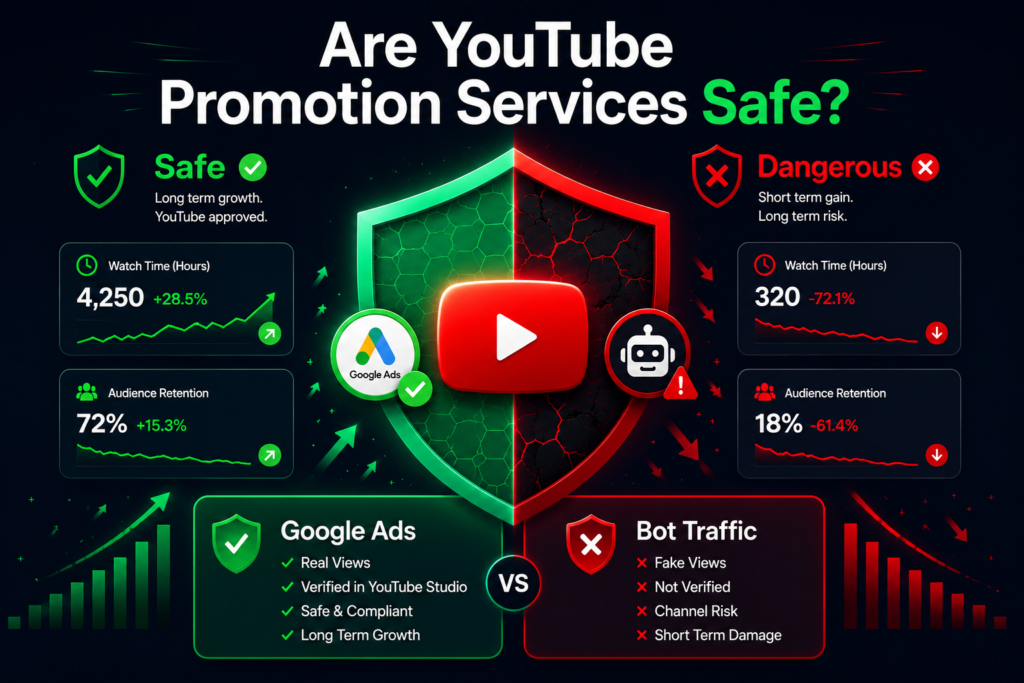
Type 1 — Google Ads-based promotion (safe)
This is the only category of paid YouTube promotion that is fully safe, YouTube-compliant, and algorithmically valuable.
Google owns YouTube. Google Ads is YouTube’s own advertising infrastructure — the same system used by every major brand, media company, and creator to run paid campaigns on the platform. When a promotion service uses Google Ads to promote your video, here’s exactly what happens:
Your video is placed as an ad — either as a pre-roll ad before other videos (in-stream) or as a suggested video in the YouTube feed (in-feed). Real YouTube users see your video as they browse. Some choose to watch. Those views are recorded in YouTube Studio with full analytics — watch time, geographic data, audience retention, and device information.
These views are genuine, human, and verifiable. They generate real watch time that counts toward your YouTube Partner Program thresholds. They can result in real subscriber conversions. And they feed YouTube’s algorithm with real engagement data about your content and your audience, which influences how the platform recommends your videos going forward.
Google Ads-based promotion is safe because it uses YouTube’s own system. There is nothing to violate. You are using the platform’s official advertising infrastructure exactly as it was designed to be used.
To see how this process works step by step — from campaign setup to view delivery — read our detailed walkthrough of how we promote YouTube videos using Google Ads.
Type 2 — Bot traffic and click farms (dangerous)
This covers the vast majority of cheap promotion services found at the bottom of Google search results. Prices that seem impossible — 10,000 views for $5, 50,000 views for $15 — are the clearest signal something is wrong.
These services generate views through one of two methods:
Bot networks
— automated software that simulates video views without any real human watching. The view counter goes up. Nothing else happens. No watch time. No engagement. No geographic data from real users.
Click farms
— people paid fractions of a cent to open videos and immediately close them. Technically real humans, but completely uninterested in the content — generating minimal watch time and zero genuine engagement.
YouTube’s detection systems are sophisticated and continuously improving. The platform monitors view velocity patterns, watch time ratios, geographic concentration, device fingerprints, and engagement behaviour. Unnatural view spikes without corresponding engagement are flagged automatically.
The consequences are severe:
- View removal — YouTube removes views identified as invalid, often wiping the entire view count spike
- Reduced distribution — channels with suspicious traffic history are algorithmically deprioritised
- Channel strikes — repeated policy violations result in formal strikes
- Permanent termination — in serious cases, the channel is removed from the platform entirely
Beyond the penalty risk, bot and click-farm views are strategically worthless even when undetected. They generate no real watch time, no genuine engagement signals, and no subscriber conversions. They teach YouTube’s algorithm that your content doesn’t hold attention — which actively suppresses future organic distribution even after the fake views are removed.
How to tell if a YouTube promotion service is safe
This is the practical question every creator needs to answer before handing over money. Here are the specific signals that separate legitimate services from dangerous ones.
Question 1: Does the service use Google Ads?
This is the most important question. A service that uses Google Ads is using YouTube’s own advertising infrastructure. A service that can’t clearly answer this question is delivering traffic through other means — which carries significant risk.
Ask directly: “Do you use Google Ads to promote videos?” A legitimate service will answer immediately and clearly. Evasive answers like “our proprietary network” or “our organic distribution system” are red flags.
Question 2: Do the views appear in YouTube Studio with full analytics?
Legitimate views from Google Ads campaigns appear in YouTube Studio with complete data — watch time, audience retention curves, geographic breakdown, device type, and traffic source. This is non-negotiable.
If a service delivers views that don’t appear in YouTube Studio, or appear with zero watch time, or under an unrecognisable traffic source — they are not real views delivered through YouTube’s advertising system.
Before using any service, ask: “Will these views show up in my YouTube Analytics with full data?” Any legitimate provider will say yes without hesitation.
Question 3: Is the pricing realistic for Google Ads?
Running video ads on YouTube through Google Ads costs approximately $0.01 to $0.05 per view, depending on targeting, niche, and competition. This is Google’s own pricing — it doesn’t change based on the middleman.
A service offering 10,000 views for $5 — which works out to $0.0005 per view — is mathematically impossible through Google Ads. Those views are coming from somewhere else entirely.
Realistic pricing for legitimate Google Ads-based promotion in 2026 starts at around $9 for approximately 800–1,000 real targeted views. This reflects the actual cost of running compliant ad campaigns on YouTube’s platform.
Question 4: Does the service offer audience targeting?
One of the most valuable features of Google Ads-based promotion is the ability to target your video to specific audiences — by interest, geographic location, age, and content affinity.
A music artist can target listeners of specific genres. A gaming creator can target active gaming audiences. A business creator can target entrepreneurs and professionals. This targeting is what makes promotion genuinely valuable — not just for view count, but for reaching viewers who are most likely to subscribe and engage long-term.
Services that offer no targeting options are delivering untargeted traffic with significantly less algorithmic value, even if the views are technically from real people.
Question 5: Is the service transparent about what you’re buying?
Legitimate promotion services are transparent about exactly how they work, where views come from, what results you can realistically expect, and how to verify those results in your own analytics. They don’t make guarantees about viral growth or algorithmic miracles.
If a service’s homepage is vague about their method, uses terms like “organic promotion” without explanation, promises guaranteed subscriber growth alongside views, or has no verifiable business information — treat it as a red flag.
What happens to channels that use fake promotion
To make the risk concrete, here’s what the typical timeline looks like for a channel that uses bot-based promotion services:
Week 1: View count spikes. The channel looks like it’s growing fast. Everything seems fine.
Weeks 2–3: YouTube’s detection systems flag the unusual pattern. Views begin disappearing — sometimes thousands at a time — as YouTube removes invalid views from the count. The view count drops back toward where it started, or lower.
Weeks 3–4: The channel’s engagement metrics — watch time ratio, click-through rate, audience retention — now look artificially suppressed because hundreds or thousands of views generated zero watch time. YouTube’s algorithm interprets this as evidence that the content doesn’t satisfy viewers and reduces organic distribution.
Month 2 and beyond: The channel is in a worse position than before the promotion. Less organic reach, worse engagement metrics, and potentially a strike on the account. The money spent on fake views generated nothing — and made future organic growth harder.
This pattern plays out consistently across thousands of creator accounts every year.
The right way to use YouTube promotion safely in 2026
Now that you understand what’s safe and what isn’t, here’s how to approach YouTube promotion in a way that actually works and builds your channel sustainably.
Start with your content.
Paid promotion only amplifies what’s already there. A video with a weak hook, poor audio, or unclear value proposition will not convert promoted views into subscribers — regardless of how well-targeted the campaign is. Before spending anything on promotion, make sure you have at least five to ten videos that represent your channel’s best work.
Use Google Ads-based promotion only.
Whether you manage campaigns yourself or use a service that manages them on your behalf, the underlying traffic source should always be Google’s official advertising platform.
Target the right audience precisely.
The value of a promoted view is directly proportional to how well-matched the viewer is to your content. A music video promoted to music fans in your target genre delivers significantly more value than the same video promoted to a generic, untargeted audience.
Start with a small budget and scale gradually.
Starting with a modest campaign on your best-performing video lets you verify that the views appear in YouTube Studio correctly, confirm the targeting is delivering the right audience, and build confidence in the service before committing a larger budget.
Verify results in YouTube Studio.
After any promotion campaign, open YouTube Studio, navigate to Analytics, and check the traffic sources, geographic data, and watch time for the promoted period. Legitimate campaigns will show a clear traffic source, real geographic distribution, and meaningful watch time.
For creators who want the benefits of Google Ads-based promotion without navigating the ad platform themselves, a legit YouTube promotion service manages certified Google Ads campaigns on your behalf — delivering real, targeted views that appear in full in your YouTube Studio analytics.
Who YouTube promotion is best suited for
Safe, Google Ads-based YouTube promotion delivers the most value in these specific situations:
New channels with good content but no audience.
The algorithm catch-22 — needing engagement data to get distribution, but needing distribution to get engagement data — is exactly what targeted promotion solves. A well-targeted campaign on a strong video seeds the algorithm with real engagement signals and accelerates the timeline to organic growth.
Creators launching new content series.
Even established channels can struggle to get traction when introducing a new content format or topic area. Targeted promotion helps seed the algorithm with data about how a new audience segment responds to the content.
Musicians and artists promoting a new release.
For independent artists without a major label distribution budget, Google Ads-based promotion is the most accessible and compliant way to reach new listeners at scale. See our dedicated guide to YouTube promotion for musicians for a full breakdown tailored to the music niche.
Gaming creators building an initial audience.
Gaming is one of the most competitive niches on YouTube — getting traction organically can take longer than in less saturated categories. Targeted promotion to gaming audiences gives new channels a legitimate competitive tool.
Creators targeting Tier 1 markets for monetisation.
Where your views come from affects your RPM directly. Creators whose organic audience is primarily in lower-CPM countries can use geo-targeted promotion to build a viewer base in the USA, UK, Canada, and Australia — increasing both ad earnings and algorithmic distribution into high-value markets.
Common myths about YouTube promotion — debunked
Myth 1: “All paid promotion is against YouTube’s rules.”
False. YouTube’s own advertising platform — Google Ads — is explicitly designed for paid promotion. YouTube runs ads itself as its primary business model. Using Google Ads to promote your videos is not just allowed — it’s YouTube’s intended mechanism for paid discovery.
Myth 2: “Promotion views don’t count toward watch hours.”
False — if they come from Google Ads. Views delivered through legitimate campaigns generate real watch time that counts toward YouTube Partner Program thresholds: 3,000 hours for Early Access and 4,000 hours for full monetisation. Bot and click-farm views do not count and never will.
Myth 3: “I can tell a fake promotion service because it looks unprofessional.”
Not reliable. Many fraudulent promotion services have professional-looking websites, convincing testimonials, and polished branding. The only reliable evaluation method is asking the specific questions outlined in this article.
Myth 4: “Once YouTube removes fake views, my channel goes back to normal.”
Not exactly. YouTube removing fake views restores your view count, but the suppressed engagement metrics — low watch time ratio, poor retention signals — can persist and affect your organic distribution for weeks or months afterward.
Myth 5: “Big channels use paid promotion so it must be fine.”
Partially true, but context matters. Large channels and media companies run Google Ads campaigns — which is safe and compliant. They are not using bot view services. The distinction is the mechanism, not the act of paying for promotion.
Quick safety checklist before using any YouTube promotion service
Use this checklist every time before committing to a promotion service:
- Does the service explicitly state it uses Google Ads?
- Will the views appear in YouTube Studio with full watch time and analytics data?
- Is the pricing consistent with real Google Ads costs ($0.01–$0.05 per view)?
- Does the service offer audience targeting by interest, location, and demographics?
- Is the service transparent about exactly how they work?
- Does the service avoid guarantees of viral growth or unrealistic subscriber counts?
- Can you find verifiable information about the service as a legitimate business?
If a service passes all seven checks — it’s worth considering. If it fails any one of them — walk away.
Final thoughts
YouTube promotion services are not inherently safe or unsafe — the safety depends entirely on the method used. Google Ads-based promotion is completely safe, fully compliant, and genuinely effective when used correctly. Bot traffic and click-farm services are dangerous, algorithmically counterproductive, and in the worst cases, can end a channel’s existence on the platform.
The creators who use promotion most effectively treat it not as a shortcut to viral success, but as a legitimate tool for seeding the algorithm with real engagement data during the period when organic distribution is limited.
For a complete picture of every promotion method available — both organic and paid — see our full guide to The Complete Guide to YouTube Promotion in 2026.
To understand exactly why Google Ads-based promotion works so differently from fake views at a technical level, our detailed comparison of Google Ads vs fake YouTube views breaks down the full mechanics side by side.
Before you spend anything on YouTube promotion — understand exactly what you’re buying, verify it will appear in your analytics, and make sure the service you choose is building your channel, not quietly undermining it.
Frequently asked questions
Are YouTube promotion services safe in 2026?
Yes — if they use Google Ads. Promotion services that run campaigns through Google’s official advertising platform are fully safe and YouTube-compliant. Services that deliver views through bot networks or click farms are unsafe and can result in channel penalties or termination.
Can YouTube ban your channel for using a promotion service?
YouTube can take action against channels using promotion services that deliver fake or artificial views. Channels using Google Ads-based promotion are at no risk — this is YouTube’s own advertising infrastructure. The risk of banning applies specifically to bot traffic and click-farm services that violate YouTube’s Terms of Service.
How can I tell if a YouTube promotion service is legitimate?
Ask whether they use Google Ads, confirm that views will appear in YouTube Studio with full analytics data, and verify that the pricing is consistent with real Google Ads costs (approximately $0.01–$0.05 per view). Any service that cannot clearly answer these three questions should be avoided.
Do promoted YouTube views count toward monetisation thresholds?
Yes — views from legitimate Google Ads campaigns generate real watch time that counts toward YouTube Partner Program requirements: 3,000 hours for Early Access at 500 subscribers, and 4,000 hours for full monetisation at 1,000 subscribers. Bot views do not count toward any threshold.
What is the safest way to promote a YouTube channel?
The safest paid method is Google Ads-based promotion — either by running campaigns yourself through the Google Ads platform, or by using a verified service that manages Google Ads campaigns on your behalf. Organic methods (YouTube SEO, community engagement, Shorts, cross-platform promotion) remain the foundation, with targeted paid promotion as an accelerant.
How much should I spend on YouTube promotion to see results?
You don’t need a large budget to start. A well-targeted campaign with as little as $9–$30 on your best-performing video is enough to verify that the service delivers genuine views, check the results in YouTube Studio, and generate initial engagement signals for the algorithm. See our full breakdown of affordable YouTube promotion packages to understand what different budgets deliver.
What makes a YouTube promotion service legit vs fake?
A legit YouTube promotion service uses Google’s official advertising infrastructure to deliver real views from real users browsing YouTube. The views appear in YouTube Studio with full analytics, generate real watch time, and count toward monetisation thresholds. Fake services use bots or click farms — the views briefly inflate your counter before being removed by YouTube’s detection systems, leaving your channel with worse engagement metrics than before.

Hi, I am Jason, a digital content strategist with 8 years of experience helping YouTube creators and brands grow their channels through data-driven content decisions. I have worked with creators across niches including tech, education, and lifestyle, and specialise in translating YouTube Analytics data into actionable growth strategies.
Categories: YouTube Promotion