How to Grow a YouTube Channel as an Independent Musician in 2026
Posted on September 24, 2026 by Jason Caldwell
Most independent musicians approach YouTube the same way they approach Spotify — upload the music and wait for listeners to find it. That approach works on Spotify because Spotify’s algorithm actively pushes new tracks into playlists and discovery features without requiring ongoing video content. YouTube is completely different.
On YouTube, 60% of listeners discover new artists on the platform first — more than any other single source. But that discovery doesn’t happen by uploading audio and hoping the algorithm notices. It happens through consistent video content, strategic use of Shorts, a properly optimised channel setup, and an understanding of how YouTube distributes music content differently from other categories.
This guide covers everything an independent musician needs to grow a real YouTube presence in 2026. Not just the generic advice that fills every other article on this topic — but the specific mechanics, the content ratios that work, the channel setup steps most artists skip, and the honest picture of what results look like at different stages.
Why YouTube Is Different for Musicians — and Why That Makes It an Opportunity
YouTube reaches 2.7 billion monthly active users in 2026. It is the world’s largest music discovery platform by total listening hours — larger than Spotify, Apple Music, and every other streaming service. But the way musicians need to use it is completely different from how they use those platforms.
On Spotify, the product you deliver is audio. On YouTube, the product you deliver is an experience. Viewers come to YouTube to watch, to connect, to understand who an artist is beyond the recorded track. A listener who discovers your music on Spotify might stream it. A viewer who discovers you on YouTube can immediately access your personality, your process, your story, and your entire catalog in one session. The ceiling for connection is significantly higher.
That’s also what makes YouTube harder. You can’t just upload a track. You need video content — consistently, in multiple formats, optimised for how YouTube’s recommendation system actually works.
The Musician-Specific Cold Start Problem
YouTube’s algorithm learns your channel’s audience profile from your first uploads. Music channels face a specific challenge here: the algorithm categories content by viewer behaviour, not by genre. A new music channel uploading only official audio tracks attracts listeners whose primary behaviour is passive — they press play and don’t engage with comments, don’t click through to other videos, and don’t subscribe at high rates. This passive engagement profile gives the algorithm weak signals, which results in conservative distribution.
The fastest-growing independent artist channels solve this by publishing content that generates active engagement — comments, shares, saves, click-throughs to other videos — alongside the music itself. Behind-the-scenes footage, songwriting breakdowns, and reaction content all generate the kind of active engagement signals that tell YouTube this channel’s audience is genuinely invested. That’s what triggers broader distribution.
What YouTube Offers Musicians That Other Platforms Don’t
YouTube pays through two separate systems. Ad revenue on your own videos (through the YouTube Partner Program) rewards view count and watch time. Content ID royalties pay you whenever your music appears in someone else’s video — even if you didn’t upload it and didn’t know about it. As your catalog grows and more creators use your music in their own content, Content ID becomes a meaningful passive income stream that runs without any effort from you. No other music streaming platform offers an equivalent.
YouTube also allows long-term content — a music video from three years ago can still accumulate views and generate royalties today if it maintains search relevance. This compounding catalog value is one of YouTube’s most powerful and underused advantages for independent musicians.
Set Up Your Channel Correctly Before You Post Anything
Most artists create a YouTube channel by setting a profile picture and uploading their first video. That’s not enough. There are several setup steps that directly affect how YouTube categorises your channel, how it appears in search, and whether you qualify for additional features that only music channels can access.
Apply for an Official Artist Channel
An Official Artist Channel (OAC) is a specific account type that YouTube provides to artists who distribute music through an approved distributor. It looks different from a standard creator channel — it carries a music note icon next to the channel name, it merges your uploaded videos with your YouTube Music profile, and it gives your channel priority placement in music-related search results.
To get an OAC, your music needs to be distributed through a partner like DistroKid, TuneCore, Symphonic, CD Baby, or similar. Once your distribution is live, your distributor can claim the OAC on your behalf, or you can request one through YouTube Studio. The process takes 1 to 4 weeks. If you’re planning to build a serious music presence on YouTube, getting your OAC before you start growing is significantly better than converting after you’ve already built an audience, because the merge changes how your channel appears and may temporarily affect metrics.
Channel Branding That Works at Small Sizes
Your channel icon appears at approximately 40 pixels wide in most mobile views. At that size, logos with text and complex imagery become unreadable. The most effective music channel icons use a simple, high-contrast design — a face, a symbol, or a wordmark in one or two colors — that’s instantly recognisable at thumbnail size. Your banner art should reflect your current release era and include links to your other platforms via the channel’s social links feature.
Write a Channel Description That Includes Your Genre and Key Terms
YouTube uses your channel description as a text signal for categorisation. Most musicians write a single sentence like ‘Official YouTube channel of [Name].’ That provides no useful information to the algorithm. Write 100 to 150 words describing your genre, your location, what kind of content your channel posts, and what listeners can expect. Include the genre names and related terms your potential audience would actually search for — not to keyword-stuff, but to give YouTube the context it needs to cluster your channel with relevant content.
Set Up Content ID Through Your Distributor
Content ID is YouTube’s system for identifying and managing rights to your music across the platform. When it’s set up correctly, YouTube automatically detects every video that uses your music — by other creators, in fan videos, in compilations — and routes the ad revenue from those videos to you. The global average Content ID rate runs approximately $1.57 per 1,000 views, with US-sourced claims significantly higher.
Most distributors offer Content ID as part of their service. DistroKid, TuneCore, Symphonic, and CD Baby all include it. Confirm your distributor has registered your catalog for Content ID before you start promoting your channel — because once your music gets used in other videos, retroactive Content ID setup won’t recover the revenue from plays that already happened.
The Content Strategy That Actually Works — The 40/40/20 Framework
The fastest-growing independent musician channels in 2026 don’t just upload music videos and hope for views. They publish three categories of content in specific proportions, each serving a different purpose in the listener’s journey from cold discovery to committed fan.
|
Content Type |
Proportion | Purpose |
Examples |
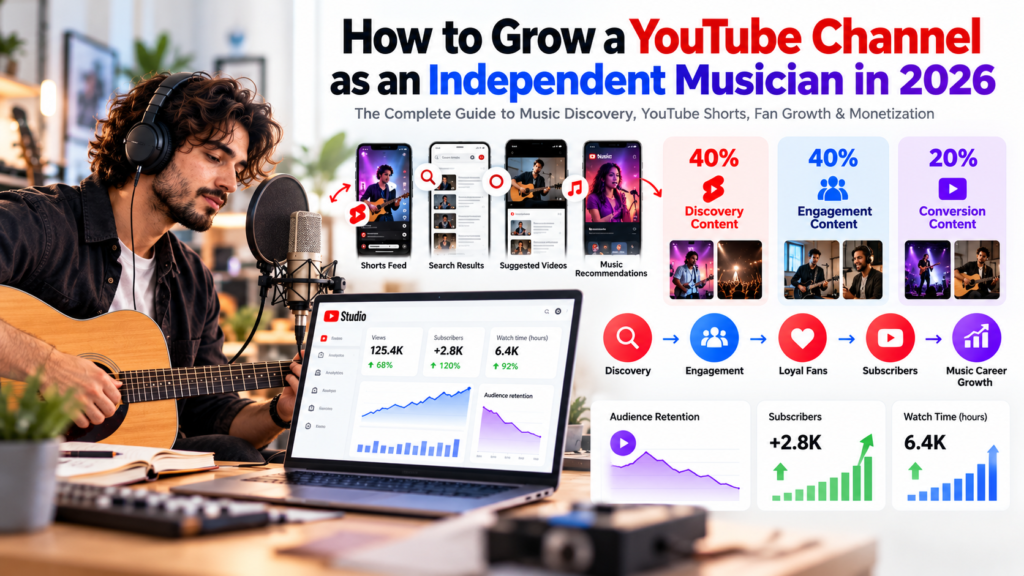
| Discovery Content | 40% of uploads | Reach new listeners who have never heard of you | YouTube Shorts, song hooks, trend clips, covers, genre-specific challenges |
| Engagement Content | 40% of uploads | Build connection with viewers already aware of you | Behind-the-scenes, songwriting sessions, studio breakdowns, gear tours, day-in-the-life |
| Conversion Content | 20% of uploads | Turn interested viewers into committed fans and subscribers | Official music videos, full live performances, album release videos, lyric videos |
The logic behind this ratio is the listener journey. Someone who discovers an artist through a 30-second Short has not yet decided whether to follow that artist. The engagement content — the behind-the-scenes footage, the songwriting process, the personality — is what converts casual discovery into genuine interest. The conversion content is what turns genuine interest into a subscriber who shows up for every new release.
Channels that post only official music videos are posting almost entirely conversion content for an audience that hasn’t been through the discovery and engagement phases yet. The music video is the end of the journey, not the beginning. That’s why channels with excellent music but only music video uploads consistently underperform channels that also show the person behind the music.
What Discovery Content Looks Like in Practice
Discovery content for a musician is anything that can reach a cold audience — someone who has never heard of you — in under 60 seconds and leave them wanting to hear more. The most effective formats are Shorts using the hook of your best track, covers of well-known songs in your style (which benefit from existing search demand), and trend-based clips that use a trending audio or format as the vehicle for introducing your sound.
Covers deserve specific attention. A cover of a popular song in your genre generates search traffic from people actively looking for that song — audiences who already enjoy the style of music you make. When they discover your cover, they’re one click from your original music. Many independent artists have grown their channels significantly faster through strategic cover uploads than through original releases alone.
What Engagement Content Looks Like in Practice
Engagement content is the behind-the-scenes world of your music. Recording sessions. The decision that changed a song’s direction. What a specific lyric really means and why you wrote it. The gear you use and why. A day on the road. Feedback on demo tracks. Arguments with collaborators.
This content doesn’t need to be polished. In fact, raw and unfiltered performs better than produced in this category — because the point is authenticity, not production value. Viewers watching this content are building a relationship with the person, not evaluating the artistry. A 5-minute smartphone-filmed studio session where you’re honest about what you’re struggling with will often outperform a fully produced documentary in this category.
What Conversion Content Looks Like in Practice
Conversion content is your best work, presented at the highest production quality your budget allows. Official music videos, full live performances, acoustic sessions, album documentaries. This is the content that justifies subscribing — that makes a viewer think ‘I want to see more of this when it comes out.’ It doesn’t need to be expensive. Many of the most effective music videos in 2026 are filmed simply with strong visual direction and intentional framing rather than elaborate production. What matters is that this content represents your music at its best.
How to Use YouTube Shorts as a Music Discovery Engine
YouTube Shorts generates over 200 billion daily views. For independent musicians, it is the single highest-reach surface available without any existing audience. Shorts are distributed to non-subscribers by default — meaning your content can reach millions of viewers who have never heard of you, without requiring a single person to already follow your channel.
In June 2026, YouTube made a change to the Shorts feed: it removed the dislike button and replaced the like button with a heart icon, mirroring Instagram and TikTok. Instead of dislikes, viewers can now signal ‘Not interested’ or ‘Don’t recommend this channel.’ It also added a Save button in July 2026, allowing viewers to add Shorts directly to playlists. Both changes affect how musicians should approach Shorts strategy.
What Works in Music Shorts in 2026
The most effective music Shorts for independent artists share a consistent structure: the hook of your strongest song playing within the first 2 seconds, a visual that immediately communicates mood or genre, and a clear end-frame that tells the viewer where to find more. That last part is critical — a Short that leaves a viewer wanting more but doesn’t direct them to your channel loses the conversion opportunity entirely.
The Save button addition means that Shorts can now be saved to playlists, which increases the likelihood that a viewer returns to your Short later and follows through to your main channel. Creating Shorts that viewers would want to save — a particularly striking musical moment, a short that works as a mood playlist addition — is now a valid strategic consideration.
Covers vs Originals in Shorts
Cover Shorts consistently generate higher initial view counts because they attach to existing search demand for the original song. A Short using the hook of a currently trending song in your style benefits from the recommendation momentum that song already has on the platform. The tradeoff is that cover Shorts attract viewers who came for the original artist’s music — converting them into followers of your original work requires that the Short demonstrates something about your own style that’s worth following.
The most effective approach is alternating: original track hooks to build your own identity, cover hooks to reach new audiences, with each Short ending consistently with the same call to action directing viewers to your main channel.
How to Bridge Shorts Viewers to Long-Form Content
Shorts subscribers and long-form subscribers behave differently. A viewer who followed you from a 30-second Short has not yet committed to watching a 10-minute video. The bridge between these two audience types requires deliberate content design.
The most reliable bridge is making Shorts that explicitly reference a longer video: ‘The full studio session is on the channel.’ End each Short with a visual that shows the kind of content your main channel posts. Create Shorts that tease a specific long-form video — a behind-the-scenes clip that ends mid-story, with the conclusion available on the main channel. The more specific the tease, the higher the click-through to long-form content.
Optimising Your Videos for YouTube Search and Discovery
YouTube search is the second-largest search engine in the world. For independent musicians, it is an underused acquisition channel — most artists optimise their releases for Spotify and Instagram but give minimal thought to how their YouTube videos appear in search results. The artists who grow fastest on YouTube typically combine social discovery (Shorts, trending content) with search discovery (properly optimised video metadata).
Title Optimisation for Music Videos
The default approach for a music video title is: Artist Name — Song Title (Official Music Video). That format works for established artists whose name already generates search volume. For an independent artist, almost nobody is searching for your name yet — so a title that’s only your name and song title will generate near-zero search traffic.
More effective title formats for independent artists include the genre, mood, or context of the song: ‘Late Night R&B — [Song Title] (Official Video),’ ‘Indie Folk Guitar Session — [Song Title],’ or ‘[Song Title] — Acoustic Version (Recorded Live in Studio).’ These titles capture viewers searching for music by mood, genre, and format — audiences who are actively looking for new music in the style you make, even if they’ve never heard of you specifically.
Descriptions That Work as Discoverability Tools
Most musicians write a two-sentence description for their videos. A description that’s 150 to 300 words — with the song name, artist name, genre, mood, and a brief story about the song in the first paragraph, followed by links to other platforms and a short bio — significantly outperforms a minimal description for both search ranking and viewer engagement.
The first 100 words of your description are the most important because that’s what YouTube shows before the ‘Show more’ cutoff. Front-load the most important terms: your song name, your name, the genre, and one sentence about what the listener is about to hear. Think of it as a micro-review of your own music — the kind of description that makes a viewer decide to press play.
Thumbnails for Music Channels
Music video thumbnails work differently from tutorial or vlog thumbnails. The emotional register of the image matters more than the information it conveys. A thumbnail that communicates the song’s mood — through lighting, expression, color grade, and composition — attracts viewers who are already in that emotional state. A thumbnail that looks like a stock photo or a generic release graphic communicates nothing about the experience of the song.
The most effective musician thumbnails in 2026 are either striking performance stills from the video itself, or simple artist portraits with the song title in a font and color treatment consistent with the release’s visual identity. Bright colors outperform dark ones for CTR in most genres except electronic and dark alternative, where the audience expects darker aesthetic signals.
Building an Upload Schedule That the Algorithm Rewards
Consistency of schedule matters more than frequency of uploads for most independent musicians. YouTube’s algorithm learns when your audience expects new content. A channel that publishes reliably on a schedule — even if that schedule is every two weeks — builds stronger algorithmic momentum than one that posts three videos in a week and then disappears for a month.
The realistic schedule for most independent musicians working without a team is one long-form video per week or two per month, supplemented by Shorts at whatever frequency is sustainable. Shorts are significantly faster to produce than long-form content and can be filmed in batches — spending two hours filming 10 Shorts once a week is more sustainable than producing a polished long-form video every week.
Planning Around Releases
The most effective content calendars for independent musicians are built around release cycles rather than arbitrary upload schedules. When you have a single or album coming out, the content in the four weeks before release does the work of building anticipation. The content in the two weeks after release converts the peak of interest into subscribers and streams. The content between releases maintains the relationship with viewers you’ve already earned.
| Timeline | Content Type |
Goal |
| 4 weeks before release | Teaser Shorts, songwriting behind-the-scenes, mood-setting content | Build anticipation, prime existing audience |
| 2 weeks before release | Full behind-the-scenes of the video shoot, lyric reveal | Generate pre-save interest, deepen engagement |
| Release week | Official music video, lyric video, acoustic version | Convert peak interest into views, subscribers, streams |
| 1 week after release | Reaction video, story behind the song, fan comment response | Sustain momentum, reward engagement |
| Between releases | Covers, collaborations, Q&A, studio sessions, gear content | Maintain audience relationship, build toward next release |
This framework treats each release as a content event rather than a single upload. The music video on release day is the peak of a content arc, not a standalone post. Artists who plan content this way consistently see higher view counts on their releases because the audience has been warmed up and engaged before the release date.
Collaborations — The Fastest Organic Growth Tool Available
YouTube allows up to five creators to collaborate on a single video upload, with the video appearing simultaneously on all five channels. For independent musicians, this is one of the most powerful growth mechanisms available — it’s the only native YouTube feature that can double or triple your channel’s exposure from a single piece of content.
A collaboration video with an artist in a related genre, whose audience would genuinely enjoy your music, exposes you to an audience that already has the right taste profile. They’re not random viewers — they’re people who have already demonstrated interest in the style of music you make. Subscriber conversion rates from collaboration views are consistently higher than from almost any other traffic source.
How to Find the Right Collaborators
The most effective collaborations happen between artists with overlapping but non-identical audiences. Look for channels in adjacent genres with a similar subscriber count — not larger channels who won’t benefit from the collaboration, and not smaller channels that would primarily benefit from your audience without reciprocating much. Genre adjacency matters more than size: a hip-hop artist collaborating with an R&B vocalist reaches an audience that genuinely bridges both genres. A hip-hop artist collaborating with a classical pianist might generate curiosity clicks but lower subscriber conversion because the audience overlap is smaller.
What Collaboration Content Works Best
Cover songs performed together perform consistently well — they benefit from the original song’s search demand and showcase both artists’ styles in a single performance. Original collaborations (co-written tracks performed together) have higher artistic value but require more coordination. Behind-the-scenes content from a collaborative session — the process of two artists writing or recording together — consistently generates strong engagement because it combines the human interest of collaboration with genuine musical content.
How to Read Your YouTube Analytics as a Musician
Most musicians check view counts and subscriber numbers. Those two metrics tell you almost nothing useful about why your channel is or isn’t growing. The analytics that actually matter — and that most artists never look at — are the ones that reveal viewer behaviour rather than totals.
The Metrics That Actually Drive Growth
Click-through rate (CTR): What percentage of viewers who saw your thumbnail clicked it. Below 3% means your thumbnail or title is not connecting with the audience YouTube is showing it to. Above 6% means both are working well. Check CTR video by video in the Content tab — your music videos and your behind-the-scenes content will have very different CTR benchmarks.
Average view duration: How long viewers are watching on average. For music videos, 50–70% is strong. For longer behind-the-scenes content, 40–55% is good. Below 30% on any format means viewers are leaving before getting value.
Traffic Sources: Where your views are coming from. YouTube Search, Browse Features, Shorts Feed, Suggested Videos, and External sources all tell different stories. A music channel growing well has a mix — Search traffic shows SEO is working, Browse traffic shows the algorithm is distributing your content proactively.
Returning viewers: The percentage of your views coming from people who have watched your channel before. A growing returning viewer metric means your audience is building a habit around your content. A declining one means people watch once but don’t come back — which is a content or consistency problem.
The YouTube Analytics Explained guide on Vedzzy covers every section of YouTube Studio in detail, including exactly how to read the Traffic Sources tab and audience retention graph — the two most useful data points for understanding what’s actually driving or limiting your channel’s growth.
When and How to Use Paid Promotion as a Musician
Most independent musicians encounter paid promotion in one of two forms: social media ads (Instagram, Facebook, TikTok) and YouTube advertising. They’re different mechanisms with different outcomes, and understanding why matters before spending anything.
Social media ads drive traffic to a destination — they show your music to someone and hope they click through to Spotify, YouTube, or a streaming platform. The conversion journey is long: see the ad, feel interested, click through, find the link, start listening. YouTube advertising is different. The ad is the experience. Your video plays directly on YouTube, the viewer is already on the platform, and if they engage, the data goes directly into the YouTube algorithm’s model for your channel.
What YouTube Advertising Actually Does for a Music Channel
A YouTube advertising campaign run through Google Ads delivers your video as an in-stream ad to real YouTube users who match your target audience — genre interest, age range, geographic location, viewing behaviour. When those viewers watch 30 seconds or click through, they generate real watch time and retention data that YouTube’s algorithm records and uses to inform future organic distribution.
For independent musicians, this matters in two specific situations. First, when you have a new release and want it to reach your target audience immediately rather than waiting for organic search traffic to build. Second, when your channel has strong content and solid retention but the algorithm hasn’t yet built enough data to distribute it proactively — injecting real engagement signals through legitimate promotion can trigger the broader organic distribution that the algorithm needs data to justify.
Real Results From Music Channel Promotion Campaigns
Two music artist campaigns run through Vedzzy’s Google Ads-based promotion illustrate what legitimate promotion produces when the content is strong. A hip-hop artist’s channel moved from 1,200 views to 52,000 views in 10 days, triggering YouTube’s organic recommendation system with a 340% subscriber growth rate during and after the campaign. An R&B artist moved from 950 views to 41,000 views in 9 days, with a 4.2% subscriber conversion rate from promoted views — above average for the music niche, reflecting how well-targeted the audience matching was.
Both campaigns used genre and demographic targeting — not broad ‘music fans’ audiences, but specific profiles matching the genre, age range, and geographic markets most relevant to the artist’s style. The views from both campaigns appeared in YouTube Studio’s Traffic Sources as ‘YouTube advertising’ with full watch time and retention data attached. That verification is the standard to hold any promotion service to: if the views don’t show up there, they didn’t come through YouTube’s legitimate advertising infrastructure.
What to Have Ready Before You Promote
Promotion amplifies content that’s already performing. Before spending on any campaign, check your average view duration on the video you want to promote. If viewers are watching 40% or more on average, the content is strong enough to generate positive engagement signals from a promoted audience. Below 35%, the promoted viewers will leave early — generating poor retention data that can actually suppress the video’s organic reach rather than expanding it.
The right time to promote is after a new release when you have a video you’re genuinely proud of and your analytics show that viewers who find it are watching past the hook. That’s when promotion produces compounding results — the paid views generate real data, the real data triggers organic distribution, and the organic distribution continues building after the campaign ends.
Monetisation Options for Independent Musicians on YouTube
YouTube offers independent musicians more distinct revenue streams than any other platform. Understanding all of them — not just ad revenue — is important for building a sustainable channel.
|
Revenue Stream |
How It Works | Requirement |
Realistic Potential |
| Ad Revenue (YPP) | Ads shown on your long-form videos and eligible Shorts | 1,000 subs + 8,000 watch hours (from Feb 2027) | Scales with views — low early, significant at scale |
| Content ID Royalties | Revenue from other creators using your music | Music distributed through eligible distributor | Passive — grows with catalog and usage |
| YouTube Music Streams | Royalties when your music is streamed on YouTube Music | Music distributed to YouTube Music | Per-stream royalty — accumulates with streams |
| Super Thanks | One-time fan payments on individual video uploads | YPP membership | Strongest on release day and live content |
| Super Chat | Fan payments during live streams highlighted in chat | YPP membership + live streaming | Highest potential during planned live events |
| Channel Memberships | Monthly fan subscriptions for exclusive perks | YPP membership + 500+ subscribers | Predictable recurring income from loyal fans |
| YouTube Shopping | Direct product/merch sales from YouTube | YPP membership, eligible country | Strong for artists with established merchandise |
| Premium Lite Revenue | Share of YouTube Premium Lite subscription pool | YPP membership | Distributed by watch time — grows with retention |
The most underutilised of these is Content ID. Independent artists who have distributed their catalog through a service that includes Content ID are earning passive royalties from every fan video, workout playlist, vlog, gaming stream, and compilation that uses their music — often without knowing it’s happening. If your music has been distributed for more than a year and you haven’t confirmed your Content ID is active, check with your distributor immediately. Revenue from the past 12 months may be unclaimed.
The Growth Timeline — What to Expect at Each Stage
Setting realistic expectations is important for independent musicians building on YouTube. The channels that succeed are the ones that understand what each stage looks like and don’t quit during the periods that feel like nothing is happening.
0 to 100 Subscribers — The Foundation Stage
This stage is the hardest because YouTube has almost no data about your channel yet. Most of your views will come from YouTube Search — people finding specific videos because they searched for the song, the genre, or a related topic. Focus on getting your channel setup right (OAC, Content ID, description, branding), publishing consistently, and optimising every video’s title and thumbnail for search rather than Browse. Don’t evaluate the strategy based on results from this stage — it’s data-gathering, not audience-building.
100 to 1,000 Subscribers — The Momentum Stage
Between 100 and 1,000 subscribers, the algorithm begins building a reliable model for your channel’s audience. Browse traffic — your videos appearing on the home pages of new potential viewers — starts increasing. This is when content consistency has the highest leverage: each video adds another data point the algorithm uses to refine who it shows your content to. Artists who reach 1,000 subscribers typically hit the second 1,000 significantly faster than the first, because the algorithm has accumulated enough data to distribute proactively. The How Long Does It Take to Get 1000 Subscribers guide on Vedzzy covers the exact mechanics of this compounding growth in detail, including the watch hour math that runs parallel to your subscriber count.
1,000 to 10,000 Subscribers — The Credibility Stage
Reaching 1,000 subscribers and the YPP threshold (4,000 watch hours under current rules, 8,000 from February 2027) opens ad revenue, fan funding, and membership features. More practically, a channel with 1,000 to 10,000 subscribers has credibility that opens collaboration opportunities with similar-sized artists who previously wouldn’t have responded. Blog and playlist curators are more likely to feature channels with verified engagement history. Labels and sync licensing opportunities become more realistic. The growth in this stage is faster than the first 1,000 because every new subscriber arrives at a channel with more content, more social proof, and stronger algorithmic distribution.
10,000+ Subscribers — The Compounding Stage
At 10,000 subscribers, YouTube’s algorithm has a highly refined model for your channel’s audience. Your videos are being distributed to new viewers continuously, your catalog is generating compounding watch time, and your Content ID library is producing passive royalties from years of accumulated distribution. The channel at this stage is an asset rather than an ongoing project — it keeps generating discovery, engagement, and revenue even between active releases. Most independent musicians who reach this stage find that the channel itself becomes one of their most valuable promotional tools for every new release, because a new single uploaded to a 10,000-subscriber channel immediately reaches thousands of interested viewers on day one.
Frequently Asked Questions
How often should an independent musician post on YouTube?
One long-form video per week is a strong cadence if you can sustain it. Two to three per month is realistic for most independent artists working without a team. The more important factor is consistency — posting every two weeks reliably produces better algorithmic results than posting three times in one week followed by silence. Supplement your long-form schedule with Shorts, which are faster to produce and can be batched in a single session. The algorithm rewards reliable patterns more than high frequency.
Does YouTube actually help independent musicians get discovered?
Yes — and it’s the platform where 60% of listeners discover new artists first. The key distinction is that discovery on YouTube happens through video content, not just audio. Artists who post only music videos grow significantly slower than artists who also post behind-the-scenes content, Shorts, covers, and engagement content that gives the algorithm more surface area to work with. An independent musician posting one music video per month will grow much slower than one posting two long-form videos and four Shorts per month, even if the music quality is identical.
What kind of videos should a musician post on YouTube besides music videos?
The content that consistently drives the fastest growth for musician channels is behind-the-scenes footage from recording sessions, songwriting breakdowns that explain the story behind specific lyrics or chords, covers of popular songs in your genre, acoustic or stripped-down versions of your own tracks, gear tours and studio setup videos, and day-in-the-life content that gives viewers a sense of who you are beyond the music. The common thread is that all of these show the person behind the music — which is what converts a casual listener into a genuine fan.
Should I use YouTube Shorts as a musician?
Yes — Shorts is currently the highest-reach surface available to independent musicians with no existing audience. Shorts are distributed to non-subscribers by default, meaning a good Short can reach thousands or millions of viewers who have never heard of you without requiring any existing following. The most effective approach is using strong hooks from your original tracks, covers of trending songs in your style, and behind-the-scenes clips that end with a clear direction to your main channel. Bridge your Shorts audience to long-form content by explicitly referencing specific videos — not just your channel in general.
How do I get an Official Artist Channel on YouTube?
You need to distribute your music through an approved distributor — DistroKid, TuneCore, Symphonic, CD Baby, and most major distributors qualify. Once your music is live on YouTube Music through distribution, your distributor can claim an Official Artist Channel on your behalf through their dashboard, or you can request one through YouTube’s Help Center. The process typically takes 1 to 4 weeks. An OAC merges your video channel with your YouTube Music profile, adds a music note badge to your channel name, and gives your channel priority placement in music-related search results.
How does Content ID work for independent musicians?
Content ID is YouTube’s automatic rights management system. When your music is registered with Content ID through your distributor, YouTube’s audio fingerprinting technology identifies every video on the platform that uses your music — fan videos, covers, compilations, vlogs with your song as background music. For each of those videos, YouTube either redirects the ad revenue to you or blocks the video in specific territories, depending on your Content ID policy settings. Most independent artists set their policy to ‘monetize’ rather than ‘block,’ which means every fan video using your music becomes a passive revenue stream. Content ID revenue averages around $1.57 per 1,000 views globally, with US-sourced claims typically much higher.
Can YouTube promotion help an independent musician grow faster?
Yes, when used correctly and at the right stage. YouTube advertising through Google Ads delivers your video to real viewers who match your target audience by genre interest, age, and geography. Those viewers generate real watch time and retention data that feeds into YouTube’s algorithm — which can trigger broader organic distribution after the campaign ends. The condition that makes this work is content quality: if your videos generate 35% or higher average view duration from promoted viewers, the engagement signals are positive and organic growth follows. If retention is below that, improving the content before promoting is more valuable than the campaign itself.
What equipment do I actually need to start a YouTube music channel?
Less than most musicians assume. A modern smartphone — any flagship from the past three years — produces video quality that is more than sufficient for YouTube. The investment that matters most is audio quality: a USB condenser microphone in the $40 to $80 range produces dramatically better audio than any built-in camera microphone, and audio quality is the primary factor viewers use to judge production value in music content. Natural window lighting outperforms no-lighting setups and costs nothing. The most effective independent musician channels in 2026 are built primarily on smartphone footage with decent microphone audio — not expensive camera rigs.

Hi, I am Jason, a digital content strategist with 8 years of experience helping YouTube creators and brands grow their channels through data-driven content decisions. I have worked with creators across niches including tech, education, and lifestyle, and specialise in translating YouTube Analytics data into actionable growth strategies.
Categories: YouTube, YouTube Growth Tips