Legit YouTube Promotion Service by Vedzzy – Why It Matters for Your Channel
Posted on September 12, 2026 by Jason Caldwell
The YouTube promotion industry has a serious trust problem. Type ‘YouTube promotion service’ into any search engine and you’ll find hundreds of websites making identical promises. Real views. Guaranteed growth. Fast results. Most of them deliver none of those things.
The services that actually harm channels don’t announce themselves as scams. They use words like ‘organic,’ ‘real,’ and ‘safe’ while quietly delivering bot traffic that YouTube detects and removes — leaving the creator with a damaged channel, wasted money, and no path to recovery.
This article explains exactly what a legit YouTube promotion service looks like, how Vedzzy’s promotion works technically, how you can verify every result directly in your own YouTube Studio dashboard, and what realistic outcomes look like at different budget levels. If you’re evaluating YouTube promotion options, this is everything you need to make an informed decision before spending anything.
What Makes a YouTube Promotion Service Legitimate
Legitimate YouTube promotion and fake YouTube promotion look identical from the outside. Both promise views. Both show view counts going up. The difference only becomes visible when you look at three things: where the traffic comes from, whether that traffic shows up in YouTube Studio with real engagement data, and whether the views produce any lasting algorithmic effect.
There are three types of YouTube promotion in the market right now. Understanding the difference between them is the first step in evaluating any service.
Type 1: Google Ads-Based Promotion — The Only Fully Legitimate Method
Google Ads-based promotion runs your video as a paid advertisement through YouTube’s own advertising infrastructure. Your video appears as an in-stream or in-feed ad to real YouTube users who match your target audience profile. When they watch 30 seconds or click through, you pay. The views they generate are real, come from real accounts, and produce real watch time data.
These views appear in your YouTube Studio Analytics under Traffic Sources as ‘YouTube advertising’ — with full watch time, demographic, audience retention, and subscriber conversion data attached. Because the entire campaign runs through Google’s own systems, it is 100% compliant with YouTube’s terms of service. YouTube built the advertising system. Running ads through it is not a policy violation by any definition.
Type 2: Bot and Click Farm Traffic — The Most Common Scam
Bot-based services use automated scripts or low-paid click farm workers to generate view counts without real viewers. The view number goes up. But there’s no corresponding watch time, no real engagement, and no demographic data because real people aren’t watching. YouTube’s detection systems identify these patterns consistently — sudden view spikes without matching engagement, traffic from IP ranges that don’t match claimed geographies, watch time that’s too low or too uniform to reflect real viewing behaviour.
Channels that receive bot traffic don’t just fail to grow. They accumulate detection flags that affect future distribution. In serious cases, YouTube resets view counts, reduces the channel’s algorithmic reach, or flags the channel permanently in the YPP review system.
Type 3: Incentivised and Panel Traffic — The Grey Area That Still Harms
Some services use traffic panels — networks of real people paid small amounts to watch videos. The views come from real accounts, which makes them harder to detect than bots. But the viewers have no interest in the content. They watch because they’re paid to, not because the video appeared relevant to them. This produces poor retention data — viewers who leave quickly, don’t subscribe, and don’t engage. That poor retention data feeds directly into YouTube’s algorithm as a negative signal, reducing the video’s organic distribution rather than expanding it.
The test that separates all three types is the same: do the views appear in your YouTube Studio Traffic Sources tab as ‘YouTube advertising’ with real watch time and demographic data? Google Ads-based promotion passes this test. Bot traffic and panel traffic don’t appear there at all.
How Vedzzy’s Promotion Service Works — Step by Step
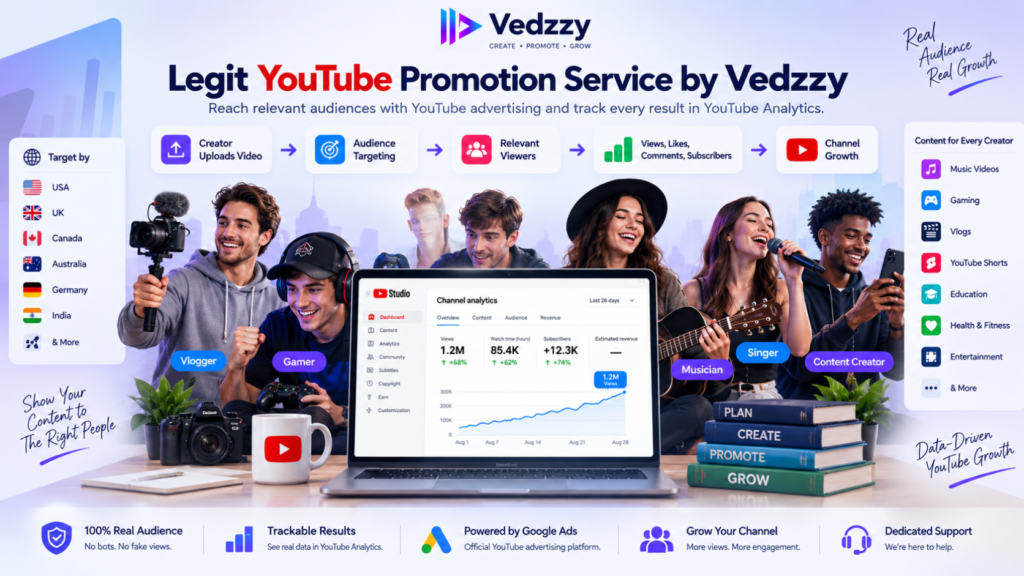
Vedzzy runs all promotion campaigns through certified Google Ads infrastructure. That’s not a marketing claim — it’s a technical description of exactly how campaigns are built and delivered. Here’s what the process looks like from start to finish.
Step 1: Campaign Setup and Audience Targeting
When you start a campaign with Vedzzy, the first step is identifying your target audience. This isn’t a generic ‘interested in YouTube’ bucket. It’s a specific audience profile built around your video’s topic, your channel’s niche, viewer demographics, and geographic targeting relevant to your content.
For a hip-hop music channel, that audience might be YouTube users aged 18–34 in English-speaking markets who regularly watch music content in the hip-hop and R&B categories. For a gaming channel, it might be users aged 16–28 who watch gaming content regularly and have recently engaged with titles in your game’s genre. The specificity of this targeting is what determines whether the views your campaign generates are useful — a promoted view from someone genuinely interested in your niche behaves completely differently from a generic impression.
Step 2: Ad Format and Delivery
Vedzzy primarily uses skippable in-stream ads — the format that plays before or during other YouTube videos and can be skipped after 5 seconds. You pay only when a viewer watches 30 seconds of your video (or the full video if it’s shorter than 30 seconds), or clicks through to your channel.
This format has a built-in quality filter that most creators don’t think about. Every viewer who generates a paid view made an active decision. They saw your thumbnail and first 5 seconds, decided it was worth watching, and didn’t skip. That self-selection means the viewers who generate your campaign’s views have already demonstrated some level of interest in the content — which is why retention rates from properly targeted promotion campaigns are meaningfully higher than from generic or bot-based services.
Step 3: Delivery and Monitoring
Once the campaign is live, views accumulate through YouTube’s own ad delivery system. The delivery is gradual and paced to match natural viewing patterns — not a sudden spike of thousands of views in an hour, which would trigger YouTube’s anomaly detection regardless of whether the views were real. The pacing matters because YouTube monitors view velocity as part of its authenticity checks.
Every view delivered is tracked inside Google Ads with full data: impression count, view count, view rate (the percentage of people who chose to watch past the skip point), average watch time per view, and geographic distribution. This data is separate from your YouTube Studio analytics but consistent with it.
Step 4: Verification in YouTube Studio
This is the step that matters most. Open YouTube Studio. Go to Analytics. Select the Reach tab. Expand Traffic Sources. If Vedzzy’s campaign has been running, you will see a line entry labelled ‘YouTube advertising’ — with view count, watch time, average view duration, and the geographic and demographic breakdown of the viewers who came through the campaign.
This verification exists because the views were delivered through YouTube’s own advertising infrastructure. YouTube logs every ad-driven view in the creator’s analytics automatically. You don’t need to take Vedzzy’s word for anything. The data is in your own dashboard, reported by YouTube directly.
Why Legitimate Promotion Helps the Algorithm — The Mechanic Explained
Most creators understand that views are good. Fewer understand why views from a legitimate promotion campaign are specifically useful for triggering organic growth — and what the mechanism is.
The Cold Start Problem
When you upload a new video, YouTube distributes it first to a small test audience — typically your existing subscribers and a limited sample of users who match your channel’s established audience profile. It measures their response: click-through rate, watch time, and audience retention. If those signals are strong, it expands distribution. If they’re weak, it pulls back.
For small or new channels, this test audience is tiny. The channel has few existing subscribers and limited watch history for YouTube to learn from. So even excellent content can fail to generate the engagement signals needed for wider distribution simply because not enough people saw it in the first place. The video never gets a fair evaluation.
How Promotion Injects Real Engagement Data
A legitimate promotion campaign puts your video in front of a targeted, real audience — thousands of viewers who match your content’s intended demographic. Those viewers generate real watch time, real retention data, and real subscriber conversions. YouTube’s algorithm receives a meaningful set of engagement signals from that audience.
If those signals are strong — above-average retention, reasonable subscriber conversion rate, engagement behaviour that matches what organic viewers in that niche typically produce — YouTube recognises that the video is worth showing to more people. It begins distributing the video organically to similar audiences. Views, watch time, and subscribers continue accumulating after the paid campaign ends.
This compounding effect is what makes legitimate promotion different from simply buying a view count. The views themselves are the means. The engagement data they generate is the actual mechanism that produces lasting growth.
What Promotion Cannot Do
It’s worth being direct about this. Promotion amplifies content that’s already working. It doesn’t fix content that isn’t.
A video with a 15% average retention rate — meaning most viewers leave in the first minute or two — will not generate strong engagement signals from a promotion campaign. The real viewers will watch briefly and leave, generating poor retention data that the algorithm interprets as a quality signal against the video. Spending money on promotion in this scenario produces low-quality campaign data and no organic lift.
The right time to consider promotion is after you’ve confirmed that your content generates decent retention — at least 35–40% average view duration, with the audience retention graph showing a gradual decline rather than a steep cliff in the first 30 seconds. That’s the content that benefits from more exposure, because the exposure generates positive signals that compound.
Real Campaign Results — What Vedzzy Has Delivered
Results from promotion campaigns vary by niche, content quality, audience targeting, and budget. The examples below reflect real campaigns run through Vedzzy’s Google Ads infrastructure on channels with solid content that had not yet broken through organically.
| Hip-Hop Music Artist — 10-Day Campaign
Starting position: 1,200 channel views | Ending position: 52,000 views Timeframe: 10 days Key outcome: Triggered YouTube’s organic recommendation system Subscriber growth: 340% increase during and immediately following the campaign What happened: Strong hook retention from the targeted hip-hop audience generated algorithm signals that pushed the video into Suggested Videos placements — continuing to accumulate views after the campaign ended. |
| Gaming Channel — 12-Day Campaign
Starting position: 2,100 channel views | Ending position: 78,000 views Timeframe: 12 days Key outcome: Video entered YouTube Search results for target keywords organically post-campaign What happened: The volume of real watch time generated by the targeted gaming audience gave the video enough search ranking authority to appear organically for the terms it had been optimised for — organic search traffic continued after campaign ended. |
| Health and Wellness Channel — 7-Day Campaign
Starting position: 800 channel views | Ending position: 30,000 views Timeframe: 7 days Key outcome: Watch time milestone crossed — YouTube Partner Program eligibility accelerated What happened: Campaign delivered watch time that counted directly toward the 4,000-hour YPP threshold. Channel reached monetization eligibility weeks ahead of the organic timeline. |
| R&B Artist — 9-Day Campaign
Starting position: 950 channel views | Ending position: 41,000 views Timeframe: 9 days Key outcome: 4.2% subscriber conversion rate from promoted views — above average for the music niche What happened: Highly specific audience targeting (R&B listeners in the US and UK aged 18–35) produced viewers whose interests matched the content closely — resulting in higher-than-average subscriber conversions from promoted views. |
These results reflect campaigns where strong content met legitimate, well-targeted promotion. They are not guaranteed outcomes — niche competition, content quality, and targeting precision all affect what any individual campaign produces. What they demonstrate is the ceiling of what legitimate promotion can do when the conditions are right.
For creators building toward their first 1,000 subscribers, the watch time and subscriber data from these campaigns counts directly toward both YPP thresholds. Understanding exactly how that data feeds into your monetization timeline is covered in detail in the How Long Does It Take to Get 1000 Subscribers on YouTube guide.
Vedzzy Pricing — What Campaigns Cost and What They Include
Vedzzy campaigns start from $9. The cost structure is straightforward: you pay per view delivered, at a rate that reflects the targeting precision and geographic focus of your campaign.
| Campaign Level | Approx. Budget | Expected Views | Best For |
| Entry | $9 – $50 | 500 – 3,000 views | Testing promotion, single video boost, very early channels |
| Starter | $50 – $150 | 3,000 – 10,000 views | Channels with 100–500 subscribers building momentum |
| Growth | $150 – $400 | 10,000 – 30,000 views | Channels actively working toward YPP thresholds |
| Acceleration | $400 – $800 | 30,000 – 70,000 views | Channels ready to break into significant organic distribution |
| Scale | $800+ | 70,000+ views | Established channels scaling reach strategically |
These view estimates reflect mid-range niche targeting. Finance, health, and legal content typically costs more per view due to higher advertiser competition in those categories. Gaming, music, and general entertainment content typically costs less. Geographic targeting also affects cost — US and UK audiences cost more per view than Southeast Asian or South Asian audiences.
Every campaign includes full audience targeting, gradual natural delivery, and all views appear in your YouTube Studio Traffic Sources as ‘YouTube advertising’ with complete engagement data. There are no hidden fees and no packages that promise outcomes Vedzzy cannot deliver through legitimate Google Ads infrastructure.
How to Verify Your Vedzzy Campaign Results in YouTube Studio
This is the most important practical section in this article. Every creator who uses any promotion service should know how to verify results independently — not from the service’s own reporting, but directly from YouTube’s own data.
The 4-Step Verification Process
Step 1: Open YouTube Studio at studio.youtube.com and log into your account.
Step 2: Click Analytics in the left sidebar. Set the date range to include the period your campaign ran.
Step 3: Click the Reach tab at the top of the Analytics page.
Step 4: Scroll down to the Traffic Sources section and expand it. Look for ‘YouTube advertising’ as a listed traffic source.
If legitimate promotion views were delivered, ‘YouTube advertising’ will appear with a view count, total watch time in hours and minutes, average view duration, and a geographic and demographic breakdown of those viewers. This data comes directly from YouTube’s systems — not from Vedzzy’s reporting. YouTube logged it automatically because the views came through the official ad infrastructure.
What Each Data Point Tells You
View count: The total number of views delivered through the campaign. Compare this against what Vedzzy reported — they should match or be very close.
Average view duration: How long the promoted viewers watched on average. Strong targeting typically produces average view durations above 40% of the video’s length. Below 30% suggests the audience targeting may need adjustment.
Watch time (hours): Total watch time contributed by promoted views. This counts toward your YPP 4,000 or 8,000-hour threshold if your channel isn’t yet monetized.
Geographic breakdown: Where the promoted viewers came from. Should match the geographic targeting of your campaign. If you targeted UK and US viewers and the data shows predominantly Southeast Asian traffic, the delivery did not match the targeting.
The YouTube Analytics Explained guide on Vedzzy covers the Traffic Sources tab in full detail, including how to compare promoted traffic against organic traffic and how to use that comparison to evaluate campaign quality.
The Single Verification Question
Before using any YouTube promotion service, ask them one question: ‘Will these views appear as YouTube advertising in my Traffic Sources tab in YouTube Studio?’
A legitimate service answers yes, immediately and without qualification. If the answer is unclear, evasive, or if they tell you to look at a different dashboard or third-party report instead of your own YouTube Studio data — that’s the answer. Don’t use the service.
Who Benefits Most From YouTube Promotion
Promotion is not the right move for every channel at every stage. The creators who see the strongest results from a Vedzzy campaign share a specific set of characteristics.
Channels With Strong Content But Slow Organic Growth
This is the most common situation. The creator has produced 10–20 videos. The content is genuinely good — strong hook, clear value, above-average retention. But organic growth is moving slowly because the channel has limited watch history for the algorithm to learn from. Promotion injects real engagement data that the algorithm can act on, breaking the cold-start loop.
Creators Working Toward YPP Thresholds
With the new 8,000 watch hour requirement taking effect February 1, 2027, creators who are at 2,000–5,000 hours and on a tight timeline benefit directly from promotion. Every legitimate promoted view generates watch time that counts toward the threshold. A well-targeted campaign delivering 30,000 views at 60% average retention generates 180,000 minutes — or 3,000 hours — of watch time. That’s a meaningful acceleration toward a milestone with a real deadline.
Music Artists and Creative Channels With Niche Audiences
Music, art, and other creative channels often face the specific challenge of highly targeted content meeting a scattered, hard-to-reach organic audience. A promotion campaign that targets viewers in the right genre and demographic brings the content directly to the people most likely to engage with it — and subscribe. The R&B artist result above (4.2% subscriber conversion rate) reflects what happens when content meets a precisely matched audience.
Channels That Are NOT Ready for Promotion
A channel with weak retention — average view duration below 30% — should fix its content before spending on promotion. Sending real viewers to a video that doesn’t hold their attention generates poor campaign data and no organic lift. The investment is wasted.
Similarly, a channel with fewer than 5 published videos hasn’t given visitors enough content to make a subscribe decision. New subscribers who arrive at a mostly empty channel often don’t stay. Build the foundation first, then promote.
Legit YouTube Promotion vs Fake Promotion — The Full Comparison
| Factor | Legit Promotion (Google Ads) | Bot / Panel Traffic |
| Traffic source | Real YouTube users served through Google’s ad auction | Automated bots or paid click farm workers |
| Appears in YouTube Studio | Yes — as ‘YouTube advertising’ with full data | No — does not appear in Traffic Sources |
| Watch time data | Real watch time attached to every view | No watch time or artificially inflated numbers |
| Retention quality | Matches targeting — typically 35–60%+ average | Very low — bots don’t watch, panel viewers leave quickly |
| Subscriber conversions | Real subscribers who found the content relevant | None or fake accounts that drop off quickly |
| Algorithm impact | Positive — real signals trigger organic distribution | Neutral to negative — poor data suppresses distribution |
| YouTube ToS compliance | Fully compliant — YouTube built the ad system | Violates ToS — risks channel strikes and bans |
| YPP watch time count | Yes — counts toward 4,000 or 8,000 hour threshold | No — YouTube removes detected fake watch time |
| Verifiable in Studio | Yes — independently verifiable by creator | No — no verification possible |
| Long-term channel impact | Positive — builds algorithmic history | Negative — creates detection flags |
The difference isn’t subtle. On every dimension that matters for channel growth, legitimate Google Ads-based promotion produces outcomes that compound — while bot and panel traffic produces outcomes that either disappear or actively harm the channel’s standing with YouTube’s systems.
Common Questions Creators Ask Before Starting a Campaign
Do I need a minimum number of subscribers to use Vedzzy?
No. Campaigns can run on channels with zero subscribers. The view targeting and delivery work the same regardless of channel size. However, channels with more published videos typically see higher subscriber conversion rates from promoted views — because visitors who like the promoted video have other content to explore and a reason to subscribe. Channels with fewer than 5 videos can still run campaigns, but may see lower subscriber conversion than channels with a more developed content library.
How long does a campaign run?
Campaign duration depends on budget and delivery pacing. Entry-level campaigns typically run 5–10 days. Mid-range campaigns run 10–21 days. Longer campaigns give the algorithm more time to learn from the engagement data and expand organic distribution. A campaign that runs for 14 days produces more compounding organic value than the same budget delivered in 3 days — because the gradual delivery of real engagement signals allows the algorithm’s distribution decisions to build progressively rather than triggering anomaly flags from a sudden spike.
Can I target a specific country or language?
Yes. Geographic and demographic targeting is part of every Vedzzy campaign setup. This matters for two reasons. First, the cost per view varies significantly by country — US and UK views cost more than views from most other markets. Second, and more importantly, the audience that comes from your promoted views should match the audience that will engage with your content long-term. Promoting a Hindi-language cooking channel to English-speaking US audiences produces poor retention and poor subscriber conversion, regardless of how many views are delivered.
What types of videos work best for promotion?
Videos that perform best in promotion campaigns share three characteristics: a strong hook that retains viewers past the 5-second skip point, clear and genuine value delivered within the first 60 seconds, and a topic that is genuinely relevant to the targeted audience. Tutorial and educational content typically performs well because viewers who click through have a specific problem they want solved — which drives strong retention. Music content performs well when targeted to the right genre audience. Vlog and entertainment content performs more variably depending on how clearly the hook communicates the video’s appeal to a cold audience.
Will promotion help my videos rank in YouTube search?
Indirectly, yes. YouTube search ranking is influenced by engagement signals — watch time, click-through rate, and audience retention — as well as metadata optimisation. A promotion campaign that generates significant real watch time on a well-optimised video increases the total engagement signals associated with that video, which can improve its search ranking over time. The R&B gaming channel example above (78,000 views in 12 days) resulted in the video entering organic search results for target keywords — a direct outcome of the volume of real engagement data the campaign generated.
Frequently Asked Questions
Is Vedzzy a legitimate YouTube promotion service?
Yes. Vedzzy runs all promotion campaigns through Google Ads infrastructure — the same official advertising system that YouTube itself built for brands and creators. Every view delivered appears in the creator’s YouTube Studio Analytics under Traffic Sources as ‘YouTube advertising,’ with full watch time, demographic, and audience retention data. This is independently verifiable by the creator directly in their own dashboard. Campaigns run through Google’s ad auction, meaning views come from real YouTube users who were shown the video as an ad and chose to watch.
How is Vedzzy different from fake YouTube promotion services?
The fundamental difference is infrastructure. Vedzzy uses Google Ads, which means views come from real YouTube users through YouTube’s own ad delivery system. Fake services use bots, click farms, or incentivised panel workers — none of which produce real views that appear in YouTube Studio’s Traffic Sources tab. The practical test is simple: run a campaign and check your YouTube Studio Traffic Sources tab. Vedzzy-delivered views appear as ‘YouTube advertising.’ Fake service views appear nowhere in that tab because they didn’t come through YouTube’s legitimate advertising system.
Will buying YouTube views get my channel banned?
Buying views through bot services or click farms violates YouTube’s terms of service and can result in view count resets, reduced algorithmic distribution, or permanent disqualification from the YouTube Partner Program. Buying views through YouTube’s own official advertising infrastructure — Google Ads — is completely compliant with YouTube’s policies. YouTube designed and built the advertising system. Using it is not a violation. The distinction between these two approaches is the entire basis of what makes a promotion service legitimate or harmful.
Do promoted views count toward YouTube Partner Program watch hours?
Yes — views delivered through Google Ads infrastructure generate real watch time that counts toward the YPP 4,000-hour threshold (or 8,000 hours under the new 2027 requirements). This is because the views come from real viewers who generated real watch time, which YouTube’s system records automatically. Views from bot services or click farms do not count — YouTube removes detected fake watch time from the total, and relying on it for YPP qualification creates a channel that appears to meet the threshold but fails the review.
How do I know if the views I receive are real?
Open YouTube Studio and navigate to Analytics, then the Reach tab, then Traffic Sources. Legitimate promotion views delivered through Google Ads appear as ‘YouTube advertising’ with view count, watch time, average view duration, and geographic data all clearly listed. This data comes directly from YouTube’s systems — not from the promotion service’s reporting. If a service’s views don’t appear in this tab, they were not delivered through YouTube’s legitimate advertising infrastructure.
What is the minimum budget to start a Vedzzy campaign?
Vedzzy campaigns start from $9. Entry-level campaigns in this range deliver several hundred to a few thousand views depending on niche and geographic targeting. This is a useful starting point for testing promotion on a specific video before committing to a larger budget — the Traffic Sources verification process works the same at any budget level, so a small test campaign gives you all the data you need to evaluate whether promotion is producing the right audience for your content.
How long does it take to see results from a promotion campaign?
Promoted views begin accumulating from the first day a campaign goes live. The downstream organic effects — increased impressions, broader algorithmic distribution, sustained view growth after the campaign ends — typically become visible 5 to 14 days into a campaign for content that’s generating strong engagement from the promoted audience. Channels with the strongest post-campaign organic growth are almost always those where the promoted video’s retention and engagement metrics signal to YouTube that the content deserves wider distribution.
Can I target a specific niche or interest group with Vedzzy?
Yes. Audience targeting by interest, content category, demographics, and geography is built into every Vedzzy campaign setup. Niche targeting is arguably the most important campaign parameter — a music promotion campaign targeting R&B listeners produces completely different results from the same budget targeting a general music audience. The specificity of audience matching is what determines whether promoted views generate the kind of retention and engagement data that triggers organic growth.
What happens if I’m not satisfied with the results?
Because all results are verifiable directly in YouTube Studio’s Traffic Sources tab, there’s no ambiguity about what was delivered. The view count, watch time, and demographic data are reported by YouTube, not by Vedzzy. If the data in your Traffic Sources tab shows the campaign delivered as described, the views are real and the data is accurate. The variable is content performance — strong content generates strong engagement from real viewers, and weak content generates poor engagement even from a real, well-targeted audience. Promotion delivers the audience; content quality determines what they do.
The Simple Version
A legit YouTube promotion service does one thing: it puts your video in front of real viewers through a verifiable, policy-compliant method. Every other claim — guaranteed viral growth, overnight subscribers, algorithm secrets — is noise.
Vedzzy’s campaigns run through Google Ads. The views are real. The data appears in your own YouTube Studio dashboard under YouTube advertising, reported by YouTube directly. You don’t have to trust the service. You verify it yourself.
If your content is ready and your retention is strong, targeted promotion through legitimate infrastructure can meaningfully accelerate the growth that organic reach alone is producing too slowly. That’s the full picture — no more, no less.

Hi, I am Jason, a digital content strategist with 8 years of experience helping YouTube creators and brands grow their channels through data-driven content decisions. I have worked with creators across niches including tech, education, and lifestyle, and specialise in translating YouTube Analytics data into actionable growth strategies.
Categories: YouTube, YouTube Growth Tips, YouTube Promotion