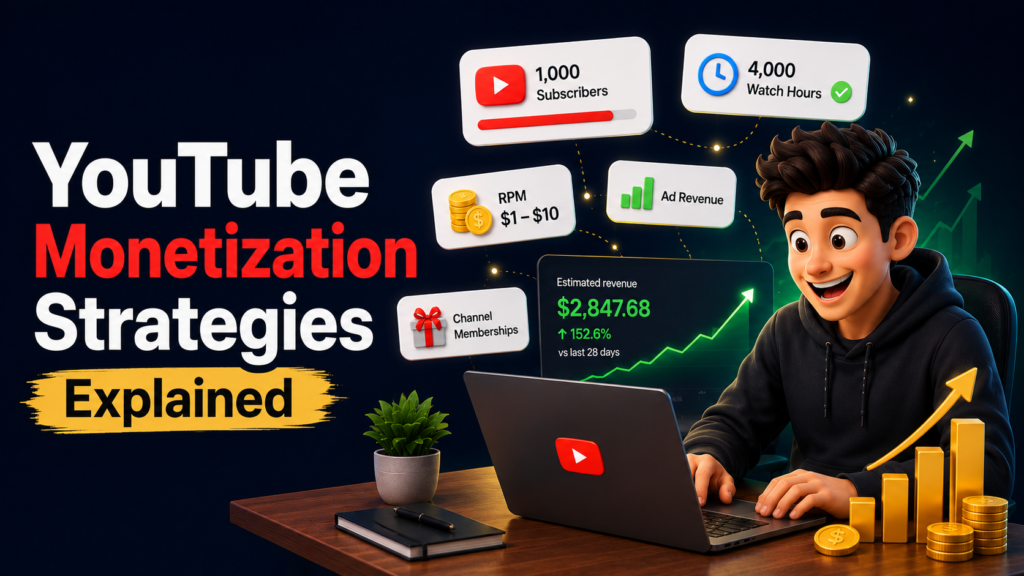
YouTube Monetization Strategies Explained- Complete Guide to Making Money on YouTube
Posted on June 23, 2026 by Jason Caldwell
YouTube monetization has become one of the most searched topics among content creators in 2026, and for good reason. Over 500 hours of video are uploaded to YouTube every minute, yet only a fraction of those creators actually earn consistent income from the platform. The difference between channels that earn and channels that do not is almost always the same thing — understanding exactly how YouTube monetization works and building toward it systematically.
This guide covers every YouTube monetization strategies available in 2026 — from the YouTube Partner Program requirements to affiliate marketing, brand deals, and how small channels reach their first milestone faster. Whether you have 50 subscribers or 5,000, this guide gives you a clear, honest picture of what it takes to earn on YouTube.
What Is YouTube Monetization and How Does It Work
YouTube monetization is the process of earning revenue from your YouTube channel through the platform’s various built-in income features. The primary gateway to monetization is the YouTube Partner Program (YPP) — an official program that grants creators access to ad revenue sharing, channel memberships, Super Chat, Super Thanks, YouTube Shopping, and YouTube Premium revenue.
When a creator joins the YPP, YouTube serves ads on their videos and shares a portion of the advertising revenue with the creator. Advertisers pay YouTube to place their ads in front of specific audiences, YouTube keeps 45% of that revenue, and the creator receives 55% of long-form ad revenue. For YouTube Shorts, creators receive 45% of the allocated revenue from the Shorts ad pool.
The important thing to understand is that YouTube monetization is not a single switch you turn on. It is a set of modules you opt into individually after joining the YPP, each covering a different revenue stream. Creators can have some modules active and others inactive depending on their channel type and audience.
YouTube Monetization Requirements 2026 — The Complete YPP Threshold Guide
As of 2026, the YouTube Partner Program operates on a two-tier structure. Each tier unlocks different monetization features, and each has its own subscriber and watch hour thresholds.
Tier 1 — Fan Funding Early Access (Lower Threshold)
The early access tier was introduced in 2023 and allows smaller channels to start earning from fan-funded features before they qualify for full ad revenue. To qualify for Tier 1, your channel must meet all of the following:
- 500 subscribers minimum
- 3 valid public video uploads in the last 90 days
- Either 3,000 valid public watch hours in the past 12 months OR 3 million valid public Shorts views in the past 90 days
- A linked AdSense account
- 2-Step Verification enabled on your Google Account
- No active Community Guidelines strikes
- Channel must comply with all YouTube monetization policies
Tier 1 does not unlock ad revenue. What it does unlock is access to fan funding features — channel memberships, Super Chat, Super Stickers, Super Thanks, and YouTube Shopping. These can generate meaningful income for channels with an engaged community, even at small subscriber counts.
Tier 2 — Full YouTube Partner Program (Ad Revenue Unlocked)
The full YPP tier is where ad revenue sharing becomes available. Requirements are higher:
- 1,000 subscribers minimum
- Either 4,000 valid public watch hours in the past 12 months OR 10 million valid public Shorts views in the past 90 days
- A linked AdSense account in good standing
- 2-Step Verification enabled
- No active Community Guidelines or copyright strikes
- Content must meet advertiser-friendly guidelines
Important: Shorts watch time does not count toward the 4,000 watch hour requirement. The two paths — long-form watch hours and Shorts views — are completely separate. You only need to meet one, but you cannot combine them.
YPP Requirements Comparison Table
| Requirement | Tier 1 (Fan Funding) | Tier 2 (Full YPP) |
| Subscribers | 500 | 1,000 |
| Watch Hours (12 months) | 3,000 | 4,000 |
| OR Shorts Views (90 days) | 3 million | 10 million |
| Public uploads (90 days) | 3 videos | No specific requirement |
| Ad Revenue | No | Yes — 55% of long-form |
| Shorts Revenue | No | Yes — 45% of Shorts pool |
| Channel Memberships | Yes | Yes |
| Super Chat / Super Thanks | Yes | Yes |
| YouTube Shopping | Yes | Yes |
What Happens After You Apply
Meeting the thresholds does not guarantee approval. YouTube manually reviews every application before granting YPP access. The review covers content originality, policy compliance, community guidelines adherence, advertiser-friendliness, and authentic channel activity. Channels with artificial view or subscriber inflation are rejected.
Most applications are reviewed within 1 to 4 weeks. Channels covering sensitive topics — news, political commentary, medical information — typically wait 2 to 4 weeks because manual review is required. You can track your application status in the Earn tab of YouTube Studio.
If rejected, you can reapply after 30 days for a first rejection, and 90 days after a second rejection. YouTube provides specific feedback on what needs to be improved.
How Much Does YouTube Pay — CPM, RPM, and Real Earnings Explained
The question every creator wants answered is how much YouTube actually pays. The honest answer is that it varies enormously based on your niche, your audience’s geography, your video format, and the time of year. Understanding CPM and RPM is essential to setting realistic income expectations.
CPM vs RPM — What Is the Difference
CPM (Cost Per Mille) is what advertisers pay YouTube for every 1,000 ad impressions. This is the gross figure before YouTube takes its share. RPM (Revenue Per Mille) is what you as the creator actually earn per 1,000 video views — after YouTube keeps its 45% cut and accounting for the fact that not every view serves an ad.
A channel with a $20 CPM typically earns $6 to $10 RPM. The gap is real and significant. RPM is the number that actually matters for your bank account. Always track RPM in YouTube Analytics, not CPM.
Average YouTube RPM by Niche in 2026
| Niche | Average CPM | Creator RPM (Approx) |
| Personal Finance & Investing | $25–$65 | $12–$35 |
| Insurance & Legal | $20–$50 | $10–$28 |
| Digital Marketing & SaaS | $12–$30 | $6–$16 |
| Technology & AI Tools | $10–$25 | $5–$14 |
| Education & Tutorials | $8–$20 | $4–$11 |
| Health & Wellness | $6–$15 | $3–$8 |
| Gaming | $2–$8 | $1–$4 |
| Music & Entertainment | $1–$5 | $0.90–$3 |
| Shorts (all niches) | $0.05–$0.15 | $0.01–$0.06 |
Geography plays an equally important role. A viewer in the United States, United Kingdom, or Australia generates 5 to 15 times more ad revenue per view than a viewer in many other markets. This means a channel with 100,000 monthly views from a US audience can earn significantly more than a channel with 500,000 monthly views from lower-CPM regions.
Seasonality also affects earnings significantly. Q4 (October through December) has the highest CPM rates of the year as advertisers push holiday campaigns with large budgets. January and February see a 30 to 50 percent dip in RPM across most niches as advertiser budgets reset — this is a normal annual cycle, not a penalty.
What a Small Channel Can Realistically Earn
A channel that just hit 1,000 subscribers with 50,000 monthly views in an average niche might earn $150 to $300 per month from ads alone. A channel in a high-CPM niche like finance with the same view count could earn $500 to $1,500 per month. The most financially sustainable creators treat ad revenue as one of four to six income streams rather than their sole source of YouTube earnings.
Every YouTube Monetization Method Available in 2026
Ad revenue is the most discussed YouTube monetization method, but it is rarely the most important one — particularly for small and mid-size channels. Here is every revenue stream available through YouTube, when it becomes accessible, and how much each one typically contributes.
1. Ad Revenue (AdSense)
Available from: Full YPP (1,000 subscribers + 4,000 watch hours)
Ad revenue comes from pre-roll ads (before your video), mid-roll ads (during your video — only available on videos 8 minutes or longer), display ads, and overlay ads. Videos over 8 minutes can place multiple mid-roll ads, which increases total ad impressions and therefore earnings per video significantly.
Creators keep 55% of long-form ad revenue. YouTube keeps 45%. Payments are processed monthly through AdSense once your balance reaches $100 (or local equivalent).
2. YouTube Shorts Revenue
Available from: Full YPP (1,000 subscribers + 10 million Shorts views in 90 days)
Shorts monetization works differently from long-form. YouTube pools all Shorts advertising revenue globally, deducts music licensing costs, then distributes a share to eligible creators based on their proportion of total Shorts views in the pool. Creators keep 45% of their allocated portion. RPM for Shorts ranges from $0.01 to $0.06 — much lower than long-form. Shorts are best used as a growth engine rather than a primary income source.
3. Channel Memberships
Available from: Tier 1 YPP (500 subscribers)
Channel memberships allow your viewers to pay a monthly recurring fee — typically $1.99 to $49.99 per month — in exchange for exclusive perks like custom badges, emoji, members-only videos, and community posts. For channels with loyal communities, memberships can generate more consistent monthly income than ad revenue because the income is predictable rather than view-dependent.
4. Super Chat, Super Stickers and Super Thanks
Available from: Tier 1 YPP (500 subscribers)
Super Chat allows live stream viewers to pay to have their message highlighted in the live chat. Super Stickers are animated images viewers purchase during live streams. Super Thanks allows viewers to pay to highlight their comment on any video. These features are most powerful for channels that do regular live streams or have highly engaged communities. Top creators earn thousands of dollars per live stream from Super Chat alone.
5. YouTube Shopping
Available from: Tier 1 YPP (500 subscribers)
YouTube Shopping allows creators to tag products directly in their videos, Shorts, and live streams. Viewers can purchase products without leaving YouTube. Creators can sell their own merchandise or link to products through affiliate partnerships. This feature has grown significantly in 2026 as YouTube competes more directly with TikTok Shop for social commerce revenue.
6. YouTube Premium Revenue
Available from: Full YPP (automatic — no separate opt-in required)
When a YouTube Premium subscriber watches your content, you receive a portion of their subscription fee based on watch time. This revenue stream is passive — it is automatically included in your YouTube Studio revenue reporting without any action required. For channels with strong watch time metrics, Premium revenue can add 10 to 20 percent on top of standard ad revenue.
7. Affiliate Marketing
Available from: Any channel size — no YPP required
Affiliate marketing is one of the most powerful monetization methods for small channels because it has no subscriber threshold. You earn a commission every time a viewer purchases a product through your unique referral link. Amazon Associates, ShareASale, and Rakuten are the most widely used affiliate platforms. In high-CPM niches like software and finance, a single affiliate conversion can be worth more than 100,000 ad-supported views.
8. Sponsorships and Brand Deals
Available from: Typically 5,000+ subscribers in a targeted niche
Brand sponsorships are typically the highest-paying revenue stream per video for mid-size and larger channels. Companies pay creators a flat fee to mention or integrate their product in a video. At 10,000 subscribers in a targeted niche, a creator can earn $200 to $1,000 per sponsored integration. At 100,000 subscribers, this range commonly moves to $1,000 to $10,000 per integration. Sponsorship rates are primarily driven by niche, audience engagement rate, and audience demographics — not just subscriber count.
9. Digital Products and Online Courses
Available from: Any channel size — no YPP required
Selling your own digital products — ebooks, presets, templates, courses, coaching programs — through your YouTube channel removes the platform’s revenue share entirely. Every dollar goes directly to you. Channels in education, business, music production, photography, and fitness niches have built six-figure businesses selling digital products to audiences of 10,000 subscribers or fewer.
How Small Channels Reach YouTube Monetization Faster in 2026
Reaching 1,000 subscribers and 4,000 watch hours is achievable for any creator who understands what drives both metrics. Here is the most direct path to monetization for small channels in 2026.
Focus on Watch Time, Not Just Views
The 4,000 watch hour requirement is about total minutes watched — which means video length and audience retention both matter. A 10-minute video that holds 70 percent audience retention contributes 7 minutes of watch time per view. A 3-minute video that holds 50 percent retention contributes 1.5 minutes per view. Longer videos with strong retention build toward 4,000 hours significantly faster than short videos with poor retention.
Check your audience retention graph in YouTube Analytics for every video. If viewers drop in the first 30 seconds, the problem is your hook. If they drop at a specific point mid-video, that section needs to be tightened.
Publish on a Consistent Schedule
YouTube’s algorithm favors channels that publish consistently. A channel that publishes one video per week for six months builds more algorithmic momentum than a channel that publishes ten videos in one month and then nothing for three months. Consistency gives the algorithm a pattern to reward and gives your audience a reason to return regularly.
Optimize Every Video for Search and Browse
The two largest traffic sources for most small channels are YouTube search and browse features. For search, your video title, description, and tags need to match what your target viewer actually types into the search bar. For browse features, your thumbnail needs to be compelling enough to earn a click when YouTube shows it to potential viewers on their homepage or in suggested videos.
Use Targeted Paid Promotion to Accelerate Watch Hours
When your analytics show strong retention and genuine viewer engagement but limited reach, the bottleneck is distribution — not content quality. Many small channels use this window to accelerate their path to the 4,000 watch hour threshold through targeted paid promotion.
Platforms that run campaigns through Google Ads — like Vedzzy — deliver views that appear directly inside your YouTube Studio Analytics under the YouTube Advertising traffic source, with full watch time, demographic, and retention data. Because these views are delivered through YouTube’s official advertising infrastructure, every view that meets YouTube’s validity criteria contributes toward your watch hour count. You can track the exact impact inside the same YouTube Analytics dashboard you already use to monitor organic performance. For a broader look at what running YouTube ads actually costs and what results to expect, the guide on YouTube Advertising Cost and Benefits covers the full breakdown of budgets, targeting, and realistic outcomes for different channel sizes.
Build a Community That Subscribes
Reaching 1,000 subscribers requires giving viewers a compelling reason to subscribe in the first place. The channels that grow their subscriber count fastest are not the ones that ask viewers to subscribe most often — they are the ones that make viewers genuinely want to subscribe. End every video with a clear value proposition for subscribing: tell viewers exactly what they will get if they hit subscribe, and make sure your next video delivers on that promise.
Common YouTube Monetization Mistakes Small Channels Make
Understanding what not to do can save months of wasted effort. These are the most common monetization mistakes small channels make in 2026.
- Buying fake views or subscribers. Channels that inflate their metrics with non-authentic activity are rejected from the YPP automatically. YouTube’s system checks for artificial activity and any views or subscribers gained through non-legitimate means are excluded from eligibility counts. Worse, if detected, the channel can be permanently banned from the YPP.
- Treating ad revenue as the only monetization path. Small channels that fixate entirely on reaching YPP ad revenue miss out on affiliate marketing and digital product income that require no subscriber threshold at all. A channel with 500 engaged subscribers promoting the right affiliate product can generate more monthly income than a 10,000-subscriber channel relying solely on ad revenue.
- Publishing shorts-only content to try to hit the watch hour threshold. Shorts watch time does not count toward the 4,000 watch hour YPP requirement. Channels that pivot entirely to Shorts to grow faster will hit the 1,000 subscriber threshold but stall on watch hours. Long-form and Shorts serve different growth functions.
- Ignoring advertiser-friendly guidelines. Content that includes excessive profanity, violent imagery, controversial topics without proper context, or misleading information may receive limited monetization — meaning fewer ads are shown and RPM is reduced — even after YPP approval. Review YouTube’s advertiser-friendly content guidelines before publishing anything in a gray area.
- Not setting up AdSense before applying to YPP. You cannot be approved for the YPP without a valid linked AdSense account. Many creators apply before completing the AdSense setup and then wonder why approval is delayed. Set up AdSense first.
How to Track Your Monetization Progress in YouTube Studio
YouTube Studio makes it straightforward to monitor your progress toward both YPP tiers without needing any third-party tools.
Using the Earn Tab
Go to YouTube Studio and click Earn in the left sidebar. If you have not yet joined YPP, this tab shows your current progress toward the eligibility thresholds — subscriber count, watch hours over the past 12 months, and Shorts views over the past 90 days, each displayed with a progress bar. This is your real-time monetization dashboard. Check it weekly rather than daily to avoid the discouragement of small day-to-day fluctuations.
Monitoring Watch Time in Analytics
Go to YouTube Studio → Analytics → Overview. Set the date range to the past 365 days. The watch time figure shown is your rolling 12-month watch time — the exact figure YouTube counts toward the 4,000 hour threshold. Divide this number by 60 to convert from minutes to hours if it is displayed in minutes.
Identify which videos contribute the most watch time by going to Analytics → Content and sorting by watch time rather than views. The videos at the top of that list are your most algorithmically valuable assets. More content in that style accelerates your path to monetization.
YouTube Monetization Methods Compared — Which to Prioritize at Each Stage
| Revenue Method | When Available | Earning Potential | Best For |
| Affiliate Marketing | Any channel size | Medium–Very High | Niche channels, review content |
| Digital Products | Any channel size | High | Education, skills, creative niches |
| Fan Funding (Tier 1) | 500 subscribers | Low–Medium | Engaged communities, live streamers |
| AdSense (Long-form) | 1,000 subs + 4,000 hrs | Low–High (niche dependent) | High-CPM niches, scale channels |
| Shorts Revenue | 1,000 subs + 10M views | Very Low | Growth supplement only |
| Sponsorships | Typically 5,000+ subs | High–Very High | Targeted niche audiences |
| YouTube Premium Revenue | Full YPP (automatic) | Low–Medium | All monetized channels |
| YouTube Shopping | 500 subscribers | Medium–High | Product, lifestyle, review channels |
FAQ — YouTube Monetization Questions Answered
How many subscribers do I need to monetize on YouTube?
You need a minimum of 500 subscribers to access Tier 1 fan funding features (channel memberships, Super Chat, Super Thanks). For full ad revenue monetization, you need 1,000 subscribers plus either 4,000 watch hours in the past 12 months or 10 million Shorts views in the past 90 days.
How long does it take to get monetized on YouTube?
This varies enormously based on upload frequency, niche, and content quality. Channels that upload 2 to 3 times per week in a targeted niche with strong retention typically reach the 1,000 subscriber and 4,000 watch hour threshold within 6 to 18 months. Channels uploading once per month may take 3 to 5 years. Consistency and content quality are the two factors most within a creator’s control.
How much does YouTube pay per 1,000 views?
After YouTube’s 45% cut, most creators earn between $1 and $10 RPM (revenue per 1,000 views) on long-form content. High-CPM niches like finance and legal can earn $12 to $35 RPM. Entertainment and gaming niches typically earn $0.90 to $4 RPM. Shorts earn dramatically less — between $0.01 and $0.06 per 1,000 views.
Does watch time from Shorts count toward the 4,000 hour requirement?
No. Shorts watch time does not count toward the 4,000 public watch hours threshold for the long-form YPP path. Shorts have their own separate threshold of 10 million valid Shorts views in the past 90 days. You cannot combine partial progress from both paths — you must meet one threshold completely.
Can I monetize a YouTube channel with 100 subscribers?
You cannot join the YouTube Partner Program at 100 subscribers — the minimum is 500 for Tier 1. However, you can earn from affiliate marketing and selling digital products at any channel size, with no subscriber minimum required. These are worth setting up before you reach YPP eligibility.
What is a good CPM on YouTube?
CPM benchmarks vary dramatically by niche. In finance, a $20 to $40 CPM is average. In gaming or entertainment, a $3 to $8 CPM is average. A better question to ask is whether your RPM (your actual take-home per 1,000 views) is growing month over month — that is the metric that indicates your channel is becoming more valuable to advertisers.
Why was my YouTube monetization application rejected?
The most common rejection reasons are: reused or repurposed content without sufficient original commentary, content that does not comply with advertiser-friendly guidelines, unresolved copyright claims or community guidelines strikes, and channels that have been inactive for extended periods. YouTube provides specific feedback with each rejection. Address the stated issue directly before reapplying.
Do private or unlisted videos count toward watch hours?
No. Only valid public watch hours count toward the YPP watch hour threshold. Private, unlisted, or deleted videos do not contribute to the 4,000 hour count. Watch hours must come from publicly available videos.
Is YouTube monetization worth it for small channels?
Ad revenue alone is not typically worth it for small channels — a channel with 10,000 monthly views in an average niche earns roughly $15 to $50 per month from ads. However, YouTube monetization becomes worth pursuing when you combine it with other revenue streams. Affiliate marketing and digital products can generate meaningful income at much smaller channel sizes than the YPP requires. Building toward YPP eligibility while simultaneously building these other revenue streams gives you a much stronger overall position.
How do I check if my channel is eligible for YouTube monetization?
Go to YouTube Studio and click the Earn tab in the left sidebar. This shows your current progress against all YPP eligibility thresholds in real time, including subscriber count, watch hours, and Shorts views. You can also see whether your channel has any strikes or policy issues that would prevent approval even if you meet the thresholds.
Summary — Your YouTube Monetization Action Plan for 2026
YouTube monetization in 2026 rewards creators who understand the system and build toward it strategically. The two-tier YPP structure means you can start earning from fan funding features at just 500 subscribers — well before the full ad revenue threshold. And with affiliate marketing and digital products available at any channel size, there is no reason to wait until you hit YPP eligibility to start building income from your content.
The fastest path to monetization for any small channel in 2026 is the same: publish consistently, optimize for watch time and retention, understand your analytics, and stack multiple revenue streams rather than relying entirely on ad revenue to carry your income.

Hi, I am Jason, a digital content strategist with 8 years of experience helping YouTube creators and brands grow their channels through data-driven content decisions. I have worked with creators across niches including tech, education, and lifestyle, and specialise in translating YouTube Analytics data into actionable growth strategies.
Categories: YouTube Growth Tips, YouTube Monetization