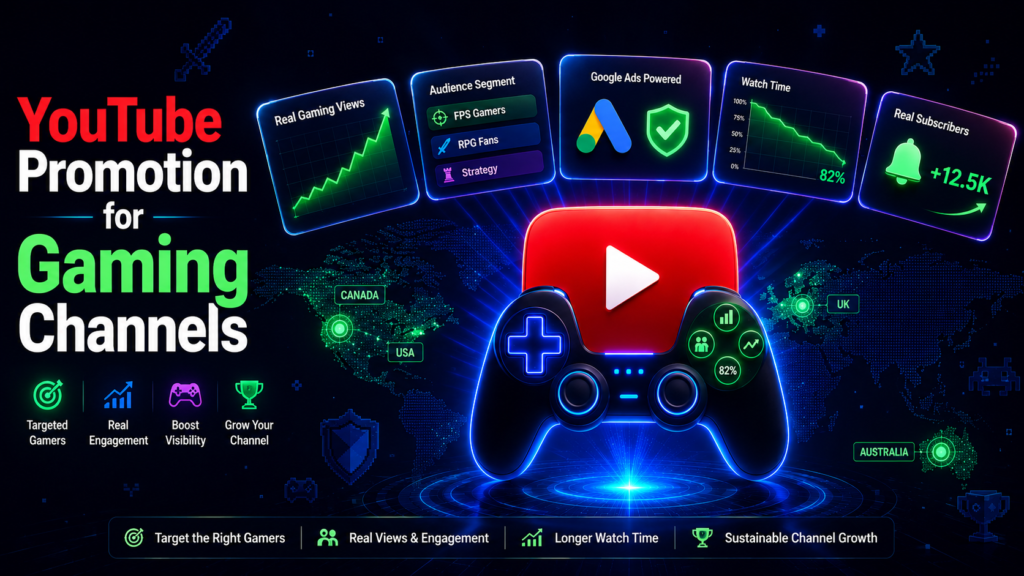
YouTube Promotion for Gaming Channels – Get Real Views Without Fake Subscribers
Posted on June 26, 2026 by Jason Caldwell
Gaming is YouTube’s most competitive content category. There are over 51 million active YouTube channels on the platform right now, and a disproportionate number of them are gaming channels. Every single day, thousands of new Let’s Play videos, speedruns, walkthroughs, highlight reels, and gaming commentary videos are uploaded — most of which will never reach 100 views.
If you run a gaming channel and you have been trying to figure out why consistent uploads, solid gameplay, and genuine effort are not translating into growth, the problem is almost certainly not your content quality. The problem is promotion strategy. Specifically, the gap between what promotion actually works for gaming channels in 2026 and what most gaming creators think works.
This guide covers YouTube promotion for gaming channels in full — what the algorithm actually rewards in the gaming niche, why gaming channels are uniquely vulnerable to fake view damage, how to build real view momentum from scratch, and what the difference is between promotion that compounds your channel’s growth and promotion that quietly destroys it.
Why Gaming Is the Hardest Niche to Grow on YouTube in 2026
Before getting into promotion tactics, you need to understand the specific challenge gaming channels face that other niches do not.
Gaming is YouTube’s largest content category by volume. That means the competition for algorithmic distribution in the gaming niche is more intense than virtually anywhere else on the platform. YouTube’s recommendation algorithm evaluates gaming videos against a pool of competing content that is significantly larger than the pool facing a cooking channel, a finance channel, or a fitness channel.
The second challenge is niche fragmentation. “Gaming” is not a single niche. Minecraft viewers and Call of Duty viewers and Elden Ring viewers are entirely different audience segments with different viewing habits, different engagement patterns, and different algorithmic routing. A gaming channel that covers multiple titles without a clear identity is competing for a fragmented audience across fragmented algorithm buckets — which produces weaker algorithmic distribution than a channel with a tightly defined gaming niche.
The third challenge is that gaming content has historically been one of the most heavily targeted niches for fake view services and bot traffic. This has caused YouTube’s spam detection systems to be particularly aggressive with gaming content. A gaming channel that receives an unusual view velocity spike — even from legitimate paid promotion — can trigger review flags that a channel in a less bot-targeted niche would not.
Understanding these three challenges is the foundation for understanding why YouTube promotion for gaming channels requires a different approach than generic YouTube promotion advice.
What Real Views Mean for a Gaming Channel — and Why Fake Ones Are Particularly Dangerous
The distinction between real and fake views matters for every YouTube channel. For gaming channels specifically, it is existential.
Fake views — delivered through bot networks, click farms, or incentivized viewer pools with no genuine interest in gaming content — generate zero meaningful engagement signals. No saves. No completions. No comments. No subscriber conversions. The view counter goes up briefly and then falls back down when YouTube’s detection systems remove invalid traffic, which they do continuously and aggressively in the gaming niche.
But the removal of fake views is not the worst outcome. The worst outcome is what happens to your channel’s algorithmic standing before the views are removed.
When YouTube sees thousands of views arriving on a gaming video with no corresponding engagement — no watch time above 10 seconds, no comments, no likes, no saves, no subscriber conversions — it draws a specific conclusion: viewers are rejecting this content. The algorithm interprets weak engagement signals as evidence of poor content quality, which actively suppresses the video’s distribution into Suggested and Browse feeds. In some cases, this suppression persists even after the fake views are cleaned up, because the algorithmic model built during the fake view period continues to penalize the video’s distribution.
This is why gaming channels that use fake view services often report that their organic reach is worse after the campaign than before it. They did not just waste money. They damaged their algorithmic standing in a way that can take months to recover from.
Real views from real gaming audiences do the opposite. A genuine gamer who watches your video for three minutes, leaves a comment about the gameplay, saves the video to watch later, and subscribes because they want more — that single viewer generates more positive algorithmic signal than a thousand fake views. That is not an exaggeration. It is how YouTube’s engagement-weighted recommendation system actually works.
How YouTube’s Algorithm Treats Gaming Content Specifically
YouTube does not apply the same algorithmic logic uniformly across all content categories. Gaming content is evaluated within gaming-specific audience clusters — the algorithm routes your content primarily to viewers whose watch history demonstrates active gaming content consumption, not to general audiences.
This has several implications for promotion strategy.
First, it means that targeting matters enormously. A gaming video promoted to a non-gaming audience — even one that generates real views — produces weak engagement signals because those viewers are not predisposed to engage with gaming content the way a genuine gamer would. The views count but the quality signal is poor, which limits how aggressively the algorithm picks up the video for organic distribution.
Second, it means that sub-niche targeting is more valuable than broad gaming targeting. A video about Elden Ring boss strategies promoted to viewers with demonstrated interest in FromSoftware games or action RPG content will generate significantly stronger engagement signals than the same video promoted to a broad “gaming” audience. The specificity of the audience match determines the quality of the engagement signal, which determines the strength of the organic distribution that follows.
Third, gaming content has unusually strong community-driven engagement patterns. Gaming audiences comment at higher rates than most other YouTube niches. They are more likely to share clips, discuss strategies, and return to re-watch key moments. This community engagement behavior, when triggered by genuinely interested viewers, creates exactly the kind of compounding signal pattern that YouTube’s algorithm rewards with broader distribution.
The implication for promotion is clear: reach fewer, more relevant gaming viewers and generate stronger engagement, rather than reaching more generic viewers and generating weaker engagement.
Niche Targeting — The Most Important Factor in Gaming Channel Promotion
This is the element that separates gaming channel promotion that compounds into real growth from promotion that produces temporary view spikes with no lasting impact.
Gaming is not a niche. It is a category containing dozens of distinct niches, each with its own audience, its own engagement patterns, and its own algorithmic cluster. When you promote a gaming video, the specific gaming sub-niche you target determines everything about the quality of the views you receive.
Here is how to think about gaming sub-niche targeting for promotion purposes:
Genre-Based Targeting
The most fundamental targeting layer is gaming genre. FPS players, MOBA players, RPG players, simulation players, and sandbox players are distinct audience segments with minimal crossover in viewing behavior. A Minecraft building tutorial promoted to competitive FPS viewers produces low watch time and weak engagement because the content is not relevant to those viewers’ interests.
For paid promotion campaigns, configure your interest targeting at the genre level — not the broad “gaming” category. If you make FPS content, target viewers in the Media & Entertainment → Gamers → FPS Gamers affinity segment. If you make RPG content, target RPG and action-adventure gaming audiences.
Platform-Based Targeting
PC gamers, console gamers, and mobile gamers have meaningfully different content preferences and engagement patterns on YouTube. Console gaming content performs differently with console gaming audiences than with PC gaming audiences, and vice versa. When configuring promotion targeting, consider which platform your content is primarily about and target the corresponding audience cluster.
Skill-Level Targeting
Gaming content also segments by viewer skill level. Beginner tutorial content, mid-level strategy guides, and advanced competitive analysis appeal to different viewer profiles even within the same game. A video titled “Elden Ring beginner tips” that gets promoted to hardcore Souls-like veterans will generate poor engagement because the content is not relevant to that audience’s needs.
Align your targeting with the implied skill level of your content — a practical consideration that most gaming creators never explicitly think about when planning their promotion strategy.
Community and Title-Specific Targeting
The most precise targeting level for gaming content is specific game communities. If your content covers a specific title — Minecraft, Fortnite, Valorant, GTA, Baldur’s Gate — targeting viewers with demonstrated interest in that specific game or its adjacent titles produces the strongest engagement signals of any targeting approach.
Keyword and tag targeting within a promotion campaign allows this level of precision. Adding specific game titles as campaign keywords narrows delivery to viewers who are actively consuming content about those games — which is the closest you can get to guaranteed audience relevance.
Organic Promotion Strategies That Work for Gaming Channels
Paid promotion works best when it amplifies an organic foundation that is already generating some engagement signals. Before spending anything on promotion, these organic strategies should be in place.
YouTube Shorts as a Gaming Discovery Engine
YouTube Shorts are now fully decoupled from long-form recommendations — Shorts performance does not affect your long-form distribution either positively or negatively. But Shorts do serve as one of the most effective free discovery tools available to gaming channels.
Gaming Shorts that work: highlight reels of exceptional gameplay moments, funny clips or unexpected in-game events, short tip or strategy clips (15 to 30 seconds showing one specific technique), reaction moments, and “this happened in my playthrough” clips that create genuine curiosity about the full video.
The strategic approach is to end every Short with a clear pathway to your long-form content — not a generic “subscribe” ask, but a specific “the full match is on my channel” or “I break down exactly how I did this in my latest video.” Viewers who complete a Short and feel motivated to find the full video arrive on your channel as genuinely interested potential subscribers.
Post three to five Shorts per week extracted from existing footage. This requires minimal additional production time and creates consistent algorithmic testing of your content with new audiences.
Gaming Community Engagement
Reddit, Discord, and gaming-specific forums contain some of the most engaged concentrated gaming audiences online. The r/gaming, r/Minecraft, r/FortNiteBR, r/learncsgo, and hundreds of other game-specific subreddits are populated by viewers who are actively passionate about the games you cover.
The approach that works is genuine contribution first and promotion second. Participate authentically in discussions, answer questions, share insights — and then, when you create content that directly addresses something the community has been discussing, share it as a contribution. A video shared as a response to a question the community has been asking receives an entirely different reception than a cold “check out my new video” post.
Gaming Discord servers follow the same principle. Many larger Discord communities have dedicated content creator channels — use these only when your content is genuinely relevant to the community’s current conversations.
Trend-Based Content Timing
Gaming content has unusually strong time-sensitivity. A video about a newly released game, a major update, a patch that changes the meta, or a viral gaming moment has a significantly shorter relevance window than a cooking tutorial or a finance guide. But that time-sensitivity also creates a disproportionate traffic opportunity if you publish within that window.
Monitor your primary game communities for emerging discussions, patch announcements, and viral moments. When you identify a trending topic you can cover quickly and competently, prioritize it. A video published within the first 24 to 48 hours of a major gaming news event can capture significant search and Browse traffic before larger channels produce their own coverage.
Collaboration With Other Gaming Creators
Collaborations extend your reach to audiences you could not reach independently — and they do so with a warm introduction through a creator those viewers already trust.
For gaming channels specifically, collaborations work best when the other creator’s gaming niche complements yours without being identical. A Minecraft creator collaborating with another Minecraft creator reaches an audience that already watches both creators’ type of content. A Minecraft creator collaborating with a broader survival/sandbox creator reaches new viewers who may not have discovered Minecraft content yet.
Reach out to five gaming creators at a similar subscriber count to yours this week. Propose something specific — a challenge video, a versus series, a collab stream — that gives both audiences a reason to watch. The subscriber count you already have is irrelevant to whether a similarly-sized creator will collaborate with you; what matters is whether your proposal offers genuine value to their audience.
Paid Promotion for Gaming Channels — How to Do It Without Getting Burned
When your organic foundation is in place — strong content, consistent uploads, active community engagement — paid promotion can meaningfully accelerate your channel’s growth by delivering your best videos to targeted gaming audiences who have no other way of discovering your channel.
The critical factor is using a promotion method that delivers real views from real gaming viewers, not inflated numbers from disengaged or artificial traffic.
Why Google Ads-Based Promotion Is the Only Safe Option
The only paid promotion method that is simultaneously safe for your channel, compliant with YouTube’s Terms of Service, and capable of generating engagement signals that feed the algorithm constructively is Google Ads-based promotion. YouTube is owned by Google. Google Ads is YouTube’s official advertising infrastructure — the same system every major brand and media company uses to run paid campaigns on the platform.
When a gaming video is promoted through Google Ads with proper gaming-audience targeting, it is served as an ad to real YouTube users who are actively browsing gaming content. These viewers watch because they have demonstrated interest in gaming — which means their engagement behavior mirrors what organic gaming viewers would produce.
The views appear in your YouTube Studio analytics with full data: watch time, audience demographics broken down by age and gender, geographic distribution, audience retention curves, and traffic source. You can verify every result yourself by opening YouTube Studio after the campaign runs. If the engagement data does not reflect genuine gaming audience behavior — if the watch time is near zero, if the geographic distribution is anomalous, if there are no engagement signals beyond raw view count — the traffic was not genuine.
Targeting Your Paid Promotion Campaign to Gaming Audiences
The targeting parameters available through Google Ads-based gaming promotion include:
Interest segment targeting
Reaching viewers in specific gaming affinity audiences: Hardcore Gamers, PC Gamers, Console Gamers, Mobile Gamers, Action Game Fans, Strategy Game Fans, Sports Game Fans, and others within the Media & Entertainment → Gamers category.
Age and gender targeting
Gaming audiences are not uniformly distributed across demographics. If your analytics show that your organic viewers skew heavily toward a specific age range or gender, configure your paid promotion to match that profile. Views from your natural demographic produce better engagement signals than views from a mismatched demographic.
Geographic targeting
Tier 1 markets (USA, UK, Canada, Australia) produce higher engagement quality and better RPM for monetization-eligible channels. If building toward YouTube Partner Program thresholds, Tier 1 geographic targeting produces watch time that counts more effectively toward monetization.
Tag and keyword targeting
Adding specific game titles as campaign tags narrows delivery to viewers actively consuming content about those games — the most precise audience targeting available for gaming-specific campaigns.
For gaming creators who want all of these targeting parameters configured without managing Google Ads directly, platforms like Vedzzy run Google Ads-based campaigns on your behalf with gaming-specific audience targeting built in — delivering views from genuine gaming audiences with all results verifiable in your YouTube Studio analytics.
What to Expect From a Well-Targeted Gaming Campaign
A properly configured gaming promotion campaign — using Google Ads infrastructure with genre-specific interest targeting and appropriate age/geographic parameters — delivers views from real gaming viewers who have demonstrated interest in your content category. These viewers watch for meaningful durations, generate real engagement signals, and produce the kind of algorithm data that improves your channel’s organic distribution after the campaign ends.
View rates for well-targeted gaming campaigns typically fall in the 25 to 35 percent range — meaning 25 to 35 viewers out of every 100 who see your video as an ad choose to watch rather than skip. This view rate reflects genuine interest — a viewer who actively chooses to watch a skippable ad is demonstrably more interested than one who simply does not close a window.
What a well-targeted gaming campaign does not do is guarantee viral growth or immediate subscriber conversion at high rates. It generates real engagement signals from real gaming viewers — which feeds the algorithm with the data it needs to begin distributing your content more widely to organic gaming audiences. The compounding effect of this algorithmic data is the actual value of paid promotion, not the raw view count itself.
Building a Long-Term Promotion System for Your Gaming Channel
Individual promotion tactics produce limited results. A systematic, layered approach — where each method supports and amplifies the others — is what produces compounding channel growth over time.
The gaming channel promotion system that consistently produces results in 2026 looks like this:
Content foundation: Publish on a defined schedule — two to three long-form videos per week is the growth sweet spot for gaming, with three to five Shorts per week extracted from existing footage. Every video is optimized before upload: specific keyword-rich title, custom thumbnail tested against two alternatives, detailed description with timestamps, genre-appropriate tags.
Community layer: Spend 30 minutes per day engaging genuinely in gaming communities — your game-specific subreddits, Discord servers, and YouTube comments. Reply to every comment on your own videos within the first 24 hours. This community engagement generates real viewers who arrive with genuine interest.
Collaboration layer: Execute one meaningful creator collaboration per month. The compound effect of twelve collaborations per year — each introducing your channel to a new warm audience — is one of the most reliable growth mechanisms in gaming.
Paid promotion layer: Run a targeted Google Ads-based promotion campaign on your single best video each month. Target your specific gaming sub-niche, configure age and geographic parameters based on your analytics data, and verify results in YouTube Studio. Use paid promotion as an amplifier for content that already performs well organically — not as a substitute for organic strategy.
Analytics review: Conduct a weekly 15-minute analytics review focused on save rate, completion rate, session continuation, and subscriber conversion per video. Identify which content types are producing the strongest engagement signals and double down on those formats.
This system compounds. Each component feeds the others. Community engagement produces genuine early views. Early genuine views feed the algorithm. Algorithm distribution produces organic reach. Organic reach builds the audience that makes paid promotion more efficient. Paid promotion generates additional audience data that improves algorithmic targeting.
Common Gaming Channel Promotion Mistakes That Kill Growth
Promoting to a Broad Gaming Audience Instead of Your Sub-Niche
The most expensive promotion mistake gaming creators make is targeting “gaming” as the audience rather than their specific gaming sub-niche. Broad gaming promotion reaches millions of viewers — the vast majority of whom have no interest in your specific content type. The resulting engagement data is poor, which damages rather than helps your algorithmic standing.
Buying Views From Services That Cannot Explain Their Traffic Source
If a service cannot clearly and specifically answer where the views come from — “real users,” “organic traffic,” and “our network” are not answers — do not use it. The only acceptable answer is “Google Ads” or “YouTube’s official advertising infrastructure.” Any other answer means the traffic source is potentially artificial, which carries the engagement damage risks described earlier in this guide.
Promoting Your Average Videos Instead of Your Best Ones
Paid promotion amplifies what is already there. A video with a weak hook, generic thumbnail, or unclear value proposition will not convert promoted views into subscribers or meaningful engagement — regardless of how well the targeting is configured. Identify the video in your catalog with the strongest organic engagement signals — highest save rate, best completion rate, most subscriber conversions per view — and promote that video first. Then build from there.
Ignoring the First 48 Hours After Upload
YouTube evaluates a new video’s algorithmic potential heavily based on the first 24 to 48 hours of performance. A gaming video that accumulates strong engagement in its first two days gets pushed further by the algorithm. One that stalls gets limited distribution that is often permanent. Activating every promotion channel simultaneously on upload day — sharing in communities, posting related Shorts, emailing your list if you have one — is not optional. It determines whether the algorithm picks up the video.
Treating Subscriber Count as the Primary Success Metric
Subscriber count matters for YouTube Partner Program eligibility thresholds but it is a poor indicator of channel health or promotional effectiveness. A gaming channel with 2,000 subscribers where 60 percent of viewers consistently return for new videos is in a fundamentally stronger algorithmic position than a channel with 20,000 subscribers where 90 percent of subscribers never watch. Focus on engagement rate and returning viewer percentage — these are the metrics that determine how aggressively the algorithm distributes your content.
Frequently Asked Questions About YouTube Promotion for Gaming Channels
Is YouTube promotion safe for gaming channels given YouTube’s aggressive spam detection?
Yes — when the promotion uses Google Ads-based traffic. YouTube’s spam detection targets artificial traffic: bots, click farms, and incentivized viewer pools. Views delivered through Google Ads come from real YouTube users and are fully compliant with YouTube’s Terms of Service. Gaming channels are more aggressively monitored for fake traffic than most other niches, which makes using only Google Ads-based promotion more important for gaming creators than for creators in less bot-targeted categories.
How much does paid YouTube promotion typically cost for a gaming channel?
Google Ads-based YouTube promotion costs between $0.01 and $0.03 per genuine view for gaming content, depending on how specific the targeting is. A well-targeted gaming campaign on a $9 to $39 budget can deliver between 800 and 4,000 genuine gaming views, depending on the service and targeting configuration. Self-managed Google Ads campaigns typically require $10 to $20 per day minimum to generate enough data for effective optimization.
How do I know if a promotion service is delivering real gaming views or fake ones?
Open YouTube Studio after the campaign and check three things: the Traffic Source report should show YouTube advertising as the traffic source; the audience retention graph should show a natural viewing curve rather than a flat line near zero; and the geographic and demographic breakdown should reflect the gaming audience you targeted. If any of these checks fail, the views are not from genuine gaming viewers.
Does paid promotion for gaming channels actually lead to real subscriber growth?
Yes — when the targeting is configured correctly. Real gaming viewers who discover your channel through a promoted video and genuinely enjoy the content subscribe because they want to see more. These subscribers engage with future uploads, which compounds your channel’s engagement rate and algorithmic performance over time. Generic or poorly targeted promotion produces view counts but minimal subscriber conversion because the viewers have no genuine interest in your gaming niche.
What gaming sub-niches are easiest to grow on YouTube in 2026?
Based on current algorithmic behavior, gaming sub-niches with strong search demand and lower creator competition produce faster growth than mainstream titles. Indie game coverage, niche strategy game communities, gaming tutorial content for specific titles, and gaming commentary with a unique perspective all offer growth opportunities that raw gameplay of mainstream titles does not. The YouTube algorithm in 2026 rewards niche clarity — a channel that is unmistakably for one specific type of gaming viewer grows faster than one that covers gaming broadly.
How many views do I need before paid promotion is worth investing in?
Paid promotion is most efficient when a channel already has some content history — at least 10 to 15 videos that establish the channel’s niche and content quality. Promoting a channel with one or two videos produces weak subscriber conversion because new visitors have no additional content to explore after watching the promoted video. Build a small catalog first, then use paid promotion to accelerate the distribution of your strongest content.
Can I use YouTube Shorts to promote my gaming long-form videos?
Yes, and this is one of the most cost-effective promotion strategies available to gaming channels. YouTube Shorts are now fully decoupled from long-form recommendations, meaning Shorts performance does not negatively affect your long-form distribution. Shorts that extract compelling moments from long-form videos — exceptional gameplay, funny moments, surprising events — drive genuine curiosity about the full content. Viewers who click through from a Short to a long-form video are among the most engaged viewers your channel receives.
What is the biggest difference between gaming channel promotion and promotion for other niches?
Two differences stand out. First, the gaming niche is more aggressively monitored for artificial traffic, making the choice of promotion method more consequential — fake traffic damages gaming channels faster and more severely than most other niches. Second, gaming audiences respond more strongly to sub-niche precision than broad topic audiences. A gaming channel that promotes to a precisely matched gaming sub-audience generates engagement signals that compound into real growth. A gaming channel that promotes to a broad gaming audience generates mediocre engagement signals that do not compound effectively.
How long does it take to see real results from gaming channel promotion?
Organic community engagement typically produces visible results within two to four weeks of consistent daily participation. Paid promotion campaigns begin delivering views within 24 to 48 hours of launch. Algorithmic pickup — the point where YouTube’s recommendation system begins distributing your content to organic gaming audiences independently — typically requires four to eight weeks of consistent, strong engagement signals. The compounding effect of a well-structured promotion system becomes clearly visible in analytics after three to four months of consistent execution.
Should gaming channels focus more on watch time or subscriber count when promoting?
Watch time generates more sustainable algorithmic momentum than subscriber count for gaming channels. Subscribers who do not watch your videos contribute nothing to your algorithm standing and dilute your engagement rate. Watch time from genuinely interested gaming viewers — particularly the kind of watch time that produces high completion rates and strong session continuation — feeds the algorithm with exactly the signals it needs to expand your organic distribution. Focus promotion efforts on reaching viewers who will generate strong watch time, and subscriber growth will follow from that engaged viewer base.
The Bottom Line
YouTube promotion for gaming channels is not about inflating your view count. It is about getting your best gaming content in front of the right gaming viewers — people who are genuinely interested in your specific type of content, who will watch it fully, engage with it authentically, and potentially subscribe because they want more.
The gaming niche is competitive, fragmented, and heavily monitored for artificial engagement. These factors make real, targeted promotion more important for gaming channels than for any other content category. They also make the choice of promotion method — real versus fake, targeted versus generic — more consequential.
The channels that are genuinely growing in gaming in 2026 are not the ones with the biggest promotion budgets. They are the ones with the clearest niche identity, the most precisely targeted audience matching, and the most consistent community engagement. Paid promotion accelerates what organic strategy builds. Organic strategy creates the foundation that makes paid promotion efficient.
Build the foundation. Target precisely. Verify everything in your analytics. The growth follows from there.

Hi, I am Jason, a digital content strategist with 8 years of experience helping YouTube creators and brands grow their channels through data-driven content decisions. I have worked with creators across niches including tech, education, and lifestyle, and specialise in translating YouTube Analytics data into actionable growth strategies.
Categories: YouTube Growth Tips, YouTube Promotion