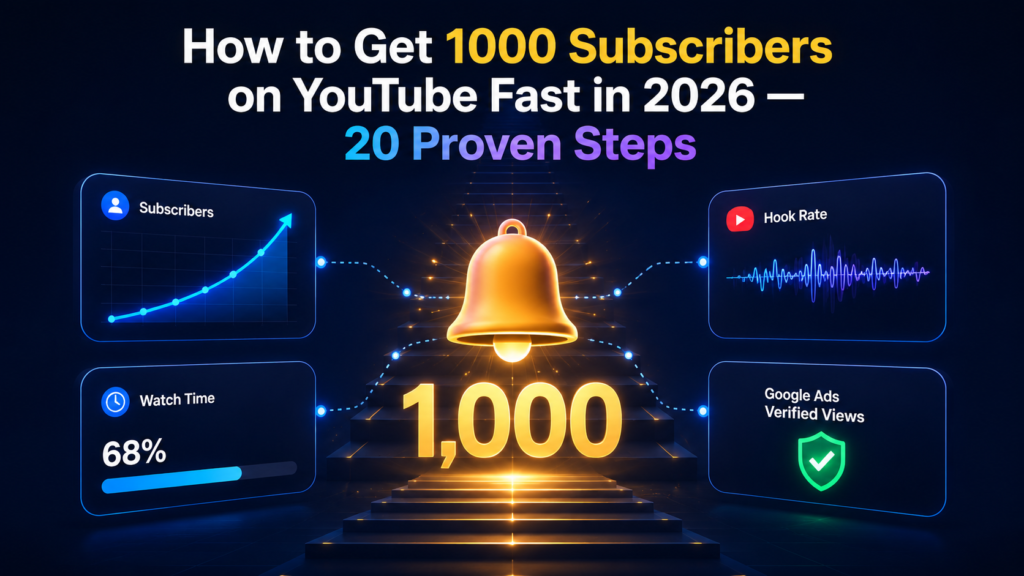
How to Get 1000 Subscribers on YouTube in 2026 – 20 Proven Steps
Posted on June 4, 2026 by Jason Caldwell
Getting to 1,000 subscribers is the single most important milestone on YouTube.
Not because of bragging rights. But because 1,000 subscribers — combined with 4,000 watch hours — unlocks YouTube Partner Program monetization. It’s the point where your channel stops being a hobby and starts being a business.
And yet most creators stall between 50 and 500 subscribers for months, sometimes years, doing everything “right” but still not breaking through.
This guide is not a generic list of tips you’ve read a hundred times. Every step here is based on what actually moves the subscriber needle in 2026 — considering YouTube’s current algorithm behavior, the shift toward Shorts, and the increasing competition from over 50 million active channels globally.
Let’s get into it.
Why 1,000 Subscribers Is Harder Than It Looks in 2026
Before the steps, it helps to understand why most creators struggle.
YouTube’s algorithm in 2026 is almost entirely driven by viewer satisfaction — not just view counts. Watch time, click-through rate, audience retention, and engagement signals (likes, comments, shares, saves) collectively determine whether YouTube pushes your video to new audiences or buries it.
This means you can post 50 videos and still have a flat subscriber count if the content isn’t holding viewer attention. Promotion alone won’t fix poor retention. But strong content with smart promotion compounds extremely fast.
The 17 steps below address both sides of that equation.
Step 1 — Create a Hook in the First 30 Seconds That Makes Leaving Feel Wrong:
The most common reason channels stall at low subscriber counts is a weak video opening.
YouTube’s internal data shows that the majority of viewer drop-off happens within the first 30 seconds of a video. If someone clicks your video and leaves before the 30-second mark, YouTube registers it as a poor experience and reduces distribution of that video.
Your first 30 seconds need to do three things simultaneously: state the problem the viewer has, promise the specific value your video delivers, and give them one compelling reason not to skip.
A formula that works consistently in 2026: open with the most surprising or counterintuitive statement in your video. If your tutorial eventually reveals that most creators waste time on the wrong strategy, say that in your first sentence — not five minutes in.
What to change right now: Watch your last three videos and note the timestamp where the audience retention graph starts dropping most sharply. That’s where your hook is failing. Rewrite your video opening to address the viewer’s core problem within the first 20 seconds.
Step 2 — Choose a Niche You Can Own, Not Just Cover:
Generic channels don’t grow in 2026. The YouTube algorithm has become extremely good at matching specific content to specific audiences — which means broad channels get shown to broad audiences who have weak interest in the content.
The creators hitting 1,000 subscribers fastest right now are not the ones covering every topic in their space. They are the ones who have staked out a specific position within a niche and owned it completely.
Instead of “fitness tips” — “fitness for people over 40 who work desk jobs.” Instead of “cooking videos” — “30-minute meals for college students with no kitchen experience.” Instead of “music production” — “beat-making tutorials for independent hip-hop artists on a budget.”
The narrower the focus, the stronger the subscriber conversion rate. Viewers who feel like a channel was made specifically for them subscribe at 3 to 5 times the rate of viewers watching generic content.
Action step: Write one sentence describing exactly who your channel is for and what specific result they get from watching it. If you can’t write that sentence clearly, your niche needs to be refined before anything else.
Step 3 — Use a Teaser Clip at the Very Start of Every Video:
A teaser clip is a 10 to 20 second preview of the most compelling moment in your video — placed right at the beginning, before your intro or title card.
This technique works because it answers the viewer’s unconscious question: “Is this video worth my time?” before they decide to stay or leave.
The best teaser clips show the end result, reveal a surprising fact, or pose a question that the rest of the video answers. Film it naturally during your recording session — it doesn’t need to be a separate shoot. Just identify your most valuable moment and move it to the front.
Channels that consistently use opening teasers report 15 to 25% improvements in average view duration, which directly improves algorithm distribution and, over time, subscriber growth.
Step 4 — Build a Channel Page That Converts First-Time Visitors:
When someone discovers one of your videos and wants to know more about your channel, they visit your channel page. That page has approximately 8 seconds to convince them to subscribe before they leave.
Most channel pages fail this test because they look incomplete, inconsistent, or confusing.
In 2026, a high-converting channel page needs: a banner that clearly communicates your niche and upload schedule, a profile picture that is sharp and recognizable at small sizes, a channel description with your primary keyword in the first two lines, a channel trailer that is under 90 seconds and ends with a direct subscribe call-to-action, and organized playlists that make it easy to find your best content.
One underused feature: the “For new visitors” featured video setting. This ensures every first-time visitor sees your best-performing or most representative video — not just your most recent upload.
Step 5 — Ask for the Subscription at the Right Moment, Not Just Any Moment:
Every YouTube creator knows to ask viewers to subscribe. Most do it wrong.
Asking for a subscription at the beginning of a video — before you have delivered any value — is the least effective placement. The viewer has no reason yet to trust that your channel is worth following.
The highest-converting placement for a subscription ask in 2026 is immediately after your strongest moment. This could be right after you reveal a key insight, demonstrate a surprising result, or solve the core problem your video promises to address.
At that exact moment, the viewer’s trust in your content is at its peak. That is when you say: “If this was useful, hit subscribe — I cover this topic every week and you won’t want to miss the next one.”
The specific reason to subscribe (“I cover this every week,” “I’m dropping a follow-up to this next Thursday”) outperforms a generic “please subscribe” by a significant margin.
Step 6 — Use End Screens and Cards Strategically to Keep Viewers on Your Channel:
Every viewer who watches one video and then leaves your channel is a missed subscription opportunity. Every viewer who watches two or more videos is significantly more likely to subscribe.
End screens and cards are YouTube’s built-in tools for extending watch sessions. Use end screens in the final 20 seconds of every video to recommend your single most relevant next video — not two or three options, just one clear recommendation.
When viewers are given too many choices, decision paralysis kicks in and they leave. When they’re given one clear, relevant next video that directly continues the journey they’re already on, they click through.
Build thematic playlists organized around specific viewer problems rather than just upload dates. A playlist titled “Complete YouTube Growth Guide for Beginners” outperforms a playlist titled “YouTube Tips” because it speaks to a specific outcome.
Step 7 — Promote Your Content Across Platforms Where Your Audience Already Lives:
Your YouTube channel is the destination. Other platforms are the highways that bring people there.
The most effective cross-platform promotion in 2026 is not posting your full video everywhere — it’s creating platform-native content that teases the full video.
On Instagram and TikTok: post a 30 to 60 second vertical clip of the most compelling moment from your video with a caption that creates curiosity about the full version. On X (Twitter): post the single most surprising stat or insight from your video as a standalone text post, then link to the video in the comments. On LinkedIn: write a genuine 150-word reflection on the topic your video covers, then mention the video naturally at the end.
Reddit and niche forums are underrated for early channel growth. Find the 2 or 3 communities where your target audience spends time and become a genuine, helpful contributor — not a link-dropper. Creators who build genuine presence in relevant communities before sharing their videos get significantly higher click-through rates.
Step 8 — Design Thumbnails That Win the Click Before the Title Does:
Your thumbnail is seen before your title. On mobile devices — where over 70% of YouTube viewing happens — your thumbnail is often the primary decision-making visual.
A thumbnail that wins clicks in 2026 is not necessarily the most beautiful one. It is the one that creates the strongest emotional or curiosity response in the specific audience your video is targeting.
Three thumbnail frameworks that consistently outperform in 2026: the before-and-after (showing a transformation), the reaction face (genuine, exaggerated expression that mirrors how the viewer wants to feel about the topic), and the counter-intuitive text overlay (a statement that contradicts what the viewer expects to hear).
Test your thumbnails by showing them to someone who matches your target audience for 3 seconds, then asking what they think the video is about. If their answer doesn’t match your actual content, redesign it.
Never use a thumbnail that requires reading the title to understand — the thumbnail should work completely on its own.
Step 9 — Collaborate With Creators at Your Level or Slightly Above:
Collaboration is one of the fastest subscriber-growth strategies available to creators who are still building their audience — because it gives you direct access to an already-engaged, already-subscribed audience that trusts the creator you’re working with.
The common mistake is chasing collaborations with creators who are significantly larger. A creator with 500,000 subscribers has little incentive to collaborate with a creator who has 200 — and even if they did, their audience would be unlikely to cross over to a much smaller channel.
The most effective collaborations happen between creators of similar size in complementary niches. A gaming channel at 800 subscribers collaborating with a gaming gear review channel at 1,200 subscribers is a natural, mutually beneficial partnership.
Approach potential collaborators with a specific, prepared concept — not a vague “want to collab?” message. Show them exactly what the video would be, who their audience would benefit from it, and what you bring to the project.
Step 10 — Understand and Use YouTube Analytics Every Week:
YouTube Analytics is the only source of ground truth about what is actually working on your channel. Most creators check it occasionally and look at vanity metrics. The creators who grow fastest check it weekly and look at diagnostic metrics.
The four metrics that matter most for hitting 1,000 subscribers:
Click-through rate (CTR):
If your CTR is below 2%, your thumbnails and titles are not winning clicks against competing videos. If it is above 6%, your content discovery is strong.
Average view duration:
This is the single strongest signal YouTube uses to decide how widely to distribute your video. A video with a 55% retention rate on a 10-minute video will consistently outperform a video with 20% retention — regardless of which one has more total views.
Subscriber conversion rate by video:
Found in the “Subscribers” section under each video’s analytics. This tells you which videos are actually converting viewers into subscribers — and which are generating views with no channel growth.
Traffic sources:
Knowing whether your views are coming from YouTube search, suggested videos, external sites, or direct traffic tells you where to focus your growth efforts.
Look at these four numbers every week. Make one adjustment based on what you find. Over 90 days, this compounding habit produces measurable channel growth.
Step 11 — Identify and Replicate Your Best-Performing Videos:
Inside YouTube Analytics, every channel has a handful of videos that consistently outperform the rest in subscriber conversion. Most creators know which videos got the most views — far fewer know which videos drove the most subscriptions.
Go to your channel analytics, click on “Content,” then sort videos by “Subscribers gained.” The results are often surprising. A video that got modest views might be responsible for a disproportionate percentage of your total subscriber growth.
Once you identify these videos, analyze what made them work. Was it the topic? The format (tutorial vs. opinion vs. story)? The length? The specific audience problem it addressed? Then create 3 to 5 follow-up videos that replicate the same elements — different topic, same structure and approach.
This is not copying yourself. It is understanding what your specific audience responds to and serving more of it.
Step 12 — Post YouTube Shorts Consistently to Accelerate Discovery:
YouTube Shorts has become one of the fastest paths to channel discovery for creators in 2026, particularly for channels under 1,000 subscribers.
Shorts appear in a dedicated feed that is separate from regular search and suggested videos — which means they reach people who might never encounter your long-form content. The best Shorts strategy for subscriber growth is not to post random short videos, but to create Shorts that are directly connected to your long-form content.
A Short that shows the most surprising 45 seconds from a full video — with a clear call-to-action to watch the full version — drives both Shorts views and long-form traffic simultaneously.
Post a minimum of 3 Shorts per week alongside your regular video schedule. The compounding visibility effect of consistent Shorts posting typically becomes noticeable around the 4 to 6 week mark.
Step 13 — Build a Real Community Through Genuine Engagement:
YouTube’s algorithm gives additional visibility to channels where comment sections are actively engaged. More importantly, viewers who feel personally connected to a creator subscribe and stay subscribed at significantly higher rates than passive viewers.
Reply to every comment for your first 100 subscribers. Every single one. This investment of time pays compounding returns because it signals to new visitors that the channel is active and the creator cares — two powerful subscription triggers.
Use YouTube’s Community tab to post between uploads. Polls, questions, and behind-the-scenes posts keep subscribers engaged during gaps between videos and generate activity signals that keep your channel visible in their feeds.
Go beyond your own channel. Leave genuine, substantive comments on videos in your niche. Not “great video!” — but comments that add perspective, ask a real question, or share relevant experience. Viewers who like your comment visit your channel. If they find relevant content, they subscribe.
Step 14 — Optimize Every Video Description for Both Search and Viewers:
Most creators treat the video description as an afterthought. In 2026, it serves two critical functions: helping YouTube understand what your video is about for search indexing, and providing value to viewers who read it.
Your first 150 characters of the description appear in search results — treat them like a meta description. Include your primary keyword naturally in the first two lines.
The full description should include: a 2 to 3 sentence summary of the video’s value, timestamps for every major section (this significantly improves viewer experience and retention), relevant keywords mentioned naturally in the text, links to related videos on your channel, and your social media links.
A strong description improves your video’s searchability, extends dwell time, and gives YouTube more context for recommending your video to the right audience.
Step 15 — Maintain a Realistic, Sustainable Upload Schedule:
Consistency in 2026 does not mean posting every day. It means posting at a pace you can maintain for 12 months without burning out — and communicating that schedule clearly to your audience.
YouTube’s algorithm does not reward daily uploads from channels that produce low-retention content. One high-quality video per week with strong audience retention consistently outperforms three mediocre videos per week in terms of both subscriber growth and long-term channel health.
Choose a specific upload day and time and stick to it. Subscribers who know when to expect new content are more likely to return, watch fully, and stay subscribed. Even announcing your schedule in your channel description and channel trailer creates a measurable improvement in subscriber retention.
Step 16 — Optimize Your Click-Through Rate and Audience Retention Together:
CTR and audience retention are not independent metrics — they work together to determine your video’s success.
High CTR with low retention tells YouTube that your thumbnail and title are misleading — your video promised something it didn’t deliver. YouTube penalizes this pattern by reducing distribution.
Low CTR with high retention tells YouTube that your content is good but not being discovered. The fix here is thumbnail and title optimization — not content improvement.
The target combination is CTR above 4% with average view duration above 40% of total video length. Channels that achieve both consistently see significant algorithm-driven growth within 60 to 90 days.
Run thumbnail and title A/B tests using YouTube’s built-in test and compare feature. Change one element at a time — either the thumbnail or the title, never both simultaneously — so you can isolate what is driving the improvement.
Step 17 — Use Strategic Content to Convert Viewers Into Subscribers:
The final step is understanding that subscriber conversion is a content strategy decision, not just a call-to-action decision.
Certain content formats convert viewers to subscribers at dramatically higher rates than others. Tutorial and how-to content converts strongly because viewers who learned something valuable want more learning. Series content converts strongly because the promise of continuation gives viewers a clear reason to subscribe. Opinion and perspective content converts strongly in niche communities where the creator’s viewpoint resonates deeply.
Structure your content calendar so that approximately 60% of your uploads are in the highest-converting format for your specific niche. The remaining 40% can experiment with different formats to discover new growth angles.
Every video should end with a subscriber ask that is specifically tied to what comes next: “I’m releasing part two of this guide next Tuesday — subscribe so you don’t miss it” is measurably more effective than “Subscribe if you liked this video.”
Step 18 — Optimize Every Video for YouTube Search:
YouTube is the world’s second largest search engine, processing over 3 billion searches every month. Unlike the suggested videos feed — which requires an existing audience to work in your favor — YouTube search sends traffic based purely on relevance and optimization. A brand new channel with zero subscribers can appear on page one of YouTube search results from day one, if the video is correctly optimized.
Before you film anything, research your keyword. Open YouTube, type your topic, and study the autocomplete suggestions — every suggestion is a real search real people are making. Use TubeBuddy or VidIQ to check monthly search volume and competition level. For new channels, always target low competition, specific long-tail keywords over broad high-competition terms.
Once you have your keyword, place it in five locations: your video title (in the first half), the first line of your description, your first spoken sentence, your first tag, and your chapter titles.
Searchable evergreen content builds consistent monthly traffic. Trending content creates spikes. The fastest-growing new channels build their content plan around both — and optimize every single upload before hitting record.
Step 19 — Build Outcome-Based Playlists That Keep Viewers Watching:
Most creators organize playlists by topic or upload date. This is a missed opportunity.
The difference between a playlist titled “YouTube Tips” and one titled “Complete YouTube Growth Guide for Beginners” is not just naming — it is conversion psychology. The first describes content. The second promises a specific result. Viewers who want that result feel compelled to watch the entire playlist — not just one video.
This matters for subscriber growth because watch session length is one of YouTube’s strongest ranking signals. When a viewer watches three or four of your videos in a single session, YouTube registers your channel as highly satisfying and increases its distribution across suggested videos and homepages.
Build every playlist around a specific outcome your target viewer wants to achieve. “How to Start a YouTube Channel From Zero,” “Get to 1,000 Subscribers Faster,” or “YouTube SEO Masterclass for Beginners” — each speaks directly to a result.
Also use YouTube’s playlist feature to set a specific video as the playlist’s official start. Make it your strongest, highest-retention video — it sets the tone for the entire viewing session and dramatically improves the chances of a first-time visitor subscribing.
Step 20 — Turn Your Best Topic Into a Series:
Single videos get views. Series build subscribers.
When a viewer watches episode one of a series and finds it valuable, they have a compelling reason to subscribe that no standalone video can replicate — they need episode two. That psychological commitment is the strongest natural subscriber trigger available to any creator.
The format is simple. Pick your highest-performing topic or the subject your target audience cares about most. Then structure it as a numbered, progressive series with a consistent title format. “Day 1 of Learning Guitar,” “Week 1 of Growing My Channel From Zero,” or “Stock Pick of the Day” — each creates an open loop in the viewer’s mind that only subscribing can close.
The series does not need to be long. Even a five-part series creates momentum. What matters most is consistency — same style, same structure, same viewer promise in every episode. Viewers who know exactly what to expect from each upload return reliably and subscribe to guarantee they never miss the next one.
Pin a comment on episode one directing viewers to the full playlist. This single step dramatically increases series completion rate and subscriber conversion from first-time visitors.
How Vedzzy Helps You Reach 1,000 Subscribers Faster
Even with strong content and all 17 strategies in place, one challenge remains for new channels: getting your videos seen by enough people for the algorithm to understand who your audience is and start recommending your content.
This is where a targeted YouTube promotion service can make a significant difference — not by replacing the strategies above, but by accelerating their impact.
Vedzzy is a targeted YouTube promotion service that runs your video promotion exclusively through certified Google Ads campaigns. When you promote a video through Vedzzy, it is shown to real people on YouTube who are already interested in your niche — defined by age, gender, geographic location, interests, and viewing behavior.
Here’s why this matters specifically for hitting 1,000 subscribers:
Jumpstarting algorithm signals:
YouTube’s algorithm needs data to know who to recommend your video to. A new channel with few views gives the algorithm little to work with. Targeted promotion generates real watch time, engagement, and viewer data — which gives the algorithm the signals it needs to start recommending your content organically.
Real watch time, not inflated numbers:
Because every view comes from a real person who chose to watch your video through Google Ads, the watch time is genuine. This directly contributes to your 4,000-hour monetization threshold — the other requirement for YouTube Partner Program alongside your 1,000 subscribers.
Reaching the right audience from day one:
Random views don’t build subscriber counts. Targeted views — from people who are already interested in your content category — convert to subscribers at significantly higher rates. A creator in the hip-hop music niche reaching actual hip-hop fans will see dramatically different results than the same creator reaching a broad, untargeted audience.
Manual or AI-powered targeting options:
Inside the Vedzzy dashboard, you choose how your audience is defined. Select manual targeting to specify your audience by age, gender, interests, and content tags — or choose auto targeting, where Vedzzy’s AI builds the optimal audience profile based on your video and goals.
Reaching 1,000 subscribers through great content alone typically takes 6 to 18 months for most creators. Combining strong content with targeted promotion through a legitimate service like Vedzzy compresses that timeline significantly — because you’re getting your video in front of the right people from the very beginning, rather than waiting for the algorithm to figure it out on its own.
The 1,000 Subscriber Roadmap — Putting It All Together
| Phase | Subscribers | Focus |
| Foundation (Week 1–4) | 0–50 | Niche definition, channel page, first 5 videos, hook optimization |
| Momentum (Week 5–12) | 50–300 | Consistent uploads, Shorts, community engagement, analytics review |
| Acceleration (Month 4–6) | 300–700 | Collaborations, cross-platform promotion, targeted promotion |
| Breakthrough (Month 6–9) | 700–1,000 | Double down on best-performing formats, subscriber conversion optimization |
Frequently Asked Questions
- How long does it realistically take to get 1,000 subscribers on YouTube?
For most creators starting from zero, hitting 1,000 subscribers takes between 6 and 18 months with consistent uploads and strong content. Channels that combine quality content with targeted promotion through legitimate ad platforms typically reach 1,000 subscribers faster — often within 3 to 6 months — because they generate real audience data earlier, which accelerates algorithm distribution.
- Does buying fake subscribers help reach 1,000 faster?
No — and it actively harms your channel. Fake subscribers don’t watch your videos, which means your watch time stays low, your engagement rate drops, and YouTube’s algorithm deprioritizes your content. Channels with fake subscribers also risk being penalized or terminated under YouTube’s Terms of Service. The only path to sustainable growth is real subscribers who genuinely watch and engage with your content.
- What is the most important metric to focus on when growing to 1,000 subscribers?
Average view duration and subscriber conversion rate per video are the two metrics that most directly predict subscriber growth. View count alone is a poor predictor. A video with 500 views and 8% subscriber conversion drives 40 new subscribers — a video with 5,000 views and 0.2% conversion drives only 10. Focus on content quality and audience matching, not raw view counts.
- Does YouTube Shorts help reach 1,000 subscribers?
Yes — significantly. YouTube Shorts reaches audiences who don’t find your long-form content through search or suggestions. Creators who post Shorts consistently alongside regular videos report 40 to 60% faster subscriber growth in their first 6 months compared to creators posting long-form content only.
- Is YouTube promotion safe for my channel?
Promotion through Google Ads — the method used by Vedzzy — is completely safe and compliant with YouTube’s Terms of Service. It’s the same ad platform businesses worldwide use to run legitimate YouTube campaigns. Promotion through bot services, fake view sellers, or click farms is not safe and violates YouTube’s policies.
- How many videos should I post before promoting my channel?
Ideally, have at least 5 to 10 videos published before investing in promotion. This gives new visitors who discover your channel through promotion enough content to explore — and gives the algorithm enough data to understand your content category. Promoting a channel with only 1 or 2 videos results in lower subscriber conversion because there’s little reason for viewers to subscribe to an incomplete channel.
- What niche grows the fastest on YouTube in 2026?
The fastest-growing niches in 2026 are AI tools and productivity, personal finance for younger audiences, gaming (particularly indie games and Roblox), mental health and wellness, and short-form educational content. However, niche growth speed matters less than niche fit — a creator who is deeply knowledgeable and genuinely passionate about their niche will outperform a creator chasing trends in a space they don’t understand.
Conclusion
Reaching 1,000 subscribers on YouTube in 2026 is genuinely achievable — but it requires more than just posting regularly and hoping the algorithm picks you up.
The creators who hit this milestone fastest are the ones who understand their specific audience deeply, create content that holds attention from the first 30 seconds, optimize based on real analytics data, and get their content in front of the right viewers through both organic and targeted promotion strategies.
Every step in this guide is executable starting today. The combination of strong content, consistent uploads, community building, and targeted visibility will get you to 1,000 subscribers — and build a foundation strong enough to take you well beyond it.

Hi, I am Jason, a digital content strategist with 8 years of experience helping YouTube creators and brands grow their channels through data-driven content decisions. I have worked with creators across niches including tech, education, and lifestyle, and specialise in translating YouTube Analytics data into actionable growth strategies.
Categories: YouTube Growth Tips, YouTube Subscribers