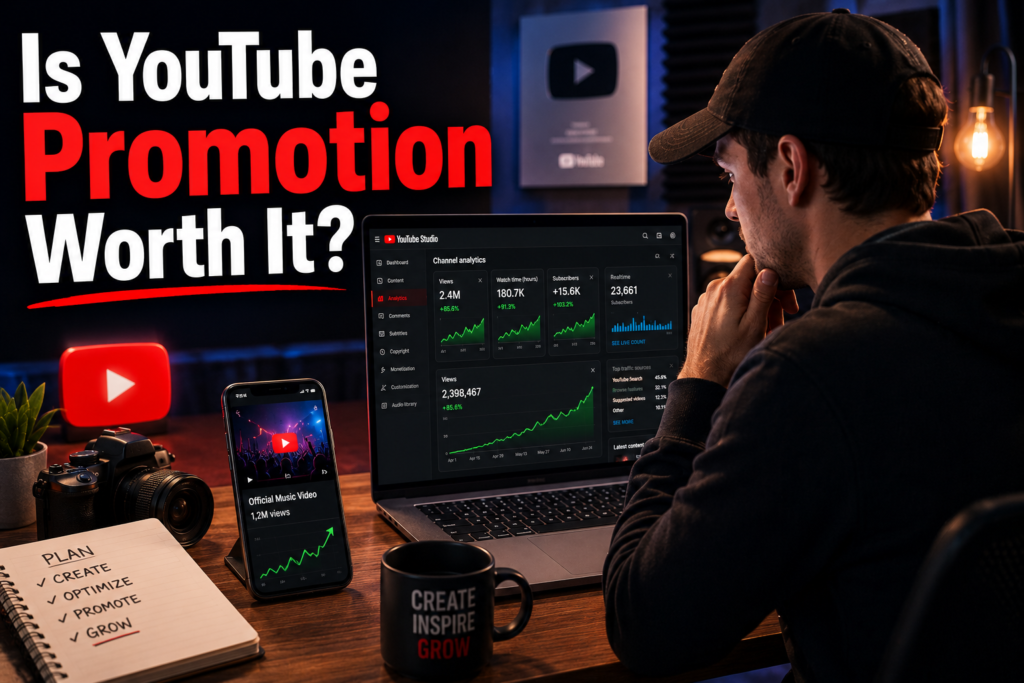
Is YouTube Promotion Worth It? Here’s What We Found After 100+ Campaigns
Posted on June 1, 2026 by Jason Caldwell
If you’ve been on YouTube for more than a few months, you’ve probably asked yourself this question at least once.
You’re uploading consistently. The thumbnails look good. The content is solid. But the views? Barely moving.
So you start looking for solutions — and somewhere along the way, you come across YouTube promotion services. And immediately, your next thought is: “Is this actually legit, or is it just another scam?”
That’s exactly what we set out to find out.
Over the past two years, we’ve run more than 100 YouTube promotion campaigns across different niches — music, gaming, business, lifestyle, education. We tracked the data. We made mistakes. We learned what works and what absolutely doesn’t.
This is that honest breakdown.
What “YouTube Promotion” Actually Means in 2026
Let’s clear something up first, because there’s a lot of confusion around this term.
When most people hear “YouTube promotion,” they think of two things: either buying fake views from some shady website, or running YouTube ads through Google. These are not the same thing — and confusing them is where most creators go wrong.
Fake views come from bots, click farms, or low-quality traffic sources. They inflate your view count but deliver zero real watch time, zero engagement, and zero subscribers. Worse, YouTube’s algorithm has become extremely good at detecting this traffic. If you get caught — and most people do — your video gets suppressed, your channel loses credibility, and in serious cases, you risk getting terminated.
Real YouTube promotion, on the other hand, means getting your video in front of actual people who are interested in your content. The most reliable way to do this in 2026 is through Google Ads — specifically YouTube’s TrueView ad format, which shows your video to targeted audiences and only charges you when someone watches at least 30 seconds.
The difference in outcome between these two approaches is night and day. And everything we’re going to share below is based entirely on real promotion — the kind that gets your video seen by real humans.
What We Actually Tested
Over 100+ campaigns, here’s what the breakdown looked like:
- Niches covered: Music (independent artists), gaming, fitness, business/coaching, food, tech reviews
- Budget range: $50 per campaign on the low end, up to $800 on the high end
- Campaign duration: 7 days to 45 days
- Targeting methods: Interest-based, keyword-based, demographic, and custom intent audiences
- Goal types: Views, watch time, subscribers, and website traffic
We weren’t just looking at how many views a campaign generated. We were looking at watch time retention, subscriber conversion rate, engagement rate (likes, comments, shares), and most importantly — whether the channel continued to grow after the campaign ended.
That last metric is the one most promotion services never talk about. And it turned out to be the most revealing.
What the Data Showed
Finding 1 — View count is the least important metric
We ran campaigns for two similar gaming channels. Channel A got 18,000 views from a broad, low-cost targeting approach. Channel B got 6,200 views from a tighter, interest-specific audience.
Channel A’s average watch time was 28 seconds. Channel B’s was 4 minutes 12 seconds.
Thirty days later, Channel A had gained 14 subscribers from that campaign. Channel B had gained 212.
The YouTube algorithm doesn’t care how many views you got. It cares how long people watched. A smaller audience that actually watches your video is worth ten times more than a massive audience that clicks away in 10 seconds.
Lesson: When evaluating any promotion campaign, ignore the raw view count. Look at average view duration and subscriber conversion rate. Those numbers tell you whether the promotion actually worked.
Finding 2 — Niche targeting makes or breaks a campaign
One of our early mistakes was targeting too broadly. We ran a promotion for an independent hip-hop artist and set the audience to “music lovers” across a wide age range and geography.
The views came in. The watch time was terrible.
We reran the same video with a tightly defined audience — people who had watched similar independent hip-hop artists, in the 18–34 age bracket, in specific cities where that genre has a strong following.
Watch time went up by 340%. Subscriber rate tripled. And the comment section suddenly had actual fans in it, not just passive scrollers.
Targeting is everything. And this is why real YouTube promotion requires real expertise — not just a budget.
Finding 3 — Promotion works best when your content is already good
This sounds obvious, but it’s worth saying clearly: promotion amplifies what’s already there. If your video has a weak hook, a confusing structure, or a thumbnail that doesn’t convert clicks — no amount of promotion budget is going to fix that.
We had a client in the fitness niche who spent $300 on promotion for a video that had a 52-second average watch time on an 8-minute video. The campaign delivered views. The channel didn’t grow.
Then they rebuilt the first 60 seconds of their next video — tightened the hook, cut the fluff, got to the value faster. Same promotion budget on that video. Average watch time jumped to 3 minutes 40 seconds. Channel gained 380 subscribers in two weeks.
Promotion is fuel. Your content is the engine. Put fuel in a broken engine and you go nowhere.
Finding 4 — The channel kept growing after campaigns ended
This was the finding that surprised us most.
Channels that received real, targeted promotion — and had solid content — continued to grow organically even after the campaign budget was gone. Not because of some magic, but because of how YouTube’s algorithm works.
When a video accumulates strong watch time and engagement signals, YouTube itself starts recommending it more aggressively — in suggested videos, on the homepage, in notifications. The promotion gets the initial momentum. The algorithm takes it from there.
Across the campaigns we tracked for 60 days post-promotion, channels that had done targeted real promotion saw an average of 34% more organic views in the two months after the campaign than in the two months before it. The promotion essentially “unlocked” the algorithm for those videos.
This does not happen with fake views. Fake views send no positive signals to the algorithm. The video stays invisible.
So Is YouTube Promotion Worth It?
Here’s our honest answer: yes — but only under specific conditions.
YouTube promotion is worth it when:
- Your video content is genuinely good (strong hook, good retention, clear value)
- The promotion uses real traffic from a legitimate ad platform like Google Ads
- Targeting is specific and relevant to your actual audience
- You’re treating it as a long-term growth strategy, not a one-time shortcut
- You track the right metrics — watch time and subscribers, not just views
YouTube promotion is NOT worth it when:
- You’re buying fake views or using bot-based services
- Your content isn’t ready (weak hook, low retention on existing organic videos)
- You’re targeting too broadly and hoping for the best
- You expect promotion to replace consistent content creation
The creators who got the best results in our campaigns weren’t the ones with the biggest budgets. They were the ones who understood that promotion is one tool in a wider strategy — not the whole strategy.
What to Look for in a YouTube Promotion Service
If you decide to explore promotion for your channel, here’s what to check before you spend a single or dollar:
- Where does the traffic come from? Any legitimate service should be able to tell you clearly that your views come from Google Ads or YouTube’s own ad platform. If they can’t tell you the traffic source — or if it’s vague — walk away.
- Do they offer targeting options? Real promotion is targeted. If a service just says “we’ll get you X views” with no mention of audience, demographics, or interest targeting, that’s a red flag.
- What metrics do they track and report? A credible service reports watch time, view-through rate, and subscriber data — not just raw view counts. View count alone is meaningless.
- Do they have real case studies or results? Not just screenshots of view counts, but actual before-and-after channel data showing growth over time.
- Is the pricing transparent? Vague pricing, unlimited guarantees, and “10,000 views for $5” offers are all signs of fake traffic. Real Google Ads-based promotion has real costs because real ad platforms charge real money.
The Bottom Line
After 100+ campaigns, the data is clear.
Real YouTube promotion — the kind that uses genuine ad targeting to put your video in front of actual people in your target audience — absolutely works. It builds watch time, signals quality to the algorithm, and creates a compounding effect that continues long after the campaign ends.
Fake promotion — bots, click farms, low-quality traffic — is a waste of money at best, and a channel-killing risk at worst.
The question was never really “does YouTube promotion work?” The better question is: are you using real promotion or fake promotion?
The answer to that question determines everything.
At Vedzzy, we run YouTube promotion exclusively through certified Google Ads campaigns — which means every view your video receives comes from a real person who chose to watch it. If you want to see what targeted, legitimate promotion looks like for your channel, explore our YouTube promotion packages and see the results for yourself.
You might also like:
- How Much Does YouTube Promotion Cost in 2026? (Real Numbers)
- YouTube Shorts Promotion — How to Get Real Views in 2026
- YouTube Promotion for Gaming Channels — What Actually Works

Hi, I am Jason, a digital content strategist with 8 years of experience helping YouTube creators and brands grow their channels through data-driven content decisions. I have worked with creators across niches including tech, education, and lifestyle, and specialise in translating YouTube Analytics data into actionable growth strategies.
Categories: YouTube Promotion