Google Ads vs fake views: what every creator needs to know before paying for YouTube promotion
Posted on May 21, 2026 by Jason Caldwell
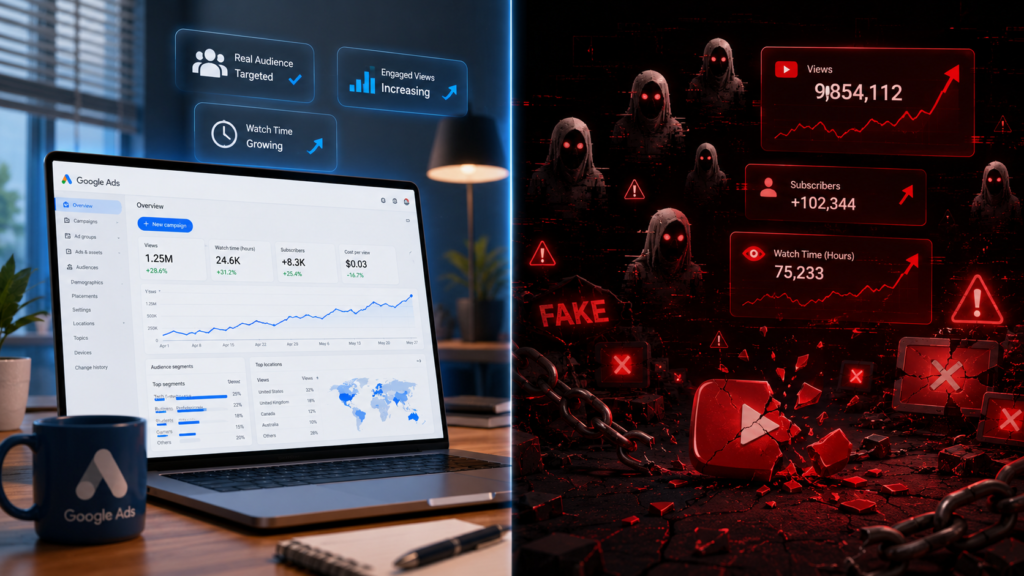
If you’ve been researching how to grow your YouTube channel faster, you’ve likely come across two very different kinds of promotion services. One type runs your videos through Google’s own advertising infrastructure and delivers real, measurable results inside YouTube Studio. The other sells bulk views at suspiciously low prices — views that come from bots, click farms, or incentivized traffic with zero genuine interest in your content.
They’re both marketed as “YouTube promotion.” They produce radically different outcomes. And if you pick the wrong one, you could set your channel back by months — or lose it entirely.
This guide breaks down exactly how these two approaches work, what each one does to your channel metrics, and how to make sure you’re only paying for promotion that actually helps. If you’ve already read our piece on Are YouTube Promotion Services Safe? this article goes deeper on the technical mechanics behind the difference.
The two types of YouTube promotion — and why they’re not comparable
Before comparing outcomes, it’s worth understanding what’s actually happening under the hood with each approach.
How Google Ads-based promotion works
When a promotion service uses Google Ads infrastructure, your video is served as an in-stream ad (skippable or non-skippable) or a discovery ad to real YouTube users who are actively browsing the platform. Google’s targeting system lets you define exactly which audience sees your content — by age, location, interest category, watch history, and even similar channel affinity.
The viewer sees your video in a native YouTube context. They can interact with it exactly as they would any organic video — subscribing, commenting, liking, adding it to a playlist. And critically, every second they watch generates real watch time that accumulates in your YouTube Studio analytics, counts toward your YouTube Partner Program thresholds, and feeds the algorithm real engagement signal data.
How fake view services work
Fake view services operate through one of several artificial traffic mechanisms:
- Bot networks that auto-play videos without any real human watching
- Click farms — low-wage workers paid fractions of a cent to open and briefly play videos
- Incentivized traffic — users offered rewards (gift cards, app credits) to watch videos they have no genuine interest in
- View exchange networks where creators watch each other’s videos solely to inflate counts
In every case, the views are technically real page visits or video loads — but there’s no genuine viewer interest, no meaningful watch time, and no organic engagement. The view counter goes up. Everything else stays flat or gets worse.
Fake views / bot traffic
- Views from bots or disinterested users
- Watch time is near-zero
- No real engagement signals
- YouTube detects and removes them
- Can trigger channel strikes or ban
- Damages algorithm distribution
Google Ads promotion
- Real users on YouTube
- Genuine watch time generated
- Engagement signals are authentic
- Tracked in YouTube Studio
- Counts toward YPP thresholds
- Helps algorithm learn your audience
What fake views actually do to your channel metrics
The damage from fake views isn’t always immediate or obvious — which is part of why creators keep falling for these services. Here’s what’s actually happening to your channel when you buy artificial traffic.
Your click-through rate (CTR) gets destroyed
CTR measures how often people click on your video when it’s shown to them as an impression. When YouTube serves your video to real audiences organically, your CTR reflects genuine interest. When fake views inflate your view count without a corresponding increase in real impressions, YouTube’s systems see a disconnect — a lot of “viewers” who didn’t come through normal discovery pathways. This tells the algorithm your content isn’t attracting organic clicks, which reduces how often it gets surfaced in recommendations and search.
Your audience retention tanks
Audience retention — the percentage of each video viewers actually watch — is one of YouTube’s most important ranking signals. Bot traffic doesn’t watch your video. Click farm workers watch for a few seconds and move on. Incentivized viewers close the tab the moment their reward is confirmed. The result: a sharp drop-off in average view duration that tells YouTube your content isn’t keeping people engaged. The algorithm responds by limiting your distribution — the exact opposite of what you paid for.
The hidden damage: A video with 10,000 fake views and 8% average retention will rank worse than the same video with 500 real views and 65% average retention. YouTube measures engagement quality, not view quantity.
Your subscriber-to-view ratio sends red flags
YouTube monitors the relationship between a channel’s subscriber count and its view counts. When a small channel suddenly accumulates thousands of views with no corresponding subscriber growth, comments, or engagement, the pattern is statistically anomalous. This can trigger manual review flags, demonetization of the affected videos, or suppression of the channel’s overall distribution.
Invalid views get removed — and so does the money you paid
YouTube’s systems continuously audit view counts and remove invalid traffic. This means the views you paid for disappear from your counter, often within days or weeks. You spend the money, the views briefly appear, then vanish — leaving you with a smaller view count than before, worse engagement ratios, and a channel that may now be flagged for suspicious activity.
What Google Ads promotion actually does to your channel
The contrast with legitimate Google Ads-based promotion is significant — not just in safety, but in actual channel outcomes.
It generates watch time that counts
Every view from a Google Ads campaign is a real user on YouTube watching your actual video. Even skippable ad views — where a viewer watches at least 30 seconds before skipping — generate real watch time. Non-skippable formats generate full view duration. All of this accumulates in your YouTube Studio analytics as legitimate watch time that counts toward your YPP eligibility thresholds.
55%
ad revenue share for creators at YPP Tier 2
30 sec
minimum for a skippable ad view to count as watch time
4,000 hrs
watch hours needed for full YPP monetization
It teaches the algorithm who your audience is
The YouTube recommendation algorithm builds a model of your channel’s audience based on who engages with your content and how. When you run Google Ads campaigns targeted at relevant audiences — people who watch similar artists, follow music channels in your genre, or have demonstrated interest in your niche — the algorithm receives clear signals about who your content is for. This makes organic recommendations progressively more accurate and more frequent over time.
This is the core mechanic behind why using a legit YouTube promotion service can have compounding benefits beyond the views you directly paid for. The engagement data from a well-targeted campaign seeds better organic distribution.
It generates subscriber conversions that stick
When a real viewer discovers your channel through a promoted video and genuinely enjoys the content, they subscribe because they want to see more. These subscribers have a real interest in your work. They click through when you upload. They watch your videos at high retention rates. They comment. Each of these behaviors strengthens your channel’s engagement signals and compounds your organic growth over time.
Fake subscribers — whether bought directly or acquired through view exchange schemes — do none of this. They sit in your subscriber count doing nothing, dragging down your per-subscriber engagement rate and signaling to YouTube that your audience isn’t responsive to your content.
How to tell which type of service you’re looking at
The promotion services market is genuinely confusing because both legitimate and illegitimate providers use similar language. Here are the specific signals that distinguish them.
Signs of a legitimate Google Ads-based service
- They mention Google Ads, Google’s TrueView system, or Google’s advertising infrastructure explicitly
- They can explain exactly how their targeting works (demographics, interests, keyword targeting)
- The views appear in your YouTube Studio analytics with normal geographic and device distributions
- Watch time and audience retention metrics are visible and reasonable (not zero)
- They don’t guarantee specific view counts within hours — real ad campaigns have normal delivery curves
- Pricing reflects actual Google Ads CPV rates (typically $0.01–$0.03 per view for music content)
Red flags that indicate fake or bot traffic
- Prices that are dramatically below market rate (e.g. 10,000 views for $5)
- Guaranteed delivery within hours or days with no targeting explanation
- No mention of Google Ads or any specific traffic source
- Views appear with flat or zero audience retention in YouTube Studio
- Heavy traffic from unexpected geographic locations with no engagement
- No subscriber conversions despite high view counts
- “Guaranteed” views with a refill policy — a giveaway that they know the views will be removed
The pricing test: Google charges advertisers between $0.01 and $0.05 per genuine ad view depending on targeting. Any service offering views significantly below this rate cannot be sourcing traffic through Google Ads — the math doesn’t work. If the price seems too good to be true, the traffic isn’t real.
The algorithm compounding effect — why this matters beyond individual videos
Most creators think about promotion at the individual video level. The smarter frame is channel-level momentum over time.
YouTube’s recommendation algorithm builds a long-term model of your channel’s audience and engagement patterns. Every video you publish adds data to this model. A channel with a consistent history of strong engagement signals — high retention, genuine subscriber conversions, real comments and likes — receives progressively better organic distribution as the algorithm becomes more confident in routing your content to interested viewers.
Fake views corrupt this model. They inject false signals that confuse the algorithm’s understanding of your audience. The corruption accumulates across videos, making it harder for the algorithm to correctly identify and route your content over time — even after you stop buying fake views.
Legitimate paid promotion, by contrast, accelerates the model-building process. A targeted Google Ads campaign for a new channel gives the algorithm high-quality audience data earlier than organic growth alone would provide. This is why creators who use well-targeted paid promotion as part of their growth strategy often see a compounding effect where organic performance improves steadily over time, even as paid spend stays flat or decreases.
For a detailed walkthrough of how to build a complete promotion strategy that combines organic and paid approaches, The Complete Guide to YouTube Promotion in 2026 covers the full framework from channel setup through advanced audience targeting.
What about YouTube’s enforcement — will they catch fake views?
Yes — and more effectively than many creators realize.
YouTube has invested significantly in its invalid traffic detection systems. The platform uses a combination of automated pattern recognition and human review to identify and remove inauthentic views. Signals that trigger these systems include:
- Abnormal view velocity (thousands of views within hours on a small channel)
- Geographic clustering inconsistent with the channel’s organic audience
- Device and browser fingerprint patterns typical of bot networks
- Zero or near-zero watch time relative to view count
- IP address patterns associated with known click farms or proxy networks
- View-to-engagement ratios that fall outside normal statistical ranges
When these systems flag a channel, the response can range from silent view removal to demonetization of specific videos to full channel termination — depending on the scale and pattern of the violation. YouTube’s Terms of Service are explicit: artificially inflating metrics through any means is a violation that can result in permanent channel removal.
The risk isn’t just losing the views. Channels that repeatedly trigger invalid traffic detection can have their entire view history audited. This can result in permanent metric suppression — YouTube throttling organic distribution as a penalty — that persists even after the channel stops using fake views.
A practical decision framework: which promotion approach is right for your channel?
Not every channel needs paid promotion. And not every paid promotion approach is appropriate for every channel type or growth stage. Here’s how to think about it.
When Google Ads-based promotion makes sense
- You’re a new channel with fewer than 500 subscribers trying to accelerate to YPP Tier 1 eligibility
- You’re releasing a new video that you want to give an early push to seed algorithm data
- You have strong content but limited organic reach because your channel is new and hasn’t built algorithm history yet
- This is especially relevant for artists — if you’re exploring YouTube Promotion for Musicians, understanding which listener segments respond to your sound before scaling spend is one of the most valuable things targeted ad campaigns can tell you.
When to focus purely on organic strategy first
- Your content quality isn’t at the level where even interested viewers would subscribe — paid promotion won’t fix this
- You don’t yet have a consistent upload schedule — promoted traffic that lands on an inactive channel produces poor subscriber conversion
- Your channel niche is extremely narrow and local — organic community building may be more efficient than broad ad targeting
The most effective approach for most independent creators — especially musicians trying to grow a YouTube channel alongside their other platforms — is a hybrid strategy: strong organic foundations (consistent posting, SEO optimization, Shorts for discovery) combined with targeted paid promotion on your highest-quality long-form uploads.
The bottom line
The choice between Google Ads promotion and fake views isn’t really a choice between two promotion strategies. It’s a choice between investing in your channel’s real growth and paying to damage it faster.
Fake views inflate your view counter briefly, corrupt your engagement metrics, confuse the algorithm’s understanding of your audience, and put your channel at risk of penalties that can be difficult or impossible to recover from. The money spent on fake views is genuinely wasted — not just ineffective, but actively harmful.
Google Ads-based promotion, run through a service that uses YouTube’s own advertising infrastructure, generates real watch time, teaches the algorithm about your real audience, and produces subscriber conversions that compound your organic growth over time. Done well, it’s not just safe — it’s one of the most efficient growth levers available to small and mid-size channels.
If you’re evaluating promotion options and want to understand what separates safe services from harmful ones in more depth, Are YouTube Promotion Services Safe? is a good companion read alongside this article.
The simple test: Before paying for any YouTube promotion, ask one question — “Does this service use Google Ads?” If they can’t answer clearly and specifically, don’t buy.
Q1. Is buying YouTube views against YouTube’s Terms of Service?
Buying fake or artificial views — from bots, click farms, or incentivized networks — is a direct violation of YouTube’s Terms of Service and can result in view removal, demonetization, or permanent channel termination. Paid promotion through Google Ads, however, is entirely within YouTube’s guidelines because it uses YouTube’s own official advertising infrastructure to deliver real views from real users.
Q2. Will Google Ads views count toward my YouTube Partner Program watch hours?
Yes. Views generated through Google Ads campaigns are real views from real YouTube users, and the watch time they generate counts toward your YPP eligibility thresholds — both the 3,000-hour Tier 1 threshold and the 4,000-hour Tier 2 threshold. Fake views do not count and are typically removed before they can accumulate any meaningful watch time on your counter.
Q3. How can I check if the views I bought were real or fake?
Open YouTube Studio and check three things: audience retention (should show a realistic curve, not a flat line near zero), geographic breakdown (should match your targeting, not cluster in unexpected countries), and subscriber conversion rate (real views produce some subscribers; fake views produce near zero). If retention is below 10% and there are no subscriber conversions despite high view counts, the traffic was not genuine.
Q4. Can fake views get my YouTube channel banned?
Yes. YouTube’s invalid traffic detection systems actively monitor for artificial view patterns. Channels that repeatedly trigger these systems can face escalating consequences — from silent view removal to video demonetization to full channel termination. The risk is not theoretical; YouTube permanently removes channels for this violation every day.
Q5. How much does legitimate Google Ads-based YouTube promotion cost?
Google charges advertisers between $0.01 and $0.05 per genuine ad view depending on targeting specificity, audience competition, and content category. Music content typically sits at the lower end of this range. Any service offering views significantly below this price point cannot be using Google Ads infrastructure — the economics are impossible. Use this as your baseline pricing test when evaluating any promotion service.
Q6. Do fake views affect my channel’s organic reach long-term?
Yes — and this is the most underappreciated risk. Fake views inject false engagement signals into your channel’s algorithm model. YouTube uses this data to decide who to recommend your videos to. Corrupted engagement data leads to worse organic recommendations, even after you stop buying fake views. Channels with a history of artificial traffic often report that organic performance takes months to recover after cleaning up their strategy.
Q7. What’s the difference between YouTube Ads and a YouTube promotion service?
YouTube Ads refers to running campaigns directly through your own Google Ads account. A YouTube promotion service manages this process on your behalf — handling targeting setup, campaign optimization, bid management, and reporting. A legitimate service acts as an agency layer on top of Google’s infrastructure. The underlying traffic source is the same; the difference is who manages the campaign. For creators without Google Ads experience, a well-run promotion service can deliver better results than a self-managed campaign.

Hi, I am Jason, a digital content strategist with 8 years of experience helping YouTube creators and brands grow their channels through data-driven content decisions. I have worked with creators across niches including tech, education, and lifestyle, and specialise in translating YouTube Analytics data into actionable growth strategies.
Categories: YouTube Promotion