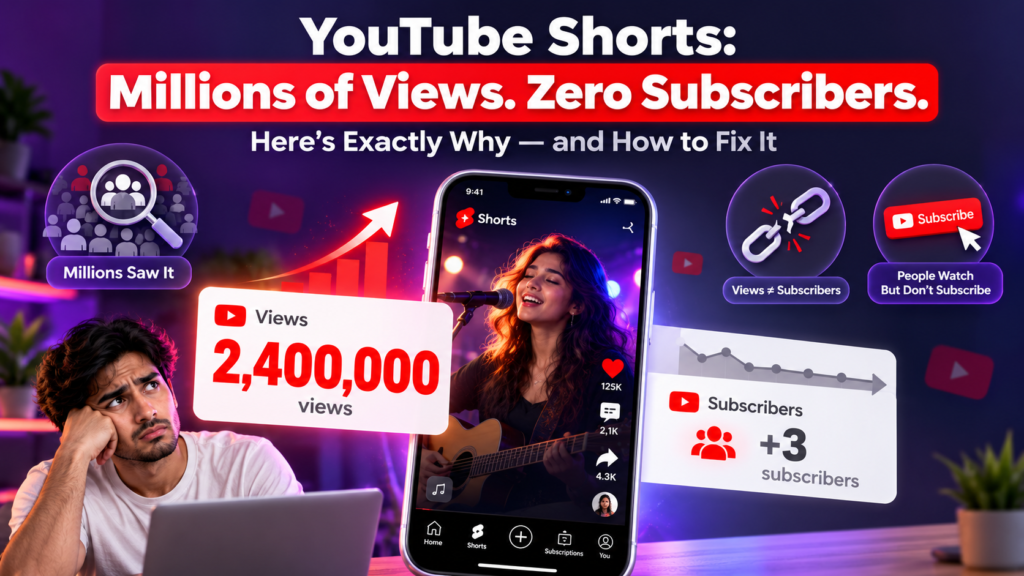
Why YouTube Shorts Get Millions of Views but Zero Subscribers – The Real Explanation
Posted on October 7, 2026 by Jason Caldwell
You open YouTube Studio and the numbers look good. Your latest Short has 80,000 views. Maybe 200,000. The comments are active. The likes are piling up. Then you check the subscriber count, and it moved by eleven. Maybe twenty.
This isn’t a glitch, and it isn’t bad luck. Your content probably isn’t the problem either. It’s just how the Shorts system was built to work. Once you understand the actual mechanism behind it, the gap between views and subscribers stops feeling mysterious and starts feeling fixable.
This guide explains why Shorts views almost never convert directly into subscribers, what the algorithm is really doing when it pushes a Short out to hundreds of thousands of people, and seven specific changes that close that gap in a measurable way.
Why YouTube Shorts Don’t Convert to Subscribers – The Algorithm Explanation
Most creators assume views lead to subscribers. More people watch, more people subscribe. On long-form YouTube, that relationship holds up reasonably well. On Shorts, it barely exists at all. To understand why, you need to understand how the Shorts recommendation system actually works.
Shorts and long-form videos run on separate recommendation systems. They use different distribution logic and different engagement signals, and each has a different relationship to subscriber conversion. Treating them as the same system is the root misunderstanding behind most of this frustration.
The Shorts Feed Is Built for Passive Consumption
When a viewer opens the Shorts feed, YouTube starts serving a continuous scroll of content. The viewer never searches for anything and never chooses your video specifically. They’re handed a stream selected by an algorithm that cares about completion rate, swipe behavior, and re-watch signals. Their subscription history and declared interests barely factor in.
That means most people who see your Short have no prior relationship with your channel at all. YouTube’s own data shows that roughly 74% of Shorts views come from non-subscribers. That’s not a flaw in the system; it’s the entire point of Shorts as a discovery surface. But it also means nearly every viewer watching your Short is a cold audience member with no existing reason to subscribe.
The Swipe Signal Matters More Than View Count
Here’s the mechanic most articles on this topic skip entirely. The Shorts algorithm evaluates content mainly on the ratio between viewers who watched and viewers who swiped away. A viewer who immediately swipes past your Short sends a negative signal. A viewer who watches to the end, or replays it, sends a positive one.
A Short with 500,000 views and a high swipe-away rate can actually produce a weaker distribution signal than a Short with only 50,000 views and a low swipe rate. The view count sitting in YouTube Studio isn’t the number the algorithm cares about most. The ratio between genuine watching and immediate swiping is.
This also explains how a Short can rack up huge view counts while generating almost no subscribers. The algorithm distributes a Short widely based on early positive signals, and once it reaches a broader audience, a lot of those later viewers swipe past instantly because the content simply doesn’t match their interests. Views keep climbing. Subscriber conversion stays close to zero.
Average Shorts Watch Time Is Approximately 16 Seconds
The average watch time on a YouTube Short in 2026 sits around 16 seconds, and that holds true even for Shorts with strong overall reach. Sixteen seconds isn’t enough time to establish who you are as a creator, show consistent value, or give someone a real reason to follow you beyond that single moment.
On a long-form video, a viewer has already stuck around for four, six, or ten minutes by the time they consider subscribing. They’ve gotten a feel for your style, your knowledge, your personality, and how your content is put together. The decision to subscribe comes from real, accumulated value. On a Short, the viewer has experienced somewhere between 16 and 59 seconds of you. Subscribing would have to happen almost on impulse, which is exactly why it rarely does unless something specific triggers it.
YouTube Shorts Subscriber Conversion – What the Data Actually Shows
Before getting into why conversion runs low, it helps to know what a realistic subscriber conversion rate from Shorts actually looks like. That way you can tell whether your own Shorts are underperforming or just behaving normally.
| Shorts Performance Level | View Range | Typical Subscriber Conversion Rate | What It Means |
| Below average | Any view count | Under 0.05% (5 subscribers per 10,000 views) | Content or niche clarity problem – viewers aren’t seeing a reason to follow |
| Average | Any view count | 0.05% – 0.15% (5–15 per 10,000 views) | Normal Shorts performance – views are reaching non-subscribers who don’t convert |
| Above average | Any view count | 0.15% – 0.5% (15–50 per 10,000 views) | Strong niche clarity and an effective subscribe trigger in the Short itself |
| Exceptional | Any view count | Above 0.5% (50+ per 10,000 views) | Very specific audience match, a clear subscribe reason, and an effective bridge to long-form |
These numbers are worth sitting with, because they reframe the frustration. A creator who reaches 100,000 views and gains 50 subscribers has hit a 0.05% conversion rate, which sits at the low end of normal rather than being a failure. A creator who reaches the same 100,000 views and gains 300 subscribers has hit 0.3%, which is genuinely strong Shorts performance.
The creators who feel the sting of this gap most acutely are the ones converting below 0.05% while reaching large audiences. That specific situation has identifiable causes, and the rest of this guide walks through them.
YouTube Shorts Reach vs Subscribers – Why the Numbers Look So Imbalanced
This imbalance is built into how YouTube distributes Shorts in the first place. The platform optimizes Shorts distribution around engagement inside the feed itself: completion rate, like rate, comment rate, share rate, and the newer Save rate added in July 2026. These signals tell YouTube whether a Short is entertaining enough to keep showing to more people.
None of them are directly tied to subscriber conversion. A Short can be genuinely excellent, with high completion, strong likes, and active comments, and still generate almost no subscribers. That’s because entertainment and subscription come from two different psychological triggers. Entertainment says “I enjoyed this.” Subscribing says “I want more from this specific creator.” Most creators lose the conversion somewhere in that gap between the two.
YouTube Shorts Algorithm 2026 – What Changed and What It Means for Creators
YouTube made two significant changes to the Shorts feed in 2026 that affect how subscriber conversion signals work, and most creators haven’t caught up with either one yet.
The Heart Button Replaced the Thumbs Up (June 2026)
In June 2026, YouTube swapped the thumbs-up icon on Shorts for a heart icon, matching Instagram Reels and TikTok. This wasn’t just cosmetic. It reflects a real shift in how YouTube frames the engagement signal, moving from “I approve of this” to “I feel something about this.” The goal is to capture engagement from viewers reacting emotionally, not just logically.
In practice, this means Shorts built around curiosity, surprise, humor, relatability, or nostalgia now generate stronger heart signals than Shorts built mainly around delivering information. The algorithm weighs those heart signals heavily when deciding how far to distribute a video. Creators making primarily informational Shorts may notice their engagement softening under this new weighting compared to the old thumbs-up model.
The Save Button Was Added (July 2026)
In July 2026, YouTube added a Save button to Shorts. Viewers can now add a Short to a playlist with one tap, or drop it into a default “Saved Shorts” playlist. A save is a stronger intent signal than a like, because it tells YouTube the viewer wants to come back to this specific piece of content later. That’s much closer to subscription intent than any prior Shorts engagement mechanism.
This changes what’s worth building. A Short worth saving usually has some utility beyond the first watch: a technique, a specific tip, a standout moment in a performance, or a recurring format viewers want to find again. Music Shorts and tutorial Shorts tend to benefit from this more than generic entertainment clips do.
The ‘Not Interested’ Signal Replaced the Dislike Button
YouTube also pulled the dislike button from Shorts in June 2026, replacing it with “Not interested” and “Don’t recommend this channel.” This matters for creators whose Shorts keep reaching the wrong audience. A dislike used to be a vague negative signal. “Don’t recommend this channel” is a direct rejection that stops that viewer from seeing your content immediately, and it builds into a channel-level suppression signal once enough viewers in a given audience segment use it.
Shorts that land in front of the wrong audience now carry a harder penalty than they did before. Niche clarity in your Shorts strategy matters more in 2026 than it did even a year earlier.
YouTube Shorts vs Long Form Subscribers – Why Long Form Converts Better
Subscriber conversion from long-form videos runs consistently 3 to 8 times higher than from Shorts with equivalent reach, and the gap comes down to how differently each format drives the subscribe decision.
| Factor | YouTube Shorts | Long-Form YouTube |
| Typical watch time before subscribe decision | 16 – 59 seconds | 4 – 12 minutes |
| Viewer relationship with creator pre-watch | Usually none (74% non-subscribers) | Often some (subscriber or returning viewer) |
| Content depth visible to viewer | Single moment or idea | Full style, personality, knowledge, structure |
| Reason to subscribe demonstrated | Rarely – not enough time | Consistently – if content delivers value |
| Typical subscribe conversion rate | 0.05% – 0.15% | 0.5% – 3% |
| Algorithm distribution basis | Feed engagement signals (completion, hearts, saves) | Audience match signals (watch time, retention, CTR) |
| Subscription motivation | Entertainment in the moment | Expectation of future value |
| June 2026 signal changes | Heart button, Save button, Not Interested | No significant changes to conversion mechanism |
This table is what makes the conversion gap structural rather than accidental. Long-form gives a viewer enough time to actually experience your value: what you make, why it matters to them, and what they’d get out of subscribing. Shorts don’t have that time to work with. They need to accomplish the subscribe trigger in under a minute, and that requires specific design choices most creators simply aren’t making yet.
Why Viral Shorts Don’t Grow Channels
A Short that goes viral, reaching 500,000 or a million views, pulls in a disproportionate share of its audience from well outside your actual niche. The algorithm spreads viral content broadly precisely because the engagement signals are strong, but broad means everyone, not your target audience specifically. A gaming channel’s viral Short might reach millions of people who mostly watch cooking, finance, or music content. They watch, they enjoy the moment, they scroll on. There’s no reason for any of them to subscribe to a gaming channel.
This is why the creators with the most viral Shorts aren’t always the ones growing fastest in subscribers. Virality and channel growth are separate outcomes driven by separate mechanisms. A Short built to go viral optimizes for broad appeal. A Short built to grow subscribers optimizes for a specific audience who would actually benefit from following the channel long-term.
Why YouTube Shorts Don’t Convert to Subscribers – The 5 Content Problems
Beyond the algorithm mechanics themselves, five specific content problems explain why Shorts rack up views without converting subscribers. Each one is fixable, but only once you know which applies to your channel.
Problem 1: Content Identity Problem – No Clear Channel Promise
The most common cause of the Shorts subscriber gap is what’s called the content identity problem. A viewer watches your Short and finds it entertaining, but has no clear sense of what your channel is actually about, what you consistently make, or what they’d get by subscribing. There’s no obvious answer to “what do I get if I subscribe?”
This usually shows up when Shorts jump between unrelated topics: motivation one day, memes the next, a tutorial after that, then gaming clips. Each individual Short might land well on its own. But the variety sends a signal that the channel itself is random, and random isn’t worth subscribing to, since subscribing is a bet on future content and unpredictable future content isn’t a bet most people want to make.
The fix is narrowing. Pick one specific niche and make every Short reinforce it. A viewer who finds a guitar-technique Short and discovers a channel entirely about guitar technique has an obvious reason to subscribe. A viewer who finds that same guitar Short on a channel covering five unrelated topics has no clear reason to, even if the guitar Short itself was excellent.
Problem 2: No Subscribe Trigger in the Short Itself
Most Shorts simply end with no mechanism built to turn the viewer into a subscriber. The content plays, the view registers, and the viewer moves to the next Short. There was never a moment where the creator gave them a specific, compelling reason to act.
A subscribe trigger isn’t “don’t forget to like and subscribe” tacked onto the end. That generic ask converts almost nobody, because it gives no actual reason to comply. A trigger that works gives the viewer something tied to real future value: “I post a new guitar technique every Tuesday, subscribe if you want it when it drops.” Or: “Part 2 is already up on the channel.” Or: “Every week I break down the chord progression behind a popular song, subscribe to get the next one.”
The trigger needs to be specific, tied to what the Short was actually about, and pointed at something the viewer would genuinely want. Generic asks get ignored. Specific promises get action.
Problem 3: Shorts Are Standalone – No Bridge to the Channel
A Short that works as a fully self-contained piece of entertainment gives the viewer nowhere to go next. They watched it, they enjoyed it, and it’s done. There’s nothing left to discover.
Shorts that actually convert subscribers are built to feel deliberately incomplete. They introduce something without finishing it. They point to a longer video that answers the exact question the Short raised. They show one technique out of a series that lives on the main channel. The Short functions as a trailer, not the full film.
This is the Shorts-to-long-form funnel in practice. A Short’s job isn’t to entertain completely. It’s to create enough curiosity that the viewer takes one more step: visiting the channel, watching a long-form video, and through that longer experience, deciding to subscribe.
Problem 4: The Short Is Attracting the Wrong Audience
Some creators make genuinely strong niche Shorts but accidentally pull in off-niche viewers through trending audio or viral formats that don’t actually connect to their content.
A finance creator who rides a trending comedy audio to a viral Short might reach two million people who found it funny. But they came for the comedy, not the finance content. When they land on the channel and see financial education videos, they leave. The Short generated massive reach and essentially zero relevant audience.
Check your YouTube Studio analytics after each Short. Look at audience demographics, geographic spread, and specifically whether viewers click through to other videos. If your channel click-through rate sits under 0.5% on a Short with meaningful views, the audience that Short reached wasn’t your actual target audience.
Problem 5: Shorts Are Replacing Long-Form Rather Than Feeding It
Some creators go all-in on Shorts after seeing strong reach and quietly abandon long-form content entirely. That removes the one thing subscribers would actually be subscribing to. If your channel has no long-form content, nothing waiting after the Short, a visitor who lands on your channel page has nothing to engage with. They leave without subscribing.
Shorts work as a top-of-funnel discovery tool. They bring new viewers into your orbit. Long-form content is the middle and bottom of that funnel, the place where conversion actually happens, where a viewer spends 10 to 20 minutes with you and decides you’re worth following. Strip out the long-form content and you’re left with a funnel that has no middle or bottom. Views come in. Subscribers don’t come out.
How to Get Subscribers From YouTube Shorts – 7 Specific Fixes
These fixes are ordered by impact, with the ones that move subscriber conversion most sitting first. You don’t need to roll out all seven at once. Start with the first two, measure the effect, then add more.
Fix 1: Establish One Clear Niche and Stay In It
Before anything else, decide exactly what your channel is about and make every Short reinforce that identity. Not a broad category, a specific one. Not “fitness,” but “strength training for people over 40.” Not “music,” but “jazz guitar for beginners.” Not “business,” but “freelance pricing strategy.”
The more specific the niche, the more clearly a viewer understands exactly what they’re subscribing to. When someone watches your Short, visits your channel, and finds twenty more Shorts on that same specific topic, the subscribe decision becomes obvious. There’s a clear answer to “what do I get if I subscribe?”
This feels limiting at first. It isn’t. The algorithm distributes specific niche content to the audience that actually matches it, which produces a higher share of subscribe-eligible viewers in your reach than broad content scattered across a mostly irrelevant audience ever will.
Fix 2: Add a Specific Subscribe Trigger in Every Short
In the final 5 to 10 seconds of every Short, add one specific, value-based reason to subscribe. Not a generic ask, a promise, and that promise needs to tie directly to what the viewer just watched.
Strong subscribe triggers for Shorts sound like: “I post one of these every week, subscribe to get the next one.” Or: “There are 12 more in this series on the channel.” Or: “Part 2 drops Thursday, subscribe so you don’t miss it.” Or: “Every week I break down one [topic], subscribe if you want the next breakdown.”
The mechanism behind this is future value. Subscribing is a decision about what’s coming, not what already happened. Telling the viewer exactly what they’ll get, in terms tied to what they just watched, is what turns a good 16 seconds into a forward-looking commitment.
Fix 3: End Every Short With a Deliberate Cliffhanger or Incomplete Story
Design your Short so it leaves something unresolved, not in a frustrating way, but in a way that creates genuine curiosity. A technique demonstration that shows the result but skips the steps. A story that reaches the interesting part and continues on the main channel. A question the Short raises without answering.
This is the bridge mechanism at work. The Short creates enough interest that the viewer wants more, and the “more” lives on your channel. A viewer who follows that curiosity to a long-form video has now spent six minutes with you, which is enough time for a real subscribe decision instead of a 16-second impression.
Fix 4: Use Your Short’s Description to Point to a Specific Video
Most creators barely use the description field. Instead of leaving it blank or writing a throwaway caption, point it at a specific long-form video with a real reason to click: “The full technique is in my 8-minute breakdown, link in bio.” Or: “I posted the complete version on my channel.” This gives viewers who don’t subscribe right away a text-based bridge to come back through later, often through search.
The description also helps the Short’s search visibility. YouTube indexes it, so a well-written description with the right terms helps the Short surface in search results, which tends to bring in higher-intent viewers than the Shorts feed alone does.
Fix 5: Analyse Which of Your Shorts Has the Highest Channel Click-Through Rate
Open YouTube Studio, go to Analytics, click Content, and filter by Shorts. For each one, look at the impressions-to-channel-visit ratio: the share of viewers who tapped through to your channel profile after watching. This number predicts subscriber conversion more directly than almost any other metric, since a viewer visiting your profile is a viewer actively weighing whether to subscribe.
Whichever Shorts have the highest channel click-through rate are telling you what’s actually working. Study the topic, the format, the subscribe trigger, and the ending each one used, then make more Shorts that copy those elements and fewer that copy your low-click-through ones. The YouTube Analytics Explained guide on Vedzzy walks through exactly how to find and read this data inside YouTube Studio.
Fix 6: Publish Long-Form Content That the Short Points To
Every Short needs a matching long-form video on your channel that actually delivers on whatever it promised. “The full tutorial is on the channel” only works as a bridge if that tutorial genuinely exists. A viewer who follows through and finds nothing relevant will leave immediately.
If you’re currently posting only Shorts, this is the single most important fix on this list. Publish two or three long-form videos that directly expand on your best-performing Shorts topics. These become the destination your Short viewers actually convert on. Without them, none of the other fixes here will move your subscriber count much at all.
Fix 7: Use Targeted Promotion to Reach the Right Audience
Once the content fixes are in place, niche clarity, a subscribe trigger, and a long-form destination, the remaining lever is making sure your Shorts reach the right people in the first place. Organic Shorts distribution reaches a broad, interest-scattered audience. Targeted promotion reaches a specific audience that actually matches your niche.
Google Ads-based YouTube promotion can target Shorts by genre interest, age range, location, and viewing behavior. Viewers who find your Short through targeted promotion are far more likely to be the right audience for it, which typically means higher save rates, higher channel visit rates, and stronger subscriber conversion than the same Short would get from broad organic Shorts feed distribution.
Promotion views delivered through Google Ads show up in your YouTube Studio Traffic Sources under “YouTube advertising,” complete with full watch time, demographic, and engagement data attached. In Vedzzy’s R&B music channel campaign, promoted views produced a 4.2% subscriber conversion rate, compared to an average under 0.15% from organic Shorts reach on the same channel. The difference came down to audience match: viewers who already listened to R&B regularly converted at a completely different rate than the broad Shorts feed audience did.
The condition that makes this actually work is having the content fixes in place first. Targeted promotion amplifies whatever is already working; it brings the right audience to a Short that’s been built to convert. A Short with no subscribe trigger and no long-form bridge will still convert poorly even with perfect targeting behind it.
The Shorts-to-Long-Form Funnel – How to Build It Properly
The most sustainable approach to Shorts treats them as the top of a funnel, not as standalone content. Building that funnel properly comes down to three stages: discovery, bridge, and conversion.
| Funnel Stage | Where It Happens | Mechanism | Goal |
| Discovery | Shorts feed | Reach new viewers through short-form content optimized for the Shorts algorithm – high completion, strong hook, heart-worthy moment | Get in front of the right audience |
| Bridge | Short’s ending + description + channel profile | Create curiosity, reference long-form content, use a specific subscribe trigger, and keep the channel profile clear about your niche | Move the viewer from the Short to the channel |
| Conversion | Long-form video on main channel | Deliver on the promise the Short made, show the full value of subscribing, end screen pointing to the next video | Turn a visitor into a subscriber |
Most creators fail at the bridge stage specifically. The Short does its job. It reaches a new viewer who watches and genuinely enjoys it. Then nothing happens next. There’s no clear path from the Short to the channel, no subscribe trigger, no obvious next step. The viewer closes the app, the view count ticks up, and the subscriber count sits still.
Fixing the bridge, the ending of the Short, the description, the subscribe trigger, and the channel profile, is what actually closes the gap. Every other fix in this guide supports that one central repair.
Diagnosing Your Specific Problem in YouTube Studio
Rather than applying all seven fixes at once, use this table to figure out which problem is actually driving your Shorts subscriber gap.
| What You See in YouTube Studio | Most Likely Cause | Start Here |
| High Shorts views, very low channel visits (under 0.3%) | No bridge – Shorts are self-contained with no reason to visit the channel | Add a specific subscribe trigger and a reference to long-form content in every Short |
| Moderate channel visits but low subscribe conversion | Channel profile problem – visitors aren’t finding a reason to subscribe once they arrive | Check your channel page: is the niche clear? Is there long-form content? Is the featured video relevant? |
| High views, high hearts/likes, near-zero subscribers | Content identity problem – Shorts are entertaining but the niche is unclear | Audit your last 10 Shorts: do they all cover the same specific topic? If not, narrow the niche |
| Strong niche Shorts but audience demographics don’t match channel | Trending audio or format pulling in the wrong audience | Stop using off-niche trending audio. Use original or niche-relevant audio only |
| Good conversion on some Shorts, near-zero on others | Inconsistent subscribe trigger – some Shorts have one, most don’t | Add the same subscribe trigger format to every Short going forward |
| Shorts views not growing at all (not just conversion) | Shorts feed distribution problem – completion or heart rate is low | Fix the hook: the first 2 seconds need to immediately communicate the Short’s value |
Match your situation against the first column, then follow the corresponding fix before trying anything else. The most common pattern, high views with low channel visits, means the bridge stage is broken, and fixing just that one thing tends to move subscriber conversion more than any other single change on this list.
Frequently Asked Questions
Why do my YouTube Shorts get views but no subscribers?
The core reason is that Shorts views and subscriber conversions come from two different mechanisms. Roughly 74% of Shorts views come from non-subscribers encountering your content in the Shorts feed with no prior interest in your channel. Average watch time sits around 16 seconds, which isn’t enough to demonstrate why someone should subscribe. Unless the Short includes a specific subscribe trigger, a clear channel identity, and a bridge to long-form content, most viewers watch, enjoy the moment, and scroll on without subscribing. Views measure entertainment in the moment. Subscriptions measure expected future value. Those are two different decisions that need two different kinds of content design.
Is it normal for Shorts to get views but not subscribers?
Yes. This is standard Shorts behavior, not a sign of weak content. A conversion rate between 0.05% and 0.15% (5 to 15 subscribers per 10,000 views) is typical for Shorts with no specific conversion optimization. Below 0.05% usually points to a content or bridge problem worth fixing. Above 0.3% means you’ve already built an effective funnel: clear niche identity, a specific subscribe trigger, and a long-form destination. Everything between 0.05% and 0.3% is within your control to improve.
Do YouTube Shorts help grow a channel?
Shorts help grow a channel when they function as the top of a funnel leading into long-form content. Used as standalone content with no bridge to the rest of the channel, they rack up views without growing subscribers. Used strategically, with consistent niche topics, subscribe triggers, and references to long-form content, Shorts are one of the fastest ways to introduce a channel to new audiences who then convert through longer engagement. The platform sees over 200 billion daily views, with 74% going to non-subscribers, so the discovery potential is genuinely enormous. Turning that discovery into subscribers just requires building the funnel on purpose.
How many Shorts views does it take to get 1000 subscribers?
At a typical conversion rate of 0.05% to 0.15%, reaching 1,000 subscribers from Shorts alone would take somewhere between 670,000 and 2 million views. At an above-average rate of 0.3%, it’s closer to 330,000 views. At an exceptional rate of 0.5%, around 200,000 views gets you there. This is why creators who grow mainly through Shorts either post at very high volume or focus on improving their conversion rate instead of just chasing bigger view counts. A creator converting at 0.5% needs less than a third of the views that a creator converting at 0.15% needs to hit the same subscriber milestone.
Why did my Short go viral but my channel didn’t grow?
Viral Shorts reach audiences far outside your niche. The algorithm spreads viral content broadly because its engagement signals are strong, but broadly means everyone, not your target audience specifically. A Short that reaches two million people generates most of those views from people with no real interest in your regular content. They watched because it was entertaining to a general audience, not because they cared about your specific niche. The fix is designing Shorts for niche-specific viral reach: content that spreads within your target audience instead of escaping into a general audience that was never going to convert.
Should I stop posting Shorts if they aren’t growing my subscribers?
No, but change how you use them. The problem is almost never the format itself. It’s that Shorts are being treated as standalone entertainment instead of the top of a channel funnel. Before giving up on them, build the bridge: add a specific subscribe trigger in the final five seconds, publish a long-form video the Short can point to, and make sure your channel profile clearly says what you make. Give those changes four to six weeks and track whether channel visit rates and subscriber conversion move. If they do, the Shorts strategy was right and the bridge was just missing. If they don’t, there may be a niche clarity or audience match issue worth digging into further.
Do Shorts watch hours count toward YouTube Partner Program eligibility?
No. Shorts watch time is tracked separately and only counts toward the Shorts-specific YPP path (10 million Shorts views in 90 days), not the long-form path (8,000 watch hours in 365 days starting February 2027). Creators building toward the long-form threshold can’t use Shorts watch time to get there. That’s one more reason Shorts need to be designed to bridge viewers into long-form content, since long-form watch time is what actually counts toward unlocking ad revenue through that path.
What is the best type of Short for getting subscribers?
The Shorts that consistently convert best share three traits: they’re tightly niche-specific rather than broad or varied, they end with a subscribe trigger tied to future content in that same niche, and they reference or tease a specific long-form video on the channel. Tutorial Shorts that teach one technique from a broader series, music Shorts featuring one performance from an ongoing catalog, and behind-the-scenes Shorts that tease a longer creative process all outperform generic entertainment Shorts for subscriber conversion, because each one gives the viewer a specific, niche-relevant reason to come back.
The Short Version
YouTube Shorts rack up millions of views and almost no subscribers because the two things run on different mechanisms entirely. Views come from the Shorts feed’s entertainment-optimized distribution algorithm. Subscriptions come from a viewer deciding to invest in future content from one specific creator. Those two decisions rarely happen inside the same 16 seconds.
Closing the gap takes three things working together: a clear channel identity so the viewer knows exactly what they’re subscribing to, a specific subscribe trigger so they have an actual reason to act, and a bridge to long-form content so the decision can happen during a session where there’s enough time to make it.
The difference between creators whose Shorts convert well and creators whose don’t is almost never about content quality. It’s about funnel design. The fixes in this guide are specific and measurable. Start with the first two, niche clarity and a subscribe trigger, check your channel visit rate in YouTube Studio over the next four weeks, and let the data tell you what to fix next.

Hi, I am Jason, a digital content strategist with 8 years of experience helping YouTube creators and brands grow their channels through data-driven content decisions. I have worked with creators across niches including tech, education, and lifestyle, and specialise in translating YouTube Analytics data into actionable growth strategies.
Categories: YouTube Growth Tips