How Manual Targeting YouTube Promotion on Vedzzy Works — And Why It Matters for Your Channel
Posted on June 9, 2026 by Jason Caldwell
If you’ve ever run a YouTube promotion campaign and felt like the views came in but nothing else happened — no real subscribers, no comment activity, no lasting algorithm boost — there’s a specific reason for that. And it has nothing to do with your content.
It has everything to do with who saw it.
Broad, untargeted promotion sends your video to a wide, mixed audience with no filtering for age, interest, or relevance to your content. Some of those viewers stick around. Most don’t. The engagement signals that reach YouTube’s algorithm are weak and difficult for the platform to act on meaningfully. Your channel doesn’t grow the way it should — because the algorithm never got a clear picture of who your content is actually for.
Defining your audience before the campaign runs — rather than leaving that decision to the platform — changes the quality of every result the campaign produces.
This article explains exactly how manual targeting works on Vedzzy, what each parameter does for your channel, and how to use it to get results that compound long after the campaign ends.
What Manual Targeting Actually Means
Manual targeting means you define your audience before the campaign runs — not after.
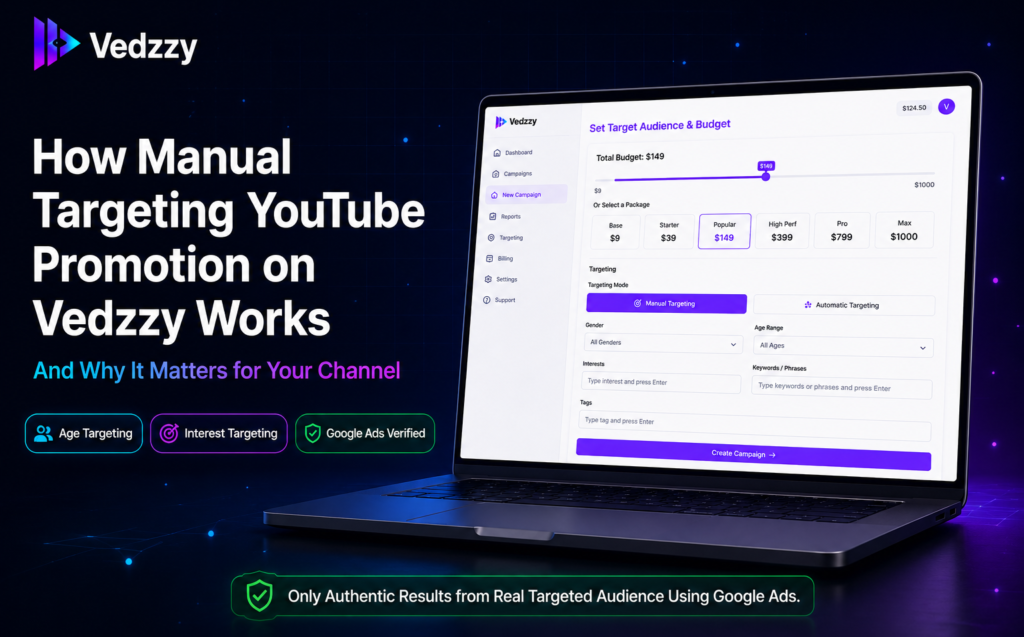
On Vedzzy’s dashboard, after submitting your YouTube link and email, you’re taken directly to a campaign setup page where you can configure your audience across five parameters:
- Age — the age range of viewers you want to reach
- Gender — male, female, or all genders
- Interests — audience segments based on demonstrated YouTube viewing behaviour
- Tags — specific keyword-level targeting within your interest category
- Category — the broader content ecosystem your video belongs to
Each parameter narrows your audience to a more relevant subset of YouTube’s active users. The more accurately those parameters match your content’s intended viewer, the better every metric performs — view duration, engagement rate, subscriber conversion, and organic reach after the campaign ends.
If you’d rather not configure targeting yourself, Vedzzy’s auto targeting option handles the full setup. The team analyzes your YouTube video, identifies the most relevant audience segments, and builds the campaign on your behalf — using the same parameters, configured by people who run these campaigns every day.
Both paths lead to the same place: genuine views from YouTube users who match your content’s audience profile, fully verifiable in your own YouTube Studio analytics.
The Five Targeting Parameters — What Each One Does
Age Targeting
Age targeting lets you define which age groups see your promoted video. This matters more than most creators realize — not just for relevance, but for the quality of engagement data that reaches YouTube’s algorithm.
Different age groups watch differently. They subscribe at different rates, comment at different rates, and contribute different RPM values to monetized channels. When your campaign reaches the age group that naturally engages most with your content, the retention signals and subscriber conversions that result are higher quality — which means the algorithm learns your audience more accurately and recommends your content more effectively going forward.
Here’s what real age-based campaign data looks like across a typical campaign on this platform:
| Age Group | TrueView Views | View Rate |
| 18–24 | 961 | 26.09% |
| 25–34 | 871 | 26.38% |
| 35–44 | 877 | 29.44% |
| 45–54 | 763 | 30.13% |
| 55–64 | 646 | 33.21% |
| 65+ | 522 | 35.70% |
Notice how view rate increases with age in this dataset. For content that resonates more strongly with older demographics, targeting the 45+ age range produces a meaningfully higher view rate — which means more watch time per view and stronger algorithm signals generated per campaign.
With manual targeting, you choose the age range that matches your content. You’re not paying for views from audiences who are statistically less likely to watch, subscribe, or engage.
Gender Targeting
Gender targeting routes your campaign to male, female, or all-gender audiences. In many content niches, audience gender composition skews significantly — and targeting the wrong gender mix dilutes the quality of your campaign results.
A hip-hop music channel whose organic audience is predominantly male should not be running campaigns distributed equally across all genders. The engagement mismatch produces lower retention, fewer subscriber conversions, and weaker algorithm signals — all because a significant portion of the views came from viewers who aren’t the natural audience for that content.
Configuring gender parameters ensures your promoted views come from the audience composition that actually engages with your content. The engagement signals that result are cleaner, more consistent, and more useful to YouTube’s recommendation algorithm.
Interest Targeting
Interest targeting is the most powerful parameter in the manual targeting suite — and the one that makes the biggest difference to long-term channel growth.
Google builds interest segments based on demonstrated YouTube viewing behaviour over time. These aren’t inferred preferences based on a single search or click. They’re patterns built from months of consistent watching, engaging, and returning to specific content types. When you target an interest segment, you’re reaching viewers who have already shown — through their own behaviour — that they’re interested in content like yours.
Here’s how interest segments performed in a real Vedzzy campaign for a gaming channel:
| Audience Segment | Type | TrueView Views | View Rate |
| Media & Entertainment → Gamers → Hardcore Gamers | Affinity | 4,545 | 30.89% |
| Media & Entertainment → Gamers | Affinity | 98 | 24.75% |
| Media & Entertainment → Gamers → PC Gamers | Affinity | 36 | 13.33% |
| Media & Entertainment → Gamers → Action Game Fans | Affinity | 42 | 22.34% |
| Media & Entertainment → Gamers → Adventure & Strategy Game Fans | Affinity | 1 | 5.56% |
The difference between segments is striking. Hardcore Gamers produced 4,545 views at a 30.89% view rate — by far the strongest performance in this campaign. Adventure & Strategy Game Fans produced 1 view at 5.56%. Same budget, same video, dramatically different results — purely because of audience interest alignment.
With interest targeting, you select the segments most relevant to your content before the campaign runs — starting from the audiences most likely to engage rather than discovering them through trial and error.
Tag Targeting
Tags add keyword-level precision within a broader interest category. Where interest targeting places your video in front of “Music fans” or “Gaming enthusiasts,” tag targeting narrows that further — to hip-hop listeners specifically, or to indie game players, or to acoustic guitar enthusiasts.
This matters most in large, diverse categories where broad audience segments contain many different sub-audiences with different tastes. A lo-fi music creator and a death metal creator both belong in the “Music” category — but their ideal audiences are completely different people. Tag targeting is what separates them at the campaign level, ensuring each creator reaches the specific subset of music viewers most likely to watch, engage, and subscribe.
Add 3 to 5 specific tags that accurately describe your content’s genre, style, or topic. The more precisely your tags describe what your channel is actually about, the more targeted — and the more effective — your campaign becomes.
Category Targeting
Category targeting places your video within its correct content ecosystem on YouTube. This is the foundational layer that makes every other targeting parameter more effective.
When your video is served within its natural content category — music, gaming, health and fitness, education, motivational content — the viewers who see it are already in the right consumption mindset. A music listener encountering your music video while browsing music content is primed to engage with it in the way a music listener would. The same video served to a general audience outside that context generates lower retention, fewer subscriptions, and weaker algorithm signals.
Set your category accurately before launching any campaign. It’s the container that everything else sits inside.
Choosing Between Manual and Auto Targeting — Which One Fits Your Situation
Both options on Vedzzy’s dashboard deliver Google Ads-based views from genuine YouTube users. The difference is who configures the audience parameters.
Choosing your own parameters works best for creators who know their audience well — who can accurately define the age range, gender composition, interests, and content tags that describe their ideal viewer. If you have a clear picture of who watches your content and why, this option gives you direct control over every campaign setting.
Letting the expert team configure it is the better fit for creators who want results without handling the setup themselves. Vedzzy’s team analyzes your YouTube video — the content, style, niche, and existing audience signals — and builds the campaign on your behalf. The same five parameters are used; the difference is that experienced campaign managers configure them based on what the data shows about your content.
Neither option is better in absolute terms. The right choice depends on how well you know your audience and how comfortable you are with campaign configuration. Many creators start with auto targeting to see what audience segments perform best, then switch to manual targeting once they understand their ideal viewer profile from the campaign results.
Why Targeting Precision Directly Improves Your Channel — Not Just Your View Count
This is the part most creators miss when they think about paid promotion: the benefit isn’t just the views you paid for. It’s what those views teach YouTube about your channel.
YouTube’s recommendation algorithm builds a model of your channel’s audience based on engagement signals — who watches, how long they watch, whether they subscribe, whether they return. The more consistent and high-quality those signals are, the more accurately YouTube can recommend your content to similar viewers organically.
When your promoted views come from precisely targeted audiences — viewers who genuinely match your content’s demographic and interest profile — the engagement signals they generate are high quality. Better retention. Higher subscriber conversion. More consistent engagement patterns. YouTube’s algorithm reads these signals and begins extending your organic reach to similar viewers who you didn’t pay to reach.
This is the compounding effect of precise audience configuration. A well-targeted campaign doesn’t just deliver views — it seeds the algorithm with audience data that keeps working for your channel long after the campaign ends.
Broad, untargeted promotion produces the opposite effect. Mixed engagement signals from unrelated audiences confuse the algorithm’s model of your channel — which can actively suppress organic recommendations even after the paid campaign ends.
How to Set Up a Manual Targeting Campaign on Vedzzy
Getting started takes less than five minutes:
Step 1 — Submit your details
Enter your email address and paste your YouTube video link on the Vedzzy homepage. You’ll be redirected to the campaign dashboard immediately.
Step 2 — Open the targeting parameters
On the dashboard, you will see five targeting options: Age, Gender, Interests, Tags, and Category. Each parameter has a simple dropdown or input field that takes seconds to configure.
Step 3 — Configure your audience
Select the age range that matches your content’s ideal viewer. Choose gender targeting if your content skews toward a specific demographic. Select the interest segment most relevant to your niche. Add 3 to 5 tags describing your content specifically. Set your category.
If you’re unsure about any parameter, leave it on auto and Vedzzy’s team will configure it for you.
Step 4 — Choose your package and launch
Select your campaign package — packages start from just $9, making targeted promotion accessible to creators at any budget level. Once your campaign is live, all results appear directly in your YouTube Studio analytics with full data — watch time, audience demographics, traffic source, and retention.
One important thing to understand: manual targeting naturally delivers a narrower audience than broad campaigns. This means the total view count may be lower compared to untargeted promotion — but every view comes from a viewer who genuinely matches your content. Fewer, more relevant views consistently outperform larger numbers of mismatched ones when it comes to channel growth, subscriber conversion, and algorithm signals.
Step 5 — Verify your results
After your campaign runs, open YouTube Studio → Analytics → Audience. Check that the age and gender distribution matches your targeting parameters. Check the interest-based traffic source. If the data aligns with your configuration, the campaign is working correctly. If something looks off, adjust the parameters before your next campaign.
What to Expect From a Well-Targeted Campaign
Real results from well-configured manual targeting campaigns on Vedzzy:
- View rate: 28% to 35% average on interest-targeted campaigns — significantly above the YouTube Ads industry average of 15% to 20%
- Narrower but higher quality audience: Manual targeting naturally delivers a more focused set of views compared to broad campaigns — fewer but more relevant viewers who watch longer, engage more, and subscribe at higher rates
- Subscriber conversion: Targeted campaigns consistently produce subscriber conversions that untargeted campaigns at the same budget level don’t — because the viewers reaching your channel are already interested in your content type
- Organic lift: Channels that run targeted campaigns report improved organic recommendation performance in YouTube Studio in the weeks following the campaign — a direct result of the high-quality audience signals generated
All results appear in your YouTube Studio analytics with full data — watch time, audience demographics, traffic source, and retention — so you can verify performance directly in your own account.
The Bottom Line
Audience targeting is not a feature for advanced users or big-budget campaigns. It is a tool for any creator who wants their promotion budget to do more than inflate a view counter.
When you define your audience accurately — age, gender, interests, tags, category — every view your campaign generates comes from a viewer who matches your content’s intended demographic. The engagement they produce feeds YouTube’s algorithm with high-quality audience data. That data improves organic recommendations. Organic recommendations compound over time.
The view count is just what you see. The algorithm data is what actually grows your channel.
Frequently Asked Questions
What is manual targeting on Vedzzy?
Manual targeting is a campaign setup option on Vedzzy’s dashboard that lets you define exactly who sees your promoted YouTube video — by age, gender, interests, tags, and content category. Instead of letting the platform decide your audience, you configure it yourself before the campaign runs.
How is manual targeting different from auto targeting?
With manual targeting, you select all audience parameters yourself. With auto targeting, Vedzzy’s expert team analyzes your YouTube video and configures the campaign on your behalf using the same five parameters. Both options deliver real, Google Ads-based views — the difference is who sets up the targeting.
Will manual targeting give me fewer views than a broad campaign?
Yes — and that’s intentional. Manual targeting narrows your audience to viewers who genuinely match your content’s demographic and interest profile. The total view count may be lower than a broad campaign at the same budget, but every view comes from a relevant viewer. Those views generate stronger watch time, higher subscriber conversions, and better algorithm signals — which is what actually grows your channel.
Do the views from manual targeting appear in my YouTube Studio?
Yes. Every view delivered through Vedzzy’s campaigns is generated through Google’s official advertising infrastructure. All views, watch time, audience demographics, and traffic source data appear directly in your YouTube Studio analytics — fully verifiable in your own account.
What targeting parameters are available on Vedzzy’s dashboard?
After submitting your YouTube link and email, you can configure five parameters on the campaign dashboard: Age, Gender, Interests, Tags, and Category. You can use all five together or select only the ones most relevant to your content.
How much does a manual targeting campaign cost?
Packages start from just $9, making targeted promotion accessible to creators at any budget level. You choose the package that fits your budget and the number of targeted views you want to generate.
Can I switch from auto targeting to manual targeting?
Yes. You can choose either option at the start of each campaign. Many creators start with auto targeting to understand which audience segments respond best to their content, then switch to manual targeting once they have a clear picture of their ideal viewer profile.
How long does it take to see results in YouTube Studio?
Campaign views typically begin appearing in YouTube Studio analytics within 24 to 48 hours of your campaign going live. You can monitor audience demographics, watch time, and view rate in real time as the campaign runs.
Does manual targeting work for all types of YouTube channels?
Yes. The five targeting parameters — age, gender, interests, tags, and category — cover the full range of YouTube content niches. Whether you run a music channel, gaming channel, fitness channel, educational channel, or any other content type, manual targeting lets you define the specific audience most relevant to your content.
What happens if I’m unsure which targeting parameters to select?
If you’re unsure about any parameter, you can leave it on auto and Vedzzy’s expert team will configure it for you — analyzing your video and selecting the most relevant audience segments based on your content.
Start Your Manual Targeting Campaign Today
Configure your audience, set your budget, and launch a campaign that reaches the viewers most likely to watch, subscribe, and come back.
Start your manual targeting YouTube promotion now →
Packages start from just $9. All views are delivered through Google’s official advertising infrastructure and fully verifiable in your YouTube Studio analytics.

Hi, I am Jason, a digital content strategist with 8 years of experience helping YouTube creators and brands grow their channels through data-driven content decisions. I have worked with creators across niches including tech, education, and lifestyle, and specialise in translating YouTube Analytics data into actionable growth strategies.
Categories: Uncategorized, YouTube Promotion