How Vedzzy Selects the Right Audience for Your YouTube Video
Posted on June 17, 2026 by Jason Caldwell
If you’ve ever run a YouTube promotion campaign — with us or with anyone else — you’ve probably asked some version of the same question. Who exactly is watching my video right now? And more importantly, how does anyone decide who should be watching it?
It’s a fair question. Most creators have heard the term “audience targeting” thrown around so many times that it’s started to feel like marketing jargon rather than something concrete. So we want to actually open this up and show you what it looks like behind the scenes — not in vague terms, but with a real campaign, real numbers, and the actual process our team follows every time a video gets submitted for promotion.
This isn’t a sales pitch. It’s a genuine walkthrough of how audience selection works inside Vedzzy, why we built it the way we did, and what we’ve learned from running thousands of these campaigns since 2026 began.
Why Audience Selection Is the Whole Game
Before getting into the mechanics, it’s worth being clear about why this matters as much as it does.
A view is not a view. That sounds like a strange thing to say, but it’s the single most important idea behind everything we do. A view from someone who genuinely listens to the genre of music in your video, who watches similar content regularly, who is in a region where that style of content performs well — that view behaves completely differently than a random view from someone who has no connection to your content at all.
The first kind of viewer watches longer. They’re more likely to like the video, leave a comment, check out your channel, and subscribe. The second kind clicks away in a few seconds, and that disengagement actually works against you — it tells YouTube’s own recommendation system that your content isn’t holding attention, which can suppress how often the algorithm shows your video to anyone else afterward.
So audience selection isn’t a nice-to-have feature. It’s the difference between promotion that builds a channel and promotion that just inflates a number on a dashboard.
The Audience Selection Process — Auto vs Manual
Inside Vedzzy, every campaign starts with a choice between two targeting paths: auto targeting and manual targeting. They’re built for different situations, and understanding the difference helps explain why we built both rather than just picking one.
Auto targeting means our team takes on the analysis work directly. When a creator submits a video without specifying detailed audience parameters, one of our specialists actually reviews the content itself — not just the title, but the substance of the video — and builds an audience profile based on what the content genuinely is and who it’s realistically going to resonate with.
If the creator has worked with us before, we don’t start from scratch. We pull from existing campaign data on that channel — what audience segments performed well last time, which ones underdelivered, what the retention numbers looked like by segment. That history becomes part of the targeting decision for the new campaign, rather than treating every video as a blank slate.
We also lean on third-party research tools as part of this process — platforms like vidIQ and TubeBuddy give us additional signal around keyword competitiveness, genre classification, and audience interest data that supplements what our team observes directly from the video itself.
Manual targeting flips the responsibility. The creator already knows their audience — sometimes better than any algorithm or external tool could tell us — and they specify exactly who they want reached: age range, gender, interests, and specific content tags. When a campaign comes in with manual targeting already defined, our job becomes considerably more straightforward. We take the audience parameters as given and move directly into campaign setup, which is also why manual targeting campaigns tend to launch faster than auto targeting ones — there’s no analysis phase to work through first.
If you want the deeper breakdown of exactly how the manual side works step by step, we’ve covered it in detail in our guide to how manual targeting on Vedzzy works and why it matters for your channel.
The Auto Targeting Intelligence — What Our Team Actually Looks At
When auto targeting is selected, here’s what genuinely happens on our end, not the marketing-brochure version.
Our team starts with the video title and description, because these usually carry the clearest signal of subject matter and genre — but we don’t stop there, because titles can be misleading or incomplete. We look at the tags attached to the video, which often reveal sub-genre or niche positioning that the title alone doesn’t capture. We check the language the content is in, since this immediately narrows the realistic geographic and demographic pool of interested viewers. And we look at the channel’s existing content as context — a single video rarely tells the full story of who a channel’s audience actually is.
From there, the goal is to map the content against YouTube’s own audience segment categories — the same structured interest categories that Google Ads uses for targeting, things like “Music Lovers,” “Pop Music Fans,” “Electronic Dance Music Fans,” and so on. This is a more nuanced process than it sounds, because the difference between a broad category and an overly narrow one has a real impact on campaign performance, which brings us to a genuinely useful real-world example.
A Real Campaign Example — What the Data Actually Shows
We want to walk through an actual campaign rather than talk about this abstractly, because the numbers tell a more honest story than any explanation could.
This is a real campaign we ran for an artist channel — we’ll refer to the campaign by its internal name, TheRealFlexTone — targeting Media & Entertainment audiences under the Music Lovers category. Here’s what the audience segment breakdown actually looked like across the campaign period:
Pop Music Fans generated 5,485 impressions and 2,135 TrueView completions — by far the strongest performing segment in the entire campaign.
Electronic Dance Music Fans generated 3,700 impressions and 1,387 views in this particular ad group, with a comparable segment in a separate paused campaign showing 4,021 impressions and 1,791 views — demonstrating that broad genre-based audience categories tend to deliver consistent volume across multiple campaign structures.
Love Songs, a more emotionally-themed rather than strictly genre-based segment, brought in 2,566 impressions and 696 views — solid, but noticeably lower conversion than the core genre categories.
Pop Music, a slightly different categorisation than “Pop Music Fans,” delivered 1,229 impressions and 570 views.
And then there’s the long tail — segments like Indie Music (15 impressions, 6 views), Electronic Dance Music as a standalone category separate from the “Fans” version (7 impressions, 1 view), and a hyper-specific tag like musique pop rock (2 impressions, 1 view).
What this data shows us, consistently, across nearly every campaign we run, is that broader interest-based categories — the ones built around genuine fan affinity, like “Pop Music Fans” or “Electronic Dance Music Fans” — almost always outperform narrower or more literal tag-based segments in both volume and engagement. The niche tags aren’t useless; they sometimes catch a small, highly specific slice of audience that the broader category misses. But if a campaign relies too heavily on narrow tags, it simply won’t have enough audience pool to deliver meaningful results.
This is exactly the kind of insight that comes only from running real campaigns and watching real data over time — and it’s a big part of why our team continuously refines which segments get prioritised for which genres, rather than applying a fixed formula to every video that comes through.
What Makes Vedzzy’s Audience Selection Different
Here’s something we think about constantly on our end, and it’s shaped a lot of how the platform has evolved: getting views in front of people was never the hard part. Almost any service can technically deliver impressions to a screen. The harder, more meaningful goal is getting views in front of people who actually care enough to engage.
By 2026, the gap between those two things has only widened. YouTube’s own recommendation systems have become considerably better at distinguishing between content that’s merely been seen and content that’s been genuinely watched, liked, commented on, and returned to. A channel that accumulates views without engagement doesn’t just fail to grow — it can actively get deprioritised by YouTube’s own systems, because low engagement relative to view count signals to the algorithm that the content isn’t satisfying viewers.
This is the entire reason we built audience selection the way we did — with both an analytical human layer and a manual control layer, rather than treating every campaign as an automated, one-size-fits-all process. A creator who deeply understands their niche audience should be able to specify exactly who they want reached. A creator who doesn’t have that level of audience clarity yet should still be able to get a thoughtful, researched targeting decision rather than a generic spray across broad categories.
The campaign data above is a good illustration of why this matters in practice. If we had simply targeted the broadest possible “Music” category without narrowing into genre-specific segments, that campaign’s numbers would likely look very different — probably more impressions overall, but almost certainly worse retention and engagement, because a huge portion of those views would have come from people with no genuine interest in that artist’s specific style.
Our view is that an authentic YouTube promotion service isn’t defined by how many views it can technically deliver. It’s defined by whether the people watching are the kind of audience a creator would have wanted to find organically in the first place — just reached faster and more reliably than waiting for the algorithm to figure it out on its own.
The Dashboard Flow — What a Creator Actually Sees
It’s worth walking through what this looks like from the creator’s side, step by step, because the audience selection process doesn’t happen in isolation — it’s built directly into how campaigns get set up.
After a creator submits either a specific video link or a full channel link, the dashboard loads a preview. If a video link was submitted, that single video appears for confirmation. If a channel link was submitted instead, the system pulls up the five or six most recent videos from that channel, and the creator selects whichever one they actually want to promote — useful for creators who want to promote a specific upload rather than whatever happens to be newest.
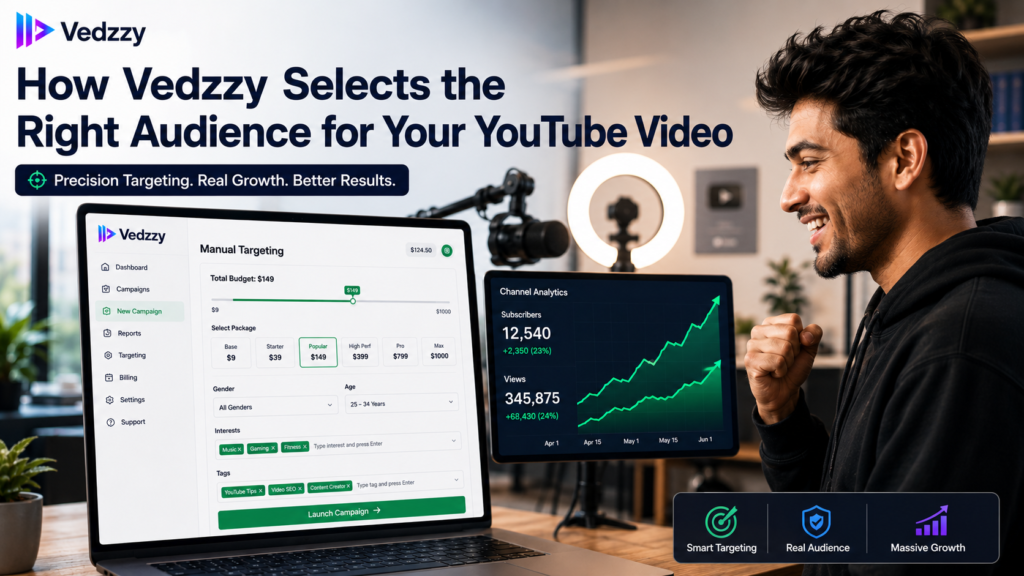
Once the video is confirmed, the next screen is the targeting and pricing page. This is where the auto-versus-manual decision actually gets made. For auto targeting, the creator sets their budget, chooses a general target location, and selects a content category — and from there, our team takes over the deeper segment-level analysis described earlier in this article.
For manual targeting, the options expand considerably. Creators can specify age range, gender, specific interest categories, and content tags directly — essentially building out the audience profile themselves, based on the rationale that nobody understands a niche audience better than the person who built the content for them in the first place.
There’s also a budget incentive built into this page worth mentioning, because it affects how creators think about campaign size: spending $35 or more unlocks an additional 40% in free views on top of the paid campaign. In practical terms, this means larger campaigns don’t just deliver more raw volume — they deliver meaningfully better value per dollar, and more importantly, more total engagement opportunities with the targeted audience the creator has selected. A bigger, well-targeted campaign gives a video a stronger foundation of real engagement signals, which is ultimately what helps a channel’s broader, ongoing growth.
Why This Process Keeps Evolving
None of this is static. The audience segment data from campaigns like TheRealFlexTone feeds directly back into how our team approaches future targeting decisions for similar content. If a particular sub-genre or audience tag consistently underperforms across multiple campaigns, that’s a signal worth paying attention to. If a broader category consistently delivers strong retention alongside strong volume, that becomes a stronger default recommendation for similar content going forward.
This is also why repeat creators tend to see better results over successive campaigns — not because the platform magically improves, but because there’s now real performance history specific to that channel informing every subsequent targeting decision. The second campaign benefits from what the first one taught us. The third benefits from the first two.
Audience targeting on YouTube, done properly, isn’t a single decision made once at the start of a campaign. It’s an ongoing process of watching what the data actually says, adjusting based on it, and treating every campaign as additional information for the next one.
Frequently Asked Questions
What is the difference between auto targeting and manual targeting on Vedzzy? Auto targeting means our team analyses the video’s title, tags, language, and content directly to determine the most relevant audience segments, supplemented by tools like vidIQ and TubeBuddy and any existing campaign history for repeat creators. Manual targeting means the creator specifies their own audience parameters — age, gender, interests, and tags — and our team launches the campaign directly based on those specifications.
Why do broader audience categories often perform better than niche ones? Broader, interest-based categories like “Pop Music Fans” or “Electronic Dance Music Fans” represent a larger pool of genuinely engaged viewers, which gives campaigns more volume to work with while still maintaining strong relevance. Hyper-specific tags can occasionally capture a small, highly targeted slice of audience, but on their own they often don’t have enough audience pool size to generate meaningful results.
Does Vedzzy use real campaign data to improve future targeting? Yes. For repeat creators specifically, prior campaign performance — which audience segments delivered strong engagement, which underperformed — becomes part of the targeting decision for future campaigns rather than starting the analysis from zero each time.
What tools does Vedzzy’s team use during the audience selection process? Alongside direct analysis of the video’s content, our team uses third-party research tools such as vidIQ and TubeBuddy to validate genre classification, keyword relevance, and audience interest signals.
How does the 40% free views offer relate to audience targeting? Spending $35 or more on a campaign unlocks an additional 40% in free views. Combined with precise audience targeting, this means a larger campaign budget doesn’t just deliver more views overall — it delivers more engagement opportunities with the specific, relevant audience that’s been targeted, which compounds the value of accurate audience selection.
Can a creator switch between auto and manual targeting for different campaigns? Yes. Each campaign submitted through the dashboard allows the creator to choose the targeting approach that fits that specific video — auto targeting for creators who want our team’s analysis, or manual targeting for creators who already have a clear picture of their audience and want direct control over the targeting parameters.

Hi, I am Jason, a digital content strategist with 8 years of experience helping YouTube creators and brands grow their channels through data-driven content decisions. I have worked with creators across niches including tech, education, and lifestyle, and specialise in translating YouTube Analytics data into actionable growth strategies.
Categories: YouTube Promotion