YouTube Is Changing How It Counts Views From August 24, 2026 and Here Is What Every Creator Needs to Know
Posted on August 20, 2026 by Jason Caldwell
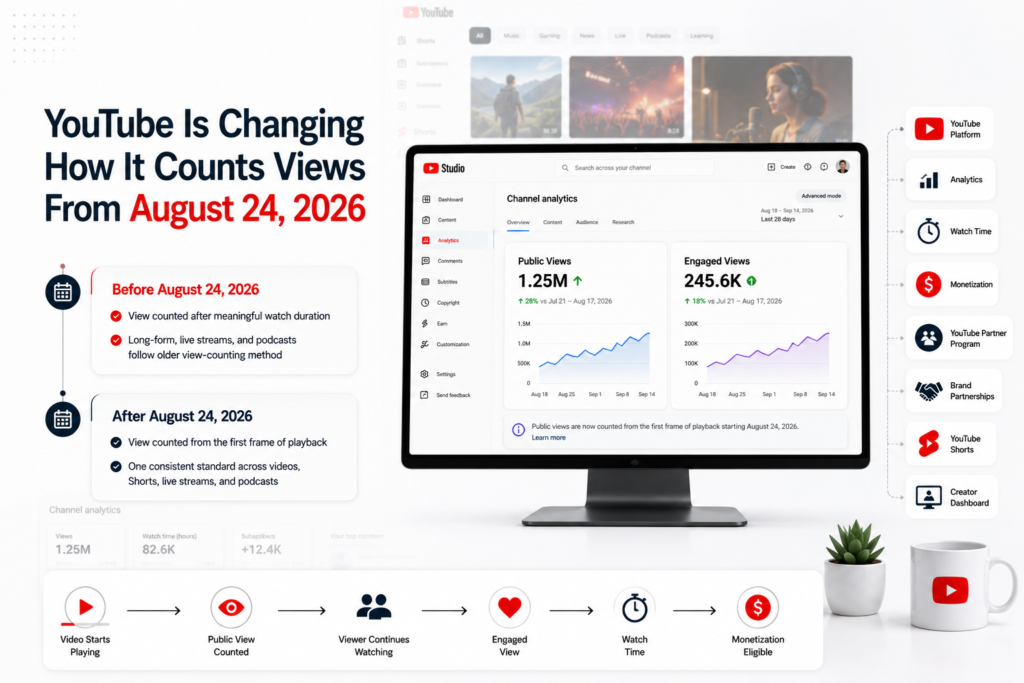
YouTube just changed something that affects every creator on the platform. From August 24, 2026, a view will be counted the moment your video starts playing. No minimum watch time. No waiting for a viewer to hit the 30-second mark. Just the first frame.
This is one of the biggest changes to how YouTube measures performance in years. And if you make videos – long-form, Shorts, live streams, or podcasts this affects you directly.
The good news is that your earnings and YouTube Partner Program eligibility are not changing. The change is to the public view counter only. But there is a lot more to understand here than just a bigger number on your video. This guide breaks down exactly what changed, why YouTube made this decision, what it means for your channel, and what you need to focus on going forward.
What Exactly Changed and When
Starting August 24, 2026, YouTube counts a public view from the very first frame of playback across all video formats. This means:
A viewer opens your video. Playback begins. That is a view. It does not matter if they watch for one second or ten minutes. The moment the video starts, the view is registered.
This new system applies to all formats on the platform — long-form videos, YouTube Shorts, live streams, and podcasts. Every format now follows the same counting standard.
Before this change, YouTube used different view-counting systems across different formats. The platform had already applied this first-frame standard to Shorts since March 2025. YouTube is now standardizing the same approach across everything else.
YouTube’s official explanation was clear: “Starting 8/24, views will count the moment a video begins to play (with no minimum watch time) across all formats. We’re standardizing views to reflect creators’ true exposure across YouTube, making it easier to show their value to brand partners.
Why YouTube Made This Change
YouTube did not make this change randomly. There were two clear reasons behind it.
Creators Asked for It
YouTube said it heard from creators who wanted to eliminate confusion between different view metrics and better understand their overall exposure. Having different counting systems for different video formats made it hard for creators to compare performance across their own content. A Shorts view counted differently from a long-form view. That confusion is now gone.
YouTube Is Aligning With TikTok and Instagram
This brings YouTube in line with how TikTok and Instagram already count views. On both of those platforms, a view registers the moment a video plays. YouTube was the outlier. Now it is not.
This also matters for brand deals. When a creator pitches their reach to a brand partner, they now use the same definition of a view that their partners already use on other platforms. That makes comparisons easier and makes creators’ numbers look more competitive.
What Happens to Your View Count
Your existing view counts will not reset or drop. They stay exactly as they are.
But from August 24 onward, your new videos will accumulate views faster than before. Views that previously would not have been counted because a viewer clicked away before the 30-second mark will now count.
YouTube’s new view-counting method is likely to noticeably boost the visible view counts on the platform.
This is significant for a few reasons. Higher view counts make your content look more popular to new viewers. They also give you stronger numbers to present to brand partners. And they make your channel appear more active to the algorithm and to potential sponsors who look at raw view numbers before deciding whether to work with you.
However, a creator’s August 2026 view counts will not sit cleanly against July’s. If you are tracking monthly performance or comparing month over month, you need to note August 24 as a break in your data. Views before that date used the old counting method. Views after that date use the new one. Comparing the two as if they are the same measurement will give you misleading data.
The Two View Metrics You Now Need to Understand
This is the most important part of the update to understand. From August 24, there are two separate view metrics on YouTube. They measure different things and they serve different purposes.
Public View Count
This is the number displayed on your video. It is what viewers, potential subscribers, and brand partners see when they look at your content.
From August 24, this number counts from the first frame. It is a reach metric. It tells you how many times playback started on your video. It goes up whether a viewer watched for one second or one hour.
This number will be higher going forward. It reflects your exposure how many times your video was played.
Engaged Views
This is the original view metric. It is not going away. YouTube will retain the original view metric under the name “Engaged views.” It will remain available in YouTube Analytics under Advanced Mode, allowing creators to see how many viewers choose to continue watching their videos.
Engaged views are the views that matter for your money and your YPP status.
Actual playback duration will continue to be the key metric for monetization. Your earnings are calculated based on engaged views and engaged watch hours not the new public view count. Nothing about how you get paid is changing.
The same applies to YouTube Partner Program eligibility. The thresholds remain the same. The metrics used to measure them are being renamed but not changed.
YouTube said Partner Program earnings will continue to be calculated using engaged Shorts views and engaged watch hours. YPP eligibility will similarly continue to depend on what the company will call “qualified Shorts views” and “qualified watch hours.
New Terminology You Will See in YouTube Studio
Along with this update, YouTube is also renaming some of the metrics used for YPP eligibility. The meaning behind them has not changed. Only the names have.
| Old Name | New Name |
| Valid public Shorts views | Qualified Shorts views |
| Valid public watch hours | Qualified watch hours |
These renamed metrics still govern your path to monetization. If you are working toward the 10 million Shorts views threshold or the 4,000 watch hours threshold for YPP, you are still working toward the same goal. The name on the label is different. The requirement is the same.
What This Means for Brand Deals and Sponsorships
If you work with brands or are planning to, this update changes something important about how you present your numbers.
Public views will now register from the first frame of playback across all formats. This change is expected to increase public view totals, as the previous unofficial 30-second watch time requirement is eliminated.
Higher public view numbers are genuinely useful when pitching yourself to brand partners. More total views means more apparent reach. And since brands on TikTok and Instagram are already used to first-frame view counting, your YouTube numbers are now on the same terms.
But brands that care about genuine audience attention should ask for your engaged views specifically not your public view count. Brands that care about how long someone actually watched can ask for engaged views in reporting, the same way they already ask for retention curves and average view duration.
If you are negotiating a brand deal after August 24, be clear about which number you are presenting. Public views show exposure. Engaged views show attention. Both are useful. They measure different things.
What This Does Not Change
It is worth being clear about what is staying exactly the same.
Your monetization is not changing. The formula YouTube uses to calculate your ad revenue does not use the new public view count. It uses engaged views and watch hours.
Your YPP eligibility path is not changing. If you are working toward 1,000 subscribers and 4,000 watch hours, or 1,000 subscribers and 10 million Shorts views, those thresholds have not moved. The metric names are updated. The targets are not.
Your audience retention data is not changing. Watch time, average view duration, and audience retention curves all remain in YouTube Studio as they are. These are still the best signals of how genuinely your content is connecting with viewers.
The algorithm’s evaluation of your content is not changing. Engaged views, watch time, and average view duration all of which remain in YouTube Analytics serve as the tools for measuring interest after playback begins. The algorithm still rewards content that holds viewers, not just content that gets clicked.
What Creators Should Actually Do Right Now
Here is the practical response to this update.
Keep your focus on engaged views and watch time.
The public view count going up sounds exciting. But your channel growth, your earnings, and your algorithmic distribution all still depend on how long people actually watch. A higher public view count with falling engaged views means more people are clicking and leaving faster. That is not growth. Keep optimizing for retention and YouTube audience retention remains the metric that actually moves the algorithm.
Learn where to find engaged views in YouTube Studio.
Go to YouTube Studio. Click Analytics. Click Advanced Mode. You will find the Engaged Views metric there. This is the number that governs your earnings and YPP eligibility. Get familiar with it now before the public view count starts rising and creates confusion.
Note August 24 in your analytics tracking.
If you track monthly views, compare year-over-year performance, or report metrics to a brand partner, mark August 24 as a measurement change. Views before that date and views after that date are not directly comparable as raw numbers. Engaged views, which use the original counting standard, give you a consistent historical comparison.
Do not be misled by a jump in your view count.
When your numbers rise after August 24, it does not mean your content suddenly got more popular. It means the counting method changed. Your content quality is the same. Your actual audience engagement is what it was before. Use engaged views to evaluate whether your content is genuinely improving.
Use the higher public view count where it helps.
If you are pitching to brand partners, applying for brand deals, or showing your channel’s reach to potential collaborators, the new public view count is a legitimate and accurate measure of exposure. Use it in that context confidently.
How This Connects to Your Promotion Strategy
This update is a reminder of something that has always been true: two types of YouTube performance exist simultaneously.
The first is visibility how many times your video was played. The public view count measures this.
The second is engagement how long people actually watched. Engaged views and watch time measure this.
Good YouTube video promotion services should serve both. Getting your video in front of more people increases public views. Getting it in front of the right people viewers who are genuinely interested in your content category increases engaged views, watch time, and YouTube audience retention.
This is exactly why audience targeting matters so much in paid promotion. When a video is promoted to viewers who already engage with similar content, those viewers watch longer. They generate stronger engaged view signals. They contribute to the watch time and retention data that the YouTube algorithm uses to decide how widely to distribute a video.
A higher public view count from the August 24 update makes your reach numbers look better. But engaged views are still what grows your channel. Keep the focus there.
Frequently Asked Questions
When does the new YouTube view counting system take effect?
The new public view counting system takes effect globally on August 24, 2026. From that date, a view is counted the moment a video begins playing across all formats long-form videos, Shorts, live streams, and podcasts.
Will my view count go up after August 24?
Yes. Because views now register from the first frame rather than after a minimum watch period, more plays will count as views. Your existing video counts stay the same. New views on all your videos will accumulate faster from August 24 onward.
Does this change affect how much money I make on YouTube?
No. Earnings are calculated using engaged views and engaged watch hours. These metrics use the original counting standard and are not affected by the change to the public view counter. Your revenue calculations remain the same.
What are engaged views and where do I find them?
Engaged views are the original YouTube view metric. They count views where a viewer watched for a meaningful duration rather than just starting playback. You can find them in YouTube Studio under Analytics, then Advanced Mode. This metric still governs your monetization and YPP eligibility.
Does this change my path to YouTube Partner Program eligibility?
No. The thresholds for YPP eligibility are unchanged. YouTube is renaming some of the metric labels valid public Shorts views becomes qualified Shorts views, and valid public watch hours becomes qualified watch hours but the actual requirements and the measurements behind them remain the same.
Why did YouTube make this change?
YouTube made the change for two main reasons. First, creators asked for a simpler, consistent view metric across all formats. Second, the change aligns YouTube with how TikTok and Instagram already count views, making it easier for creators to present comparable reach numbers to brand partners across platforms.
How is this different from how YouTube already counted Shorts views?
Shorts have used first-frame view counting since March 2025. This update extends the same standard to all other formats. Long-form videos, live streams, and podcasts previously used an unofficial 30-second threshold before a view was counted. That threshold is now removed for all formats.
Should I focus on public views or engaged views going forward?
Focus on engaged views for evaluating your channel’s actual performance and health. Public views are useful for showing reach and exposure to brand partners. For understanding how your content connects with viewers, how the algorithm evaluates your videos, and how your earnings are calculated, engaged views and watch time are the metrics that matter.

Hi, I am Jason, a digital content strategist with 8 years of experience helping YouTube creators and brands grow their channels through data-driven content decisions. I have worked with creators across niches including tech, education, and lifestyle, and specialise in translating YouTube Analytics data into actionable growth strategies.
Categories: YouTube