How to Get More Views on YouTube Shorts in 2026
Posted on December 23, 2024 by Jason Caldwell
Getting more views on YouTube Shorts is not about luck. It is about understanding exactly how the Shorts algorithm works and giving it what it rewards.
YouTube Shorts now generates over 6.5 billion daily views globally. That number sounds like an opportunity. And it is. But it also means competition for attention is fierce. Viewers swipe through the Shorts feed in seconds. If your Short does not stop the scroll in the first two seconds, it gets skipped. And skips hurt your distribution more than most creators realize.
This guide covers everything you need to know about how to get more views on YouTube Shorts in 2026. We cover how the algorithm actually works, what signals it measures, and the specific changes you can make to your Shorts that produce more views, more completions, and more channel growth.
How the YouTube Shorts Algorithm Works in 2026
Before getting into tactics, you need to understand the system you are working with. The Shorts algorithm operates differently from the long-form recommendation system.
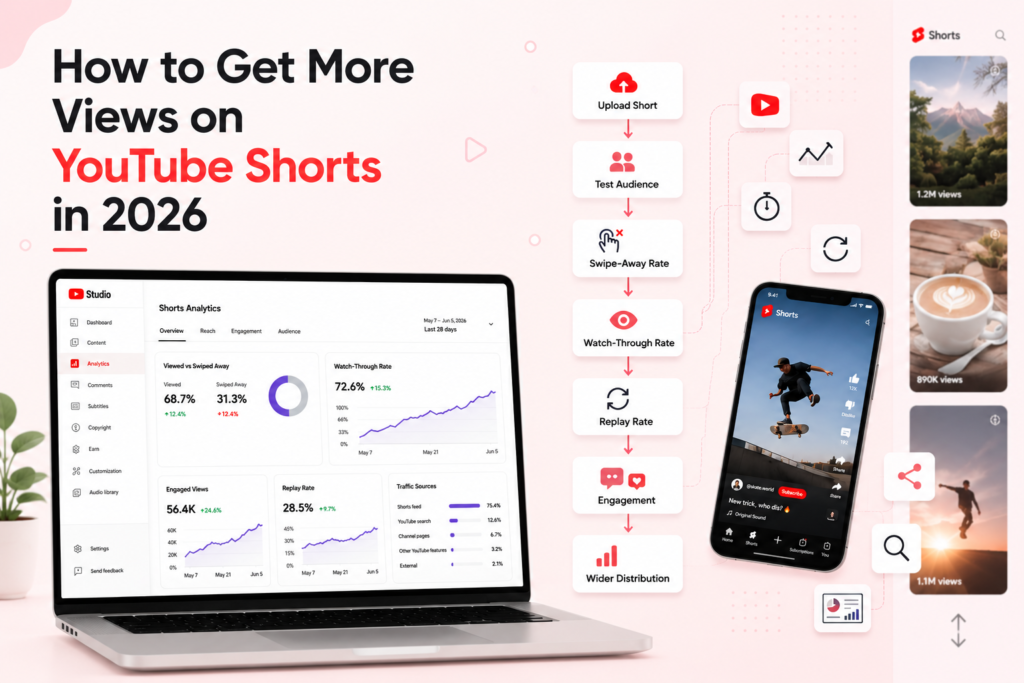
When you publish a Short, YouTube shows it to a small test audience first. This is not your subscribers. It is a sample group selected based on your content category and previous performance. The algorithm then measures how that test audience responds before deciding whether to push the Short to a wider audience.
The Four Signals That Decide Your Distribution
The Shorts algorithm evaluates four primary signals in 2026.
Swipe-away rate is the most important signal. It measures how quickly viewers skip past your Short without watching. A high swipe-away rate tells the algorithm that your Short failed to earn attention. Distribution gets pulled back immediately. This is why the first one to two seconds of your Short are the most critical creative decision you make.
Watch-through rate measures what percentage of viewers watch your Short to the end. Shorter Shorts of 15 to 35 seconds tend to achieve higher completion rates than longer ones. A Short that most viewers complete sends a strong signal that the content delivered value. The algorithm responds by showing it to more people.
Replay rate measures how often viewers watch your Short more than once. Replays are one of the strongest signals the algorithm uses because they indicate genuine interest. A Short that loops naturally — where the ending connects back to the beginning — generates more replays because viewers sometimes do not notice where one loop ends and the next begins.
Engagement rate covers likes, comments, and shares relative to views. Strong engagement tells the algorithm that viewers responded to the content emotionally — they felt something, learned something, or wanted to share it with someone else.
Engaged Views vs Total Views — A Critical 2026 Change
YouTube changed how it counts views for Shorts in late 2024. Previously, any scroll-past registered as a view. Now YouTube separates total views from engaged views.
Engaged views only count when a viewer actively watches your Short. Total views include passive impressions. This distinction matters because only engaged views count toward YouTube Partner Program eligibility. The 10 million Shorts views required for YPP monetization must be engaged views — not total view impressions.
To check your engaged views, go to YouTube Studio, click Analytics, then Advanced Mode, and select Engaged Views. Also check the Viewed vs Swiped Away report. This single report tells you whether your hook is working.
Why Your YouTube Shorts Are Not Getting Views
Most Shorts that underperform fail for one of three reasons.
The first is a weak opening frame. If the first frame of your Short is a black screen, a logo, a channel intro, or a slow setup shot, viewers swipe past before the content even starts. The opening frame is your first impression. It needs to immediately communicate that something interesting is about to happen.
The second is slow pacing. Even a 30-second Short can feel too slow if nothing new happens every five to eight seconds. Viewers in the Shorts feed are conditioned to constant movement. If your Short has a slow middle section, you will see a drop in your retention curve right at that point.
The third is a hook that does not match the content. If your opening promises something exciting but the rest of the Short fails to deliver on that promise, viewers feel misled. They leave and they leave fast. The algorithm sees this pattern — high initial engagement followed by rapid drop-off — and reduces distribution.
15 Proven Ways to Get More Views on YouTube Shorts
1. Hook Viewers in the First Two Seconds
The Shorts feed moves at speed. Viewers decide whether to keep watching or swipe within the first one to three seconds. This means your opening frame and first line of audio carry almost all the weight of your entire Short.
The most effective opening strategies in 2026 are showing the result first, starting with a bold statement that creates curiosity, or opening with motion and energy that demands attention. Show the finished cake before you show how it was made. Start with the most surprising moment of your story before explaining the context. Open in the middle of action rather than the beginning of a setup.
Skip the intro music. Skip the greeting. Get to the most compelling part of your content immediately.
2. Build Your Short to Loop
Loop structure is one of the most underused techniques in Shorts creation. When the ending of your Short connects back to the beginning, viewers who finish it sometimes continue watching without realizing they are on the second play. Each additional replay counts as a positive signal to the algorithm.
To create a loop, end your Short on a visual or audio element that matches or flows naturally into your opening frame. A Short that shows a process from start to finish can loop back to the start of the process. A Short that poses a question at the beginning can end with a partial answer that prompts the viewer to rewatch.
Even without a perfect seamless loop, ending your Short on a strong visual or satisfying conclusion encourages rewatching more than ending with a slow fade out.
3. Keep It Between 15 and 35 Seconds
YouTube Shorts can now run up to three minutes. But longer does not mean better for views.
Analysis of billions of Shorts views shows that 15 to 35 seconds maximizes watch-through rate for most content types. When viewers complete your Short, the algorithm gets a clear positive signal. When they leave halfway through a 90-second Short, the signal is negative even if 45 seconds of genuine viewing happened.
Use the full length only when the content genuinely requires it. If your Short tells a complete, compelling story in 22 seconds, do not pad it to 45 seconds to hit an arbitrary target. Tighter Shorts consistently outperform longer ones when the content supports a shorter runtime.
4. Add Captions to Every Short
A significant portion of Shorts viewers watch with the sound off. They are on public transport, in a waiting room, or browsing in a quiet environment. If your Short relies entirely on audio to communicate its value, you are losing those viewers immediately.
Captions keep sound-off viewers watching. They also help viewers who watch with sound on process information faster, which improves retention. YouTube’s auto-generated captions are acceptable but check them for accuracy. For important Shorts, use custom captions that are correctly timed and formatted.
Large, clear text overlays that emphasize key words as you say them are even more effective than standard captions because they combine audio reinforcement with visual variety.
5. Write Titles That Create Curiosity
In the Shorts feed, the title appears below the video as viewers scroll. It is one of the first things viewers read when deciding whether to watch. A generic title wastes this opportunity.
Your title should do one of two things. It should create curiosity by hinting at something surprising or useful without fully explaining it. Or it should make a specific promise that tells the viewer exactly what they will get if they watch.
Titles with relevant keywords also help the algorithm categorize your Short correctly from the start, which improves how accurately it is matched to interested viewers.
Avoid generic titles like “Check this out” or “Amazing moment.” Be specific. “The cooking mistake 90 percent of people make” is more compelling than “Cooking tips.”
6. Use Hashtags Strategically
Hashtags help YouTube understand what your Short is about and which audience to show it to. Always include the hashtag Shorts. Add two to three niche-specific hashtags that accurately describe your content category.
Do not use ten or fifteen hashtags hoping that more will improve reach. It does not work that way. Over-hashtagging looks like spam and can confuse the algorithm’s categorization of your content.
Stick to three to five hashtags per Short. Make them relevant and specific to the content.
7. Post Consistently
New Shorts receive a temporary distribution boost in their first 48 hours. The algorithm shows them to a test audience and evaluates performance before deciding on longer-term distribution. Creators who post consistently give the algorithm regular data to work with.
Analysis of 35 billion Shorts views found that channels with 200 or more published Shorts see consistent growth over time. This does not mean you need to post 200 Shorts before seeing results. It means that the algorithm builds a more accurate model of your content and audience with each Short you publish. More data means better audience matching, which means better distribution over time.
A consistent posting schedule — whether daily, five times a week, or three times a week — outperforms burst posting followed by long gaps.
8. Make Every Frame Visually Compelling
Thumbnails are not visible in the Shorts swipe feed. The opening frame of your video is what viewers see first. This means the visual quality of your opening matters more for Shorts than for long-form content.
Use good lighting. Ensure the frame is visually clear and uncluttered. Use motion in the opening — something moving draws the eye more effectively than a static shot. Bright colors and high contrast stand out in a feed full of competing content.
Throughout the Short, add visual changes every five to eight seconds. A new camera angle, a cut to a different shot, a text overlay, or a change in scene all give viewers’ eyes something new to focus on. Static visuals for more than eight seconds consistently increase swipe-away rates.
9. Open Loops Keep Viewers Watching to the End
An open loop is a question or premise introduced at the start of your Short that is not resolved until the end. The viewer’s brain wants to close the loop, so they keep watching to get the resolution.
“Wait until you see what happens at the end” at the start of a Short creates an open loop. “Here is why this common advice is wrong” creates one. Any framing that introduces a gap between what the viewer currently knows and what they are about to learn creates the psychological pull that keeps them watching.
Use open loops at the beginning of your Short and at transition points in the middle. Just make sure you deliver on the promise. A Short that teases without paying off creates negative satisfaction signals that hurt future distribution.
10. Repurpose Long-Form Content Into Shorts
Every long-form video you produce contains multiple Short-worthy moments. A 15-minute tutorial has individual tips that each work as standalone Shorts. A 20-minute vlog has highlights that work better in 30 seconds than in context.
Repurposing has two advantages. It saves production time by extracting value from content you have already created. And it drives viewers from Shorts back to your long-form catalog. A viewer who finds your Short compelling and wants more will click through to your channel and discover your full videos.
When repurposing, do not simply crop a long-form clip to vertical format. Reframe the clip with a Short-specific hook and ensure the content makes sense without the full context of the original video.
11. Link Each Short to Related Long-Form Content
YouTube’s Related Video feature allows you to connect a Short to a specific long-form video on your channel. This is one of the most underused growth tools available to Shorts creators.
When a viewer watches your Short and wants more, the related video link gives them an immediate next step. This drives long-form views from Shorts traffic, which builds your watch time and supports the YouTube audience retention metrics that contribute to channel growth and YPP eligibility.
Always connect each Short to the most relevant long-form video on your channel. If the Short is a tip from a longer tutorial, link to that tutorial. If the Short is a highlight from a vlog, link to the full vlog.
12. Keep Calls to Action Short and Late
Long calls to action in the middle of a Short interrupt the viewing experience and increase swipe-away rate. Viewers did not come to the Shorts feed to hear a subscription pitch. They came for content.
If you include a call to action, keep it to one or two seconds and place it at the very end of the Short — after you have delivered all the value. A simple “Follow for more” or “Subscribe for daily tips” at the final frame does not disrupt the viewing experience.
Mid-Short calls to action — asking for likes or subscriptions before the content has been fully delivered — consistently damage retention and therefore hurt distribution.
13. Study Your Viewed vs Swiped Away Report
This report in YouTube Studio is the single most useful data point for diagnosing Shorts performance. It shows what percentage of viewers who were shown your Short actually watched it versus swiped past.
A high swipe-away rate means your opening frame or title failed to earn attention. The viewer saw the Short and immediately moved on. The fix is almost always in the first two seconds.
Check this report for every Short you publish. Track whether your changes produce improvement in the swipe-away rate over time. This is your most direct feedback on whether your hook is working.
14. Use Trends Without Abandoning Your Niche
Trending sounds and formats increase the discoverability of Shorts because the algorithm actively pushes trending content to wider audiences. But not every trend is relevant to every channel.
Using a trending sound that has nothing to do with your niche might generate views from people with no interest in your content. Those viewers will not subscribe, will not return to your channel, and the engagement signals they generate will be weak.
Use trends when they connect naturally to your content category. A fitness creator can use a trending audio clip as background music for a workout tip. A cooking creator can apply a trending format to a recipe reveal. When the trend serves the content, it amplifies reach without diluting audience quality.
15. Analyse Your Best Performing Shorts and Make More of Them
Most channels have one or two Shorts that significantly outperform the rest. These are your data points. They tell you exactly what your audience responds to.
Look at what those Shorts have in common. Is it the topic? The format? The length? The hook style? The visual approach? Whatever made those Shorts perform well is what your audience is telling you they want more of.
The fastest way to grow through Shorts is to study your best-performing content and replicate the elements that made it work. Not copy the same content — replicate the structure, the approach, and the format that generated strong engagement.
How to Use YouTube Analytics to Grow Your Shorts
YouTube Analytics provides specific data for Shorts performance that most creators never look at. Here is what to check after every Short you publish.
Viewed vs Swiped Away — this tells you whether your hook is working. A swipe-away rate above 60 percent means most viewers are passing your Short without watching. Fix the opening before anything else.
Watch-through rate — this tells you whether viewers are completing your Short. A watch-through rate below 50 percent on a Short under 30 seconds means pacing or content is the problem.
Engaged views — this is the view count that actually matters for algorithm distribution and YPP eligibility. Check this separately from total views to understand your real performance.
Traffic sources — this shows where your Short views are coming from. If most come from the Shorts feed, your content is being distributed well. If most come from your channel page or subscriptions, the Shorts feed is not picking it up yet, which typically means swipe-away rate needs improvement.
Check these four metrics after every Short in the first 48 hours. The first two days are when the algorithm makes most of its distribution decisions. Acting on the data early — updating a title, changing a thumbnail, adjusting your next Short’s hook based on what you learn — produces faster improvement than reviewing analytics weeks later.
Frequently Asked Questions
How many views is good for a YouTube Short?
There is no fixed number. What matters is whether your Short performed well relative to your channel’s history and your current subscriber count. A Short with 500 views and a 70 percent watch-through rate is performing better algorithmically than one with 5,000 views and a 20 percent watch-through rate. Focus on engagement quality rather than raw view counts.
Why do my YouTube Shorts get views then stop?
This is normal and reflects the algorithm’s testing process. YouTube shows your Short to an initial test audience, evaluates performance, then decides whether to expand distribution. If the Short stops getting views, the test audience’s engagement was not strong enough to trigger wider distribution. Look at your Viewed vs Swiped Away report to identify whether the hook or the content was the weak point.
Do hashtags help YouTube Shorts get more views?
Yes, but only when used correctly. Two to four relevant hashtags help the algorithm categorize your content and show it to the right audience. Always include Shorts as one hashtag. Add two to three that accurately describe your content niche. Avoid stuffing ten or more hashtags — this does not improve reach and can confuse the algorithm’s categorization.
What is the best length for a YouTube Short to get more views?
15 to 35 seconds maximizes watch-through rate for most content types. Shorter Shorts are easier for viewers to complete, which sends a stronger algorithmic signal. Use longer lengths only when the content genuinely requires it. A 45-second Short that could have been 25 seconds will almost always have a lower completion rate than the shorter version.
How often should I post YouTube Shorts to get more views?
Consistency matters more than frequency. Posting three to five Shorts per week consistently outperforms posting fifteen Shorts in one week followed by nothing for a month. The algorithm builds a more accurate model of your content and audience over time, which improves distribution with each Short you publish.
Do YouTube Shorts views count toward YouTube Partner Program eligibility?
Engaged Shorts views count toward the 10 million Shorts views threshold required for YPP access. Total views — which include passive impressions — do not count. Check your engaged views specifically in YouTube Studio Advanced Mode rather than relying on the total view count shown on your video.
Why are my YouTube Shorts getting views but no subscribers?
Views without subscriber conversions usually mean viewers enjoyed one Short but did not see enough on your channel to warrant following you. Make sure your channel page is complete and clearly communicates what you make. Also ensure your Shorts link to related long-form content — viewers who explore your full catalog are significantly more likely to subscribe than viewers who watch one Short and leave.
How do I make my YouTube Shorts go viral?
Viral distribution on Shorts comes from a combination of a strong hook that keeps swipe-away rate low, content that creates a strong emotional response and gets shared, and a loop structure that generates replays. No formula guarantees viral performance, but Shorts built around surprising information, satisfying transformations, or genuinely useful one-minute lessons consistently reach wider audiences than generic content in the same format.

Hi, I am Jason, a digital content strategist with 8 years of experience helping YouTube creators and brands grow their channels through data-driven content decisions. I have worked with creators across niches including tech, education, and lifestyle, and specialise in translating YouTube Analytics data into actionable growth strategies.
Categories: Uncategorized, YouTube, YouTube Growth Tips