YouTube RPM vs CPM Explained: What Creators Actually Earn Per 1,000 Views in 2026
Posted on May 4, 2026 by Jason Caldwell
If you’ve ever opened your YouTube Studio dashboard and stared at two very different numbers — CPM and RPM — you’re not alone. Almost every creator, at some point, does the math in their head and thinks: “Wait, why am I earning so much less than the CPM says I should?”
This confusion costs creators real money. When you don’t understand these two metrics, you can’t make smart decisions about your content, your niche, or your target audience.
This guide breaks it all down clearly — what CPM and RPM actually mean, how they’re calculated, real earnings data by niche for 2026, how your viewers’ location affects your income more than almost anything else, and what you can do today to start earning more per view.
What Is CPM on YouTube?
CPM stands for Cost Per Mille — “mille” being the Latin word for thousand. It is the amount that advertisers pay YouTube for every 1,000 ad impressions served on your videos.
The key phrase there is advertisers pay YouTube — not you. CPM reflects the demand side of the equation. It tells you how valuable your content is to brands bidding for your audience’s attention, but it doesn’t tell you what lands in your pocket.
YouTube runs a real-time ad auction every single time a monetized video loads. Advertisers bid against each other for that impression based on the viewer’s location, age, interests, device, and what they’ve searched for recently. The winning bid sets the CPM for that impression. This is why your CPM fluctuates constantly — it isn’t a fixed number assigned to your channel. It changes video by video, viewer by viewer.
In 2026, the global average YouTube CPM sits around $3.50 to $4.00 — but that average is almost meaningless for planning your actual income, because the spread between niches and countries is enormous.
What Is RPM on YouTube?
RPM stands for Revenue Per Mille — your revenue per 1,000 total views, after YouTube takes its cut and after accounting for views where no ad ran at all.
RPM is the number that actually hits your bank account. It is found in YouTube Studio under Analytics → Revenue tab, and it’s the metric you should track above everything else when thinking about income.
Here’s the critical distinction:
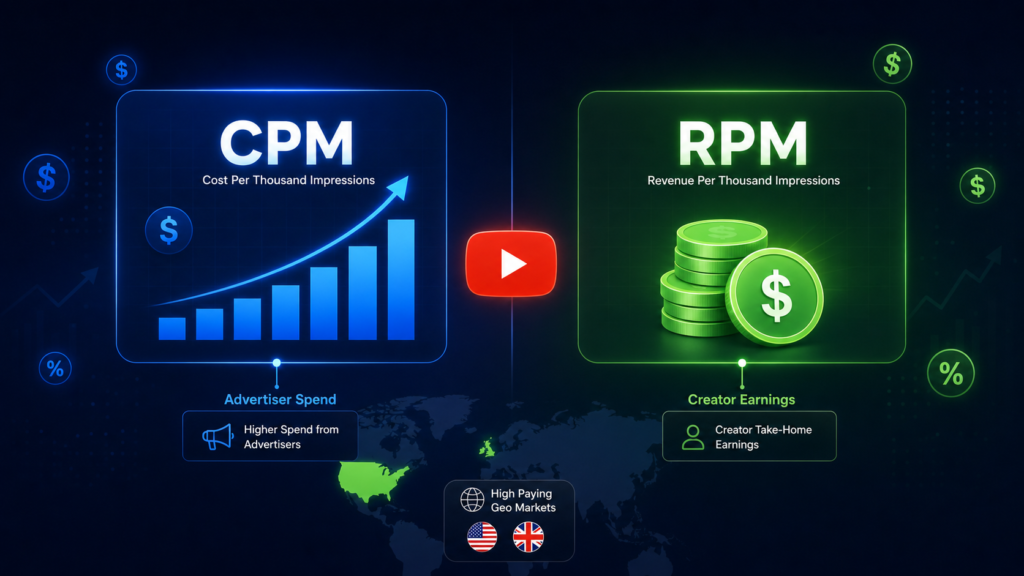
- CPM = what advertisers pay YouTube (the advertiser’s cost)
- RPM = what you actually take home (the creator’s earnings)
RPM is always lower than CPM. Sometimes significantly lower. A channel with a $20 CPM might only see an RPM of $8–$12. Here’s why.
Why RPM Is Always Lower Than CPM — The 55/45 Split Explained
When an ad runs on your video, YouTube keeps 45% of the ad revenue and pays 55% to you. That’s YouTube’s standard revenue share for long-form content under the YouTube Partner Program, and it has remained consistent since 2007.
But the math doesn’t stop there. RPM also factors in:
- Views with no ads at all. Not every view on your video results in an ad impression. Viewers using ad blockers, viewers in countries with few active advertisers, viewers who close the tab in the first second — none of these generate ad revenue. Your RPM calculation divides your total earnings across all your views, including those that earned nothing.
- Skipped ads. With skippable in-stream ads, you only earn when a viewer watches at least 30 seconds or clicks the ad. Skipped ads pay nothing or significantly less.
- Revenue from other sources. RPM actually includes income from YouTube Premium viewers, channel memberships, Super Chats, and Super Thanks — which is why RPM can sometimes feel closer to your real take-home than a pure CPM calculation would suggest.
The practical formula:
Your RPM ≈ (CPM × 0.55) × Ad Impression Rate
If your niche has a $10 CPM and about 50% of your views produce an ad impression, your RPM works out to roughly $2.75 per 1,000 views. This is why a $10 CPM doesn’t mean you’re earning $10 per thousand views.
As a rule of thumb: RPM is typically 40–60% of your CPM figure.
RPM vs CPM: Side-by-Side Summary
| CPM | RPM | |
| What it measures | Advertiser spend | Creator earnings |
| Who it reflects | Advertisers | You |
| Found in YouTube Studio? | Yes | Yes |
| Includes YouTube’s cut? | No | Yes (already deducted) |
| Includes unmonetized views? | No | Yes |
| Best use | Evaluating niche potential | Planning actual income |
Real YouTube RPM and CPM Rates by Niche in 2026
This is where things get interesting — and where niche selection becomes one of the most powerful financial decisions a creator can make.
The right niche can mean a 5x or even 10x difference in earnings for the exact same number of views. Here’s a breakdown of real RPM ranges by niche, based on verified creator dashboard data and industry benchmarks for 2026:
Highest-Earning Niches
Finance & Investing CPM: $25–$65 | Creator RPM: $12–$35
Finance is the undisputed top earner on YouTube. Topics like personal investing, stock market analysis, tax planning, retirement, and credit cards consistently command the highest advertiser bids. A single converted viewer is worth hundreds of dollars in customer lifetime value to a financial services advertiser — which is why they bid aggressively.
Insurance CPM: $30–$60 | Creator RPM: $15–$32
Overlooked by most creators, insurance is one of the highest-paying niches on the platform. Auto, health, and life insurance advertisers pay extremely high rates because their customer lifetime value is massive and competition is fierce.
Real Estate CPM: $20–$45 | Creator RPM: $10–$25
Property investing, home buying guides, and real estate market analysis draw high advertiser bids from mortgage lenders, real estate platforms, and investment services.
Marketing & Business / SaaS CPM: $18–$40 | Creator RPM: $9–$22
Business software companies and B2B advertisers pay premium rates for professional audiences. Tutorials on tools like CRM software, email marketing, or project management fall into this bracket.
Legal & Law CPM: $15–$35 | Creator RPM: $8–$19
Legal services advertisers — personal injury firms, estate attorneys, family lawyers — pay some of the highest CPMs in any digital advertising channel.
Mid-Tier Niches
Technology & Software Reviews CPM: $12–$25 | Creator RPM: $6–$14
Tech audiences have high purchasing intent and brand loyalty. Advertisers from software, hardware, and electronics compete actively for these viewers.
Health & Fitness CPM: $8–$18 | Creator RPM: $4–$10
Supplement brands, fitness apps, and health insurance advertisers drive solid CPMs. Specific sub-niches like weight loss, mental health, and nutrition earn on the higher end.
Education & Career Skills CPM: $8–$15 | Creator RPM: $4–$8
Online learning platforms, professional development tools, and tutoring services bid strongly for education audiences. Career advice, productivity, and language learning all fall here.
Cooking & Lifestyle CPM: $4–$10 | Creator RPM: $2–$5.5
Broad audience but moderate advertiser competition. Food brands, kitchenware, and meal kit services advertise here. A popular and consistent niche even if not the top earner.
Lower-Earning Niches
Gaming CPM: $3–$10 | Creator RPM: $1.50–$5
Gaming audiences are enormous, but advertisers (hardware brands, energy drinks, streaming services) pay relatively modest rates per impression. The scale can still produce good income, but the per-view earnings are far below finance or tech.
Music / Artists CPM: $1.50–$5 | Creator RPM: $0.75–$2.75
Music channels typically see the lowest CPMs because the audience demographic skews young, the content is non-purchase-oriented, and music licensing complications can limit monetization. Despite this, music is one of the most watched content categories on the platform.
Entertainment / Skits / Reaction Content CPM: $1.50–$4 | Creator RPM: $0.75–$2.20
High view counts are common, but low advertiser demand keeps per-view earnings modest. Creators in this space often rely more heavily on merchandise, memberships, and brand deals to supplement ad revenue.
YouTube Shorts RPM vs Long-Form Video
If you’re putting significant effort into Shorts, you should know this clearly: Shorts earn dramatically less per view than long-form content.
In 2026, YouTube Shorts RPM ranges from approximately $0.03 to $0.08 per 1,000 views — compared to $2–$20+ for long-form content in the same niche.
The reason is structural. YouTube pools ad revenue from the Shorts feed and distributes it across all creators whose Shorts were watched in a session, rather than paying per individual ad view. Additionally, for long-form videos over 8 minutes, mid-roll ads unlock additional monetization slots — those simply don’t exist in a 60-second Short.
This doesn’t mean Shorts aren’t valuable. They’re a powerful discovery engine that funnels new viewers to your long-form content. But for maximising revenue per view, long-form videos of 8+ minutes remain the gold standard.
How Your Audience’s Location Affects RPM (This Is Huge)
Here’s the variable that surprises most creators: where your viewers are located often matters more than your niche when determining RPM.
Advertisers pay dramatically different amounts to reach viewers in different countries. Viewers in the USA, Canada, UK, and Australia are worth many times more to advertisers than viewers in lower-income markets — simply because the purchasing power and advertiser competition in those markets is far higher.
Here’s what the country-level CPM data looks like in 2026:
| Country | Estimated CPM | Creator RPM |
| Australia | $36–$40 | $18–$22 |
| USA | $18–$28 | $9–$15 |
| UK | $15–$22 | $8–$12 |
| Canada | $14–$20 | $7–$11 |
| Germany | $10–$16 | $5–$9 |
| France | $8–$13 | $4–$7 |
| India | $1.00–$3.00 | $0.50–$1.65 |
| Pakistan | $0.50–$2.00 | $0.28–$1.10 |
| Indonesia | $0.80–$2.50 | $0.44–$1.38 |
The gap is stark. A finance channel with 100,000 views from US audiences could earn 10–15x more than the exact same channel with 100,000 views from Indian audiences. The content is identical. Only the viewer location changes.
This is why geo-targeting matters so much for creators who are serious about monetization — and it’s why targeting Tier 1 markets (USA, UK, Canada, Australia) is such a powerful strategy.
How Seasonal Timing Affects Your CPM and RPM
Your earnings aren’t constant throughout the year — advertiser budgets are cyclical, and this directly affects how much YouTube pays creators.
Q4 (October–December) is the golden quarter. Holiday advertising, Black Friday, and Christmas campaigns drive advertisers to spend aggressively. CPM across almost all niches spikes during this period. Many creators report their highest RPM months of the year in November and December.
Q1 (January–March) sees a sharp drop. After holiday budgets are exhausted, advertisers pull back dramatically. Expect a 30–50% dip in RPM in January compared to December. This is normal — it happens every year without exception.
Q2 and Q3 are middle ground. Budgets gradually rebuild through the year before the Q4 surge.
Smart creators plan accordingly — saving revenue from Q4, uploading high-effort content in Q4 when RPM is at its peak, and not panicking about the January dip.
How Promotion Affects Your RPM (and Why It Matters More Than You Think)
Here’s something most creators overlook: the source and location of your views directly impacts your RPM, not just your view count.
If your channel is getting views primarily from low-CPM countries, your RPM stays low regardless of how many views you accumulate. The algorithm distributes your content to whoever engages with it — and if your early viewers are largely from lower-CPM markets, YouTube’s algorithm tends to continue showing your content to similar audiences.
This is where paid promotion with precise geo-targeting becomes a strategic monetization tool, not just a vanity metric play.
When you run a Google Ads-powered promotion campaign targeted at the USA, UK, or other Tier 1 markets, you’re doing two things at once:
- Directly increasing views from high-CPM audiences, which immediately boosts RPM.
- Signalling to the YouTube algorithm that your content performs with Tier 1 audiences, which influences how the algorithm recommends your video going forward.
A music artist, for example, who primarily has fans in South Asia but targets a US or UK audience with a well-run promotion campaign, starts training YouTube to distribute their content into higher-value markets. Over time, this compounds — both in algorithmic recommendations and in monthly RPM.
This is fundamentally different from buying fake views or bot traffic, which comes from no real geography, earns nothing, and actually damages your channel’s credibility with the algorithm. Only views through legitimate platforms like Google Ads count as monetization-eligible and register in YouTube Studio analytics.
How to Calculate What You’ll Actually Earn
Here’s a simple framework for planning your income based on your niche and audience:
Step 1: Find your average RPM in YouTube Studio (Analytics → Revenue tab).
Step 2: Use this formula:
Monthly Earnings = RPM × (Monthly Views ÷ 1,000)
Example A — Gaming channel:
- Monthly views: 500,000
- RPM: $2.50
- Monthly earnings: $1,250
Example B — Finance channel:
- Monthly views: 100,000
- RPM: $12.00
- Monthly earnings: $1,200
Same money. One-fifth the views. That’s the power of niche selection and audience geography.
Step 3: Use this to work backward. Decide your income goal, divide by your RPM, and you’ll know exactly how many views you need per month to hit it.
Key Takeaways
- CPM is the advertiser’s cost. It’s not what you earn — it’s what brands pay YouTube before the 55/45 split.
- RPM is your real earnings per 1,000 total views, after YouTube’s cut and after unmonetized views. Always use RPM to plan income.
- Niche selection has a massive impact. Finance creators can earn 10x more per view than gaming creators, for the same audience size.
- Your viewers’ location matters enormously. US, UK, Canadian, and Australian audiences generate significantly higher CPM than most other markets.
- Long-form videos (8+ minutes) earn far more than Shorts per view due to mid-roll ads and a more favourable revenue structure.
- Q4 is peak earning season. Plan your best content for October–December.
- Geo-targeted paid promotion doesn’t just get you views — it can actively shift which markets YouTube recommends your content to, compounding your RPM improvement over time.
Frequently Asked Questions
What is a good RPM on YouTube in 2026? It depends on your niche. For most creators, an RPM between $2–$5 is average. Above $5 is solid. Finance, insurance, and legal channels regularly see $10–$20+ RPM. Gaming and entertainment typically land between $1.50–$4.
Why is my CPM high but my RPM is low? This usually means a large portion of your views aren’t resulting in ads — either due to ad blockers, short watch durations, viewers in lower-CPM countries, or videos under 8 minutes that miss mid-roll ad eligibility.
Do YouTube Shorts affect my long-form video RPM? Shorts have a separate revenue pool and separate RPM. Posting Shorts doesn’t directly lower your long-form RPM, but it can shift your overall audience demographics if your Shorts attract a different geographic audience than your long-form content.
Why does RPM drop in January? Advertiser budgets reset at the start of the year. After heavy Q4 holiday spending, brands pull back dramatically in January. This is a platform-wide trend affecting almost all niches — not specific to your channel.
Can targeting US viewers actually improve my RPM? Yes — directly and indirectly. Viewers from Tier 1 markets generate higher CPMs immediately. And over time, if YouTube’s algorithm learns your content performs with US audiences, it tends to recommend your videos to more viewers in those markets organically.
Looking to get your YouTube videos in front of genuine viewers in the USA, UK, and other top markets? Vedzzy runs certified Google Ads campaigns that put your content in front of real, targeted audiences — all trackable in your YouTube Studio. Start your campaign from $9.

Hi, I am Jason, a digital content strategist with 8 years of experience helping YouTube creators and brands grow their channels through data-driven content decisions. I have worked with creators across niches including tech, education, and lifestyle, and specialise in translating YouTube Analytics data into actionable growth strategies.
Categories: Uncategorized